

- Bittensor is gaining attention after launching a massive decentralized AI model backed by NVIDIA recognition
- Strong fundamentals include institutional demand, high staking levels, and real AI-driven revenue
- Growing AI adoption in crypto could support a long-term path toward higher valuations, including a $1,000 scenario
AI isn’t just growing, it’s accelerating, and crypto is starting to feel the impact in real time. The connection between the two used to feel… experimental, maybe even a bit forced. Now, it’s becoming more practical, more real.
Take World Financial Liberty, for example. They recently rolled out something called the AgentPay SDK, which basically allows AI agents to send payments, move money, and interact across EVM chains using USD1, all without human input. That’s a pretty big shift when you think about it. Machines transacting on their own, quietly, efficiently.
But while that’s interesting, it’s Bittensor that’s really pulling attention right now.
Bittensor Steps Into the Spotlight With Massive AI Model
At a recent event, NVIDIA CEO Jensen Huang talked about Bittensor’s latest AI model, and the details are… kind of wild. A 72-billion-parameter model, trained by over 70 contributors, all running across a decentralized network. No centralized infrastructure. Just distributed computing over the internet.
That alone is enough to turn heads. And it explains why TAO has already climbed about 24% this year. The market isn’t just reacting to hype, it’s reacting to something that feels… different.
Bittensor’s whole idea revolves around decentralizing AI, turning model training and development into a network-driven process. And right now, that idea is landing at the same time the AI agent market is exploding. In just three months, over 14,000 AI agents have been deployed in crypto, handling everything from arbitrage to liquidity management to yield optimization, nonstop.
Hype Is One Thing, But the Data Tells a Bigger Story
Of course, hype alone doesn’t sustain a move. We’ve seen that before. What actually matters is whether real capital and real usage are backing it up.
And in Bittensor’s case, there are some pretty telling signals. The Grayscale TAO Trust has been trading at a 50% premium to NAV, which suggests strong institutional interest. Around 75% of TAO’s supply is staked, limiting circulating supply. And maybe most importantly, the network generated about $43 million in Q1 revenue from actual AI customers.
That’s not theoretical demand. That’s usage.
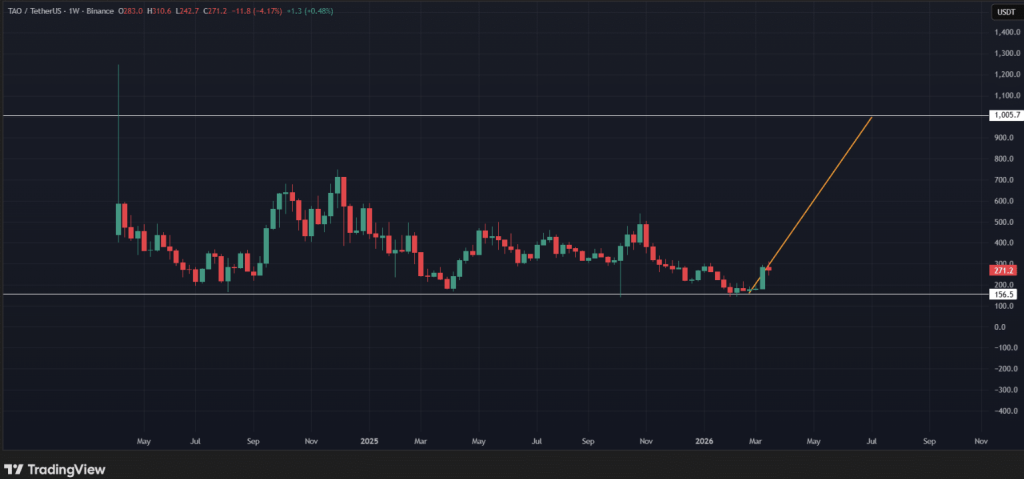
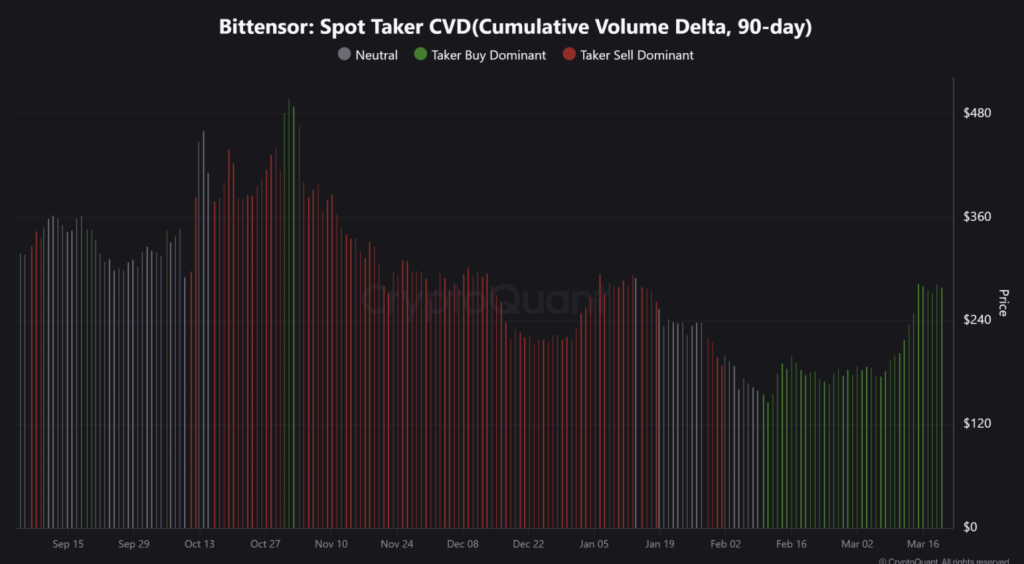
On-chain data adds to the picture too. Spot buying pressure has been building steadily since TAO’s bottom near $154, pointing to consistent accumulation rather than short-term speculation. It’s not explosive, but it’s persistent, and that kind of demand tends to matter more over time.
Can TAO Really Reach $1,000?
So now the big question starts to surface. With all of this momentum, could TAO actually push toward $1,000, or is that just another optimistic target floating around?
From a purely speculative angle, sure, it sounds aggressive. But when you start layering in the fundamentals, growing AI demand, institutional interest, real revenue, and strong staking dynamics, it doesn’t feel completely disconnected from reality.
That doesn’t mean it’s guaranteed, far from it. But it does mean the path exists, at least in theory.
A New Narrative Starting to Take Shape
What’s really happening here is bigger than just one token. It’s the early stages of a new narrative, AI and crypto blending into something more functional, not just conceptual.
Bittensor is positioning itself right at the center of that shift. And if adoption continues, if capital keeps flowing in, and if AI demand keeps expanding the way it has been… then TAO might not just be riding the trend.
It could be helping define it.