

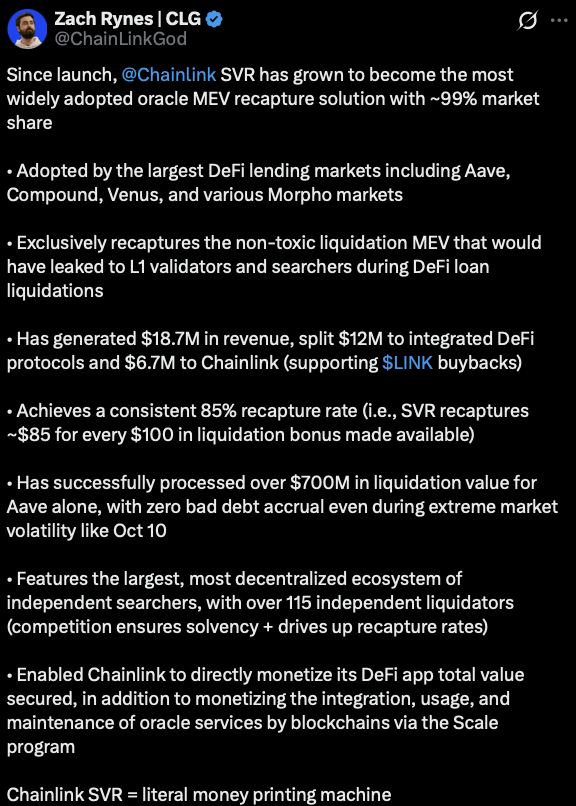
- Chainlink’s SVR solution now reportedly controls 99% of the oracle-related MEV recapture market.
- SVR has already generated roughly $18.7 million in revenue across integrated DeFi protocols.
- Analysts believe future regulatory clarity could significantly expand Chainlink’s staking and revenue-sharing ecosystem.
Chainlink keeps pushing deeper into the center of decentralized finance, and honestly, at this point it’s becoming harder to imagine the oracle economy functioning without it. As DeFi applications continue relying on secure, real-time data feeds to operate properly, Chainlink’s infrastructure has quietly become one of the most important layers supporting the broader crypto ecosystem.
Now the network is gaining even more attention because adoption of its Smart Value Recapture solution — better known as SVR — is accelerating rapidly across DeFi. And unlike some flashy crypto narratives that fade after a few weeks, this one actually comes tied to real protocol revenue and measurable usage.
Why Chainlink’s SVR Model Is Drawing So Much Attention
Since launch, Chainlink’s SVR system has quickly established itself as the dominant mechanism for capturing oracle-related Maximal Extractable Value, or MEV. According to crypto analyst Zach Rynes, the protocol now controls an estimated 99% share of this growing market.
That’s a pretty staggering figure when you think about it.
The technology has already been integrated across some of the biggest DeFi lending ecosystems in crypto, including Aave, Compound, Venus, and several Morpho markets. At its core, SVR focuses on capturing what’s considered “non-toxic” liquidation MEV — essentially reclaiming value that normally leaks away to Layer 1 validators and searchers during DeFi liquidations.
Before systems like SVR existed, much of that value simply disappeared from the protocols themselves. Now, Chainlink is helping reroute a significant portion of it back into the DeFi ecosystem instead of letting external actors absorb all the profits.
Millions in Revenue Are Already Flowing Through SVR
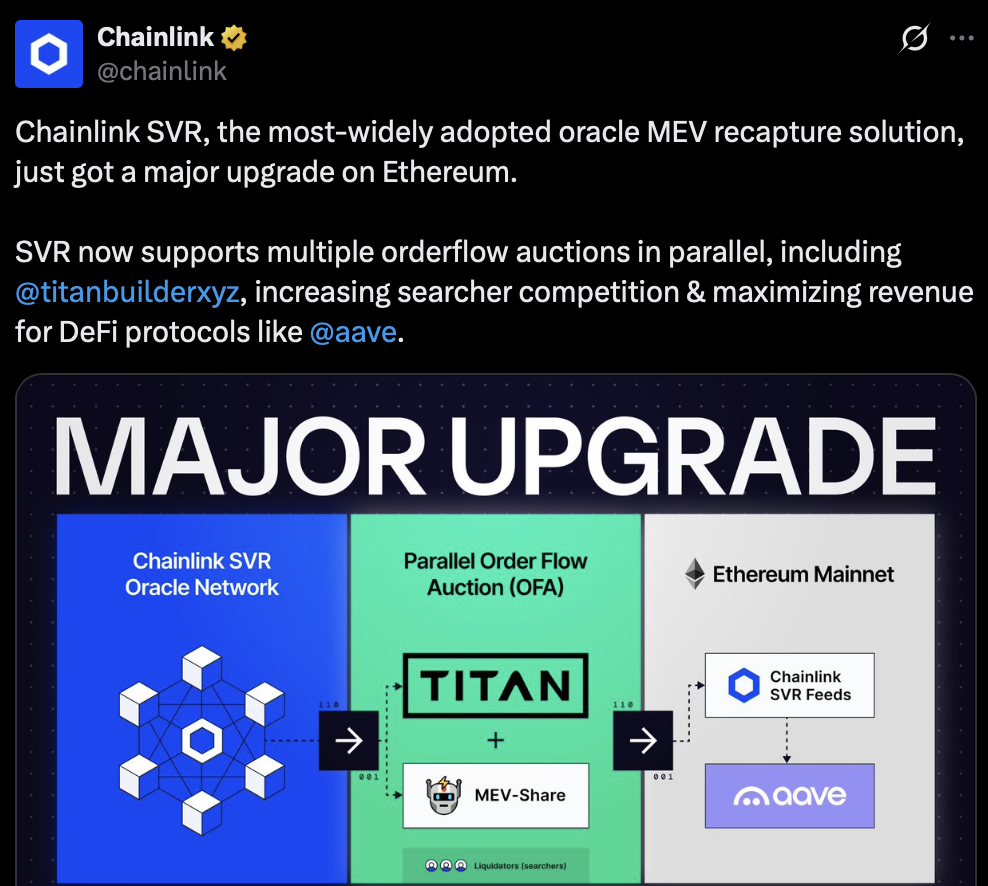
The numbers tied to the rollout are starting to look pretty serious. Reports suggest SVR has already generated around $18.7 million in revenue so far, with roughly $12 million distributed back to participating DeFi protocols. Another estimated $6.7 million has reportedly gone toward Chainlink itself, including support for LINK buybacks.
That changes the conversation around Chainlink’s business model quite a bit.
Historically, Chainlink generated value primarily through oracle integrations and infrastructure services. SVR introduces something different — direct monetization tied to the total value secured inside DeFi ecosystems. In other words, Chainlink is no longer just providing data feeds. It’s becoming economically embedded inside the activity happening across decentralized finance itself.
Efficiency metrics have also strengthened the bullish narrative around the system. SVR reportedly maintains an average recapture rate near 85%, meaning it can reclaim approximately $85 from every $100 liquidation bonus available during liquidation events. That’s an unusually high recovery rate for a system operating at scale.
On Aave alone, the protocol has already processed over $700 million in liquidation volume without creating bad debt, even during highly volatile market periods like October 10. The ecosystem supporting SVR has also expanded rapidly, with more than 115 independent liquidators now participating. More competition between liquidators generally improves solvency and pushes recapture efficiency even higher.
Chainlink Staking Could Enter a New Phase
At the same time, another major conversation is beginning to form around Chainlink’s staking ecosystem and how future regulation may impact it. According to crypto analyst LinkBoi, current legal uncertainty surrounding the proposed Clarity Act is limiting Chainlink’s ability to fully expand staking reward distribution inside the network.
Right now, LINK stakers mainly receive rewards through token emissions rather than direct shares of protocol-generated revenue. That’s a key distinction. Expanding staking pools to distribute portions of actual protocol revenue would require clearer legal guidelines around how those rewards are classified.
And that’s where things potentially get interesting.
If regulatory clarity improves, Chainlink could unlock a much larger staking economy tied directly to the network’s growing revenue streams. Some analysts believe that would fundamentally strengthen LINK tokenomics by creating stronger long-term alignment between network usage, protocol revenue, and staking participation.
Of course, regulation remains unpredictable, and none of this is guaranteed. But the direction feels important. Chainlink is gradually evolving from simply being an oracle provider into something much larger — a core economic layer sitting underneath massive portions of decentralized finance.
And with SVR continuing to expand across DeFi, the market seems to be paying closer attention now than ever before.