

- Cardano focuses on long-term stability over rapid development
- Price performance remains weak despite ongoing ecosystem growth
- Vision 2030 roadmap aims to drive future adoption and scalability
Crypto investing has always leaned toward one idea, find the next coin that explodes in value. That’s the dream, right? But lately, there’s been a quiet shift in thinking. Some investors are starting to ask… what if chasing those “moonshots” isn’t the only way, or even the best way, to build long-term value?
That’s where Cardano starts to come into the conversation, not as the fastest mover, but maybe one of the more stable ones.
A Different Approach to Blockchain Development
Cardano isn’t trying to outpace everyone. It never really has. Like Ethereum, it’s a Layer-1 blockchain with its own ecosystem, but the philosophy behind it feels… different. Slower, more methodical, maybe even frustrating at times if you’re expecting rapid updates.
Its founder, Charles Hoskinson, actually helped build Ethereum before going off to create Cardano. The idea wasn’t to compete on speed alone, but to build something more stable, more secure, something that could last. And that meant taking time, sometimes a lot of it.
A good example is smart contracts. Ethereum rolled them out early, while Cardano took years to implement its own version. At the time, it looked like a delay. In hindsight, though, it meant Cardano avoided some of the chaos that hit the DeFi space when things overheated and eventually collapsed.
Price Performance Raises Doubts
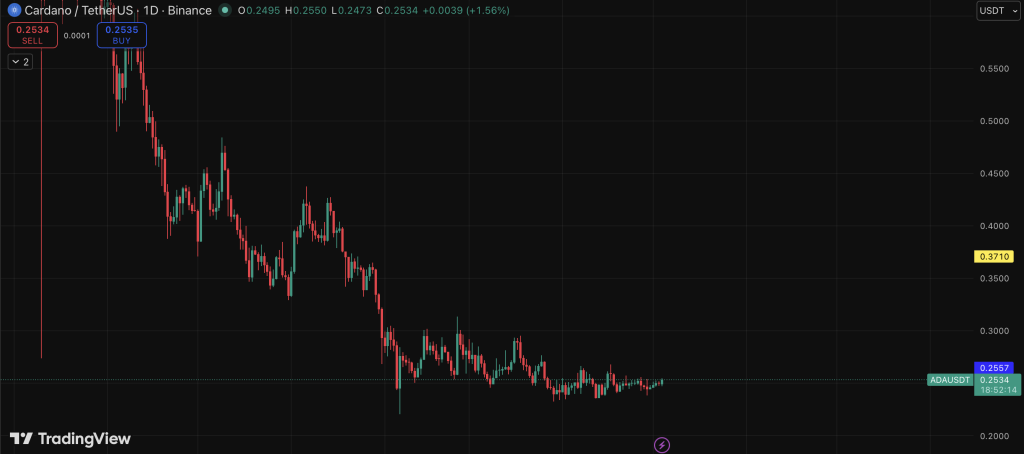
Still, none of that changes the reality of price. Cardano hasn’t exactly been exciting lately. It’s down significantly from its previous highs, and even in the short term, performance has been… underwhelming.
For many investors, that’s enough to lose interest. After all, crypto moves fast, and patience isn’t always rewarded in the way people expect. When something trades sideways for too long, people move on.
So the question becomes pretty direct, does this slow-and-steady approach actually work?
Long-Term Vision Starts to Take Shape
Cardano’s answer seems to be focused on the long game. Its “Vision 2030” roadmap outlines plans to scale transaction volume and expand network capabilities, now that much of the core infrastructure is already in place.
That’s an important detail. For years, Cardano was building quietly, laying foundations that weren’t always visible. Now, the idea is to move more aggressively into areas where it previously lagged, things like DeFi, real-world use cases, and broader adoption.
Whether that shift happens quickly enough is still uncertain. But it does suggest that the project isn’t standing still, even if the price doesn’t reflect it yet.
Not a Moonshot, But Not Irrelevant Either
At the end of the day, Cardano isn’t positioned as a high-risk, high-reward gamble. It’s not trying to be the next meme coin or deliver overnight gains. And for some investors, that’s exactly the problem.
But for others, that stability, or at least the attempt at it, might be the appeal. It’s a different kind of bet, one that depends more on gradual growth than explosive moves.
Market Expectations Need to Match Reality
So if you’re looking at Cardano, it comes down to expectations. If the goal is quick gains, it probably won’t deliver that, at least not consistently. But if the focus is on long-term infrastructure and steady development, it might still have a place.
It’s not the loudest project in crypto, not even close. But sometimes, the quieter ones are the ones that stick around the longest… even if it takes a while to see it.