

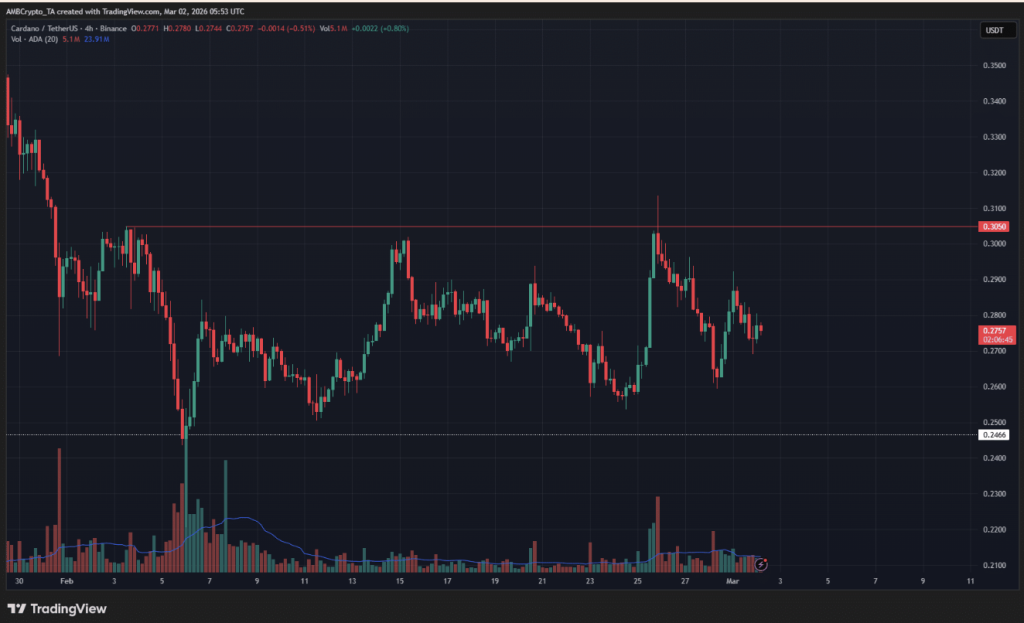
- ADA has traded between $0.246 and $0.305 for most of February, with no confirmed breakout.
- Rising mean coin age suggests accumulation, but short-term holders remain near breakeven.
- A move above $0.305 or below $0.246 will likely determine Cardano’s next directional trend.
Cardano hasn’t exactly picked a direction lately. Throughout February, ADA has mostly drifted between $0.246 and $0.305, bouncing from one boundary to the other without committing to a breakout. There have been brief wicks above resistance and dips below support, sure, but each move was quickly reversed. No follow-through. No conviction.
On the 4-hour chart, ADA now sits roughly at the midpoint of that range. Not oversold. Not overextended. Just… balanced. Trading volume spiked during the recent volatile weekend, adding a bit of energy back into the tape. And since February 25th, the recovery has been strong enough to push Cardano back into the top 10 crypto assets by market cap, overtaking Bitcoin Cash. That’s not insignificant.
Still, reclaiming a ranking doesn’t automatically create trend strength.
Liquidations Squeezed, But Trend Remains Fragile
There was a notable build-up of short liquidation levels around $0.27, and that cluster was eventually squeezed. That kind of move can create quick upside pops, especially when over-leveraged traders get caught offside. But liquidation-driven rallies often lack durability unless fresh spot demand follows.
So far, ADA hasn’t broken cleanly out of its range. It’s reacting, not expanding.
To understand whether that changes, the on-chain metrics help fill in the gaps.
Accumulation Builds, But Profit-Taking Lurks
The 90-day and 365-day mean coin age metrics have been trending higher since January. That’s important. Rising mean coin age typically signals accumulation, coins are sitting still rather than being shuffled around.
Contrast that with December, when both mean coin age dropped sharply and dormant circulation spiked. Back then, a large amount of long-held ADA suddenly moved on-chain. That spike reflected stress. Tokens that had been inactive were suddenly active, likely due to broader market duress.
Now, the picture is calmer. Dormant circulation has remained muted in recent weeks, aligning with the steady rise in mean coin age. In plain terms, long-term holders appear to be sitting tight.
But short-term holders tell a slightly different story.
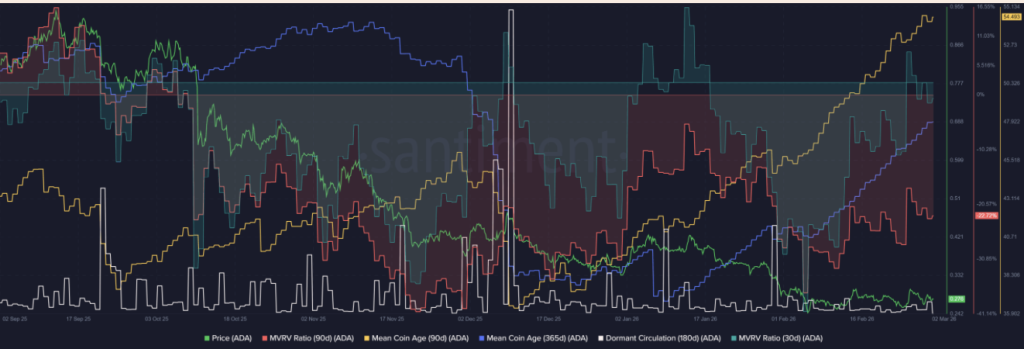
The 30-day MVRV currently sits around -3.65%. That means buyers from the past month are, on average, holding a small loss. Historically, when this metric flips positive after being negative, it can coincide with local tops. The last time it moved into positive territory, ADA formed a double top near $0.426 in early January before trending lower.
Meanwhile, the 90-day MVRV remains deeply negative, reflecting broader holder frustration. Longer-term participants are still underwater. That kind of sentiment can either fuel patience, or fuel exit liquidity when price approaches breakeven zones.
What Comes Next for ADA?
Right now, Cardano is caught between accumulation and hesitation.
Long-term holders appear to be quietly building positions. On-chain movement is subdued. That’s constructive. But short-term holders are hovering near breakeven, and any push higher could trigger waves of profit-taking, especially near the $0.30 range.
Until ADA breaks convincingly above $0.305 or loses $0.246 support, the broader structure remains range-bound. Momentum exists, but it’s fragile. The squeeze at $0.27 proved buyers can step in. The question is whether they can sustain it without leaning on forced liquidations.
For now, Cardano isn’t trending. It’s coiling inside a box, waiting for a catalyst strong enough to tip the balance.