
- Cardano has launched USDCx in collaboration with Circle, enabling 1:1 minting and redemption backed by USDC reserves.
- Stablecoin market cap is rising to around $34 million, even as TVL and on-chain activity remain relatively subdued.
- The move strengthens Cardano’s financial infrastructure ahead of a potential broader DeFi recovery.
Cardano has officially rolled out USDCx, a USDC-backed stablecoin framework built alongside Circle, and it feels like a quiet but important shift for the network. While overall on-chain momentum hasn’t exactly been roaring back to life, this move expands dollar liquidity in a way Cardano hasn’t really had before. Through integration with Circle’s xReserve system, users can mint and redeem USDCx at a clean 1:1 ratio against USDC sitting in reserve, which adds a layer of structural credibility. The token is already live across key DeFi apps like Minswap, Liqwid, and SundaeSwap, so this isn’t just theoretical infrastructure—it’s active, plugged in, and ready.
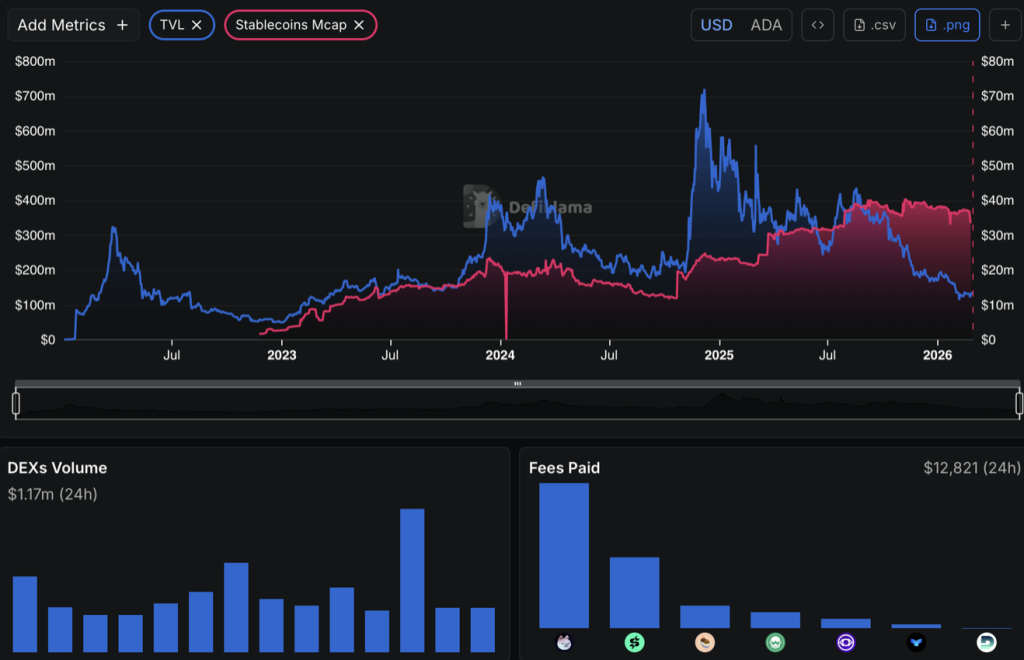
Stablecoin Growth While Activity Slows
There’s an interesting divergence happening under the surface. Stablecoin market cap on Cardano has been climbing, even as total value locked continues to drift lower compared to earlier cycle highs. At the time of writing, stablecoin capitalization sits around $34 million, while TVL is hovering above $137 million, numbers that tell a slightly uneven story.
What that pattern suggests is subtle but important. Capital is coming in, yes, but it’s parking itself in dollar-denominated form rather than flowing into aggressive yield farms or leveraged lending loops. In other words, liquidity is entering cautiously. Traders and users seem to be positioning defensively, maybe waiting for clearer signals before rotating into higher-risk strategies.
Usage Metrics Tell a Similar Story
If you zoom out to activity metrics, the tone remains measured. Decentralized exchange volumes are still modest, and network fees remain relatively low. That typically signals limited transactional demand, even with more stable liquidity available.
So while the rails are being strengthened, the trains haven’t fully started moving yet. Cardano appears to be laying groundwork—quietly reinforcing its financial plumbing—before a broader wave of participation returns. It’s almost preparatory, like infrastructure being upgraded during a slow season.
What USDCx Actually Changes
Structurally, USDCx isn’t native USDC minted directly on Cardano. Instead, it’s a reserve-backed representation tied to Circle’s existing infrastructure, which matters from a compliance and trust standpoint. Users can bridge USDC from Ethereum to mint USDCx, burn USDCx to redeem USDC, or route liquidity straight into supported DEXs without too much friction.
There’s also an accessibility angle here. Deposits and withdrawals can be handled through supported centralized exchanges, meaning users don’t necessarily have to touch Ethereum at all if they don’t want to. That reduces complexity, and honestly, friction is often what slows adoption more than anything else.
Why Timing Could Be Strategic
The timing feels deliberate. Cardano’s DeFi ecosystem is still in recovery mode after a prolonged cooldown, and historically the network hasn’t had deep stablecoin liquidity compared to competitors. That limitation made it harder to scale dollar-based lending, structured products, or serious real-world asset experiments.
By prioritizing stablecoin infrastructure now—before TVL clearly rebounds—the network may be sequencing its growth more methodically. Instead of chasing short bursts of speculative yield, Cardano seems to be preparing for payments, treasury use cases, and institution-aligned DeFi flows that rely on predictable settlement and compliance-friendly liquidity. It’s not flashy, but it could be foundational.