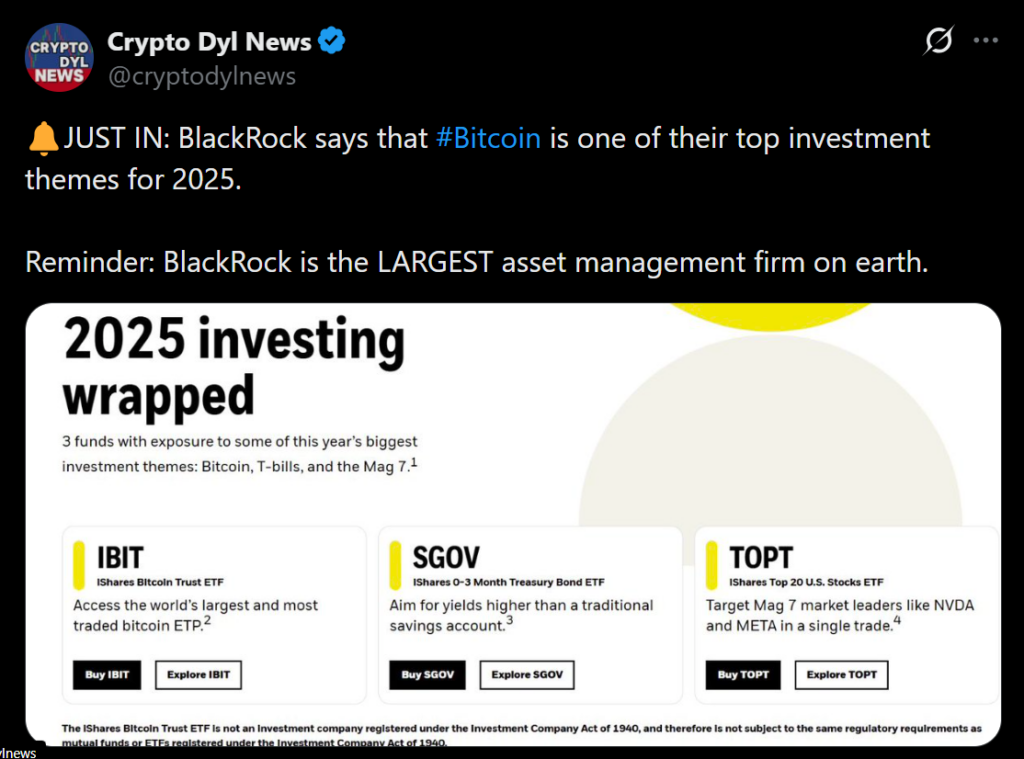
- BlackRock listed its Bitcoin ETF, IBIT, as a top investment theme for 2025.
- The ETF has drawn over $25B in inflows despite bitcoin’s year-to-date decline.
- The move signals long-term conviction rather than a focus on short-term performance.
BlackRock has placed its iShares Bitcoin Trust (IBIT) ETF among its top three investment themes for 2025, a notable endorsement given bitcoin’s uneven performance this year. The ETF now sits alongside two far more traditional picks, the iShares 0–3 Month Treasury Bond ETF (SGOV) and the iShares Top 20 U.S. Stocks ETF (TOPT). For the world’s largest asset manager, grouping bitcoin with cash-like instruments and blue-chip equities sends a deliberate message.

A Vote of Confidence Despite Price Weakness
Bitcoin is down more than 4% year-to-date, marking its first annual decline in three years, and IBIT has closely tracked that performance. Even so, investor demand has remained strong. The ETF ranks sixth among all exchange-traded funds by inflows in 2025, attracting more than $25 billion since January, a figure that stands out in a year when performance has been mixed.
Why BlackRock’s Move Stands Out
ETF analyst Nate Geraci pointed out that BlackRock’s decision is unusual in an industry that typically highlights its best-performing products. The firm has other ETFs, including gold-focused offerings, that have outperformed IBIT and charge higher fees. Yet BlackRock chose to spotlight a product that lagged in 2025, suggesting the decision is driven more by long-term conviction than short-term revenue.
Geraci noted that if fee generation were the primary goal, BlackRock could easily promote other funds. Instead, elevating IBIT signals the firm’s belief that bitcoin deserves a place in diversified portfolios, even during periods of underperformance.
What This Signals for Bitcoin’s Role
By naming IBIT a top theme for 2025, BlackRock appears to be reinforcing its view of bitcoin as a strategic allocation rather than a speculative trade. Placing the crypto asset alongside treasuries and U.S. equities may help shift perceptions among more traditional investors, especially those still hesitant to view bitcoin as a mainstream asset.
Over time, that kind of positioning from a firm of BlackRock’s size could play a meaningful role in shaping how institutional capital approaches crypto, regardless of short-term price swings.