

- Bitcoin’s fixed supply and ETF accessibility strengthen its long-term investment narrative.
- Cardano offers smart-contract functionality but currently struggles with low DeFi adoption.
- For a $1,000 investment, Bitcoin presents a more established and lower-risk entry point.
If you’ve got around $1,000 sitting on the sidelines and you’re thinking about putting it into crypto, the decision probably shouldn’t come down to whichever chart happens to look exciting this week. Markets move fast… sometimes too fast. And right now, even the big names aren’t exactly shining — both Bitcoin and Cardano have dropped roughly 27% over the past 30 days.
But short-term declines don’t always tell the whole story. Crypto markets tend to swing through cycles, and what looks weak today can look very different a few months down the road. So the real question becomes less about recent performance and more about long-term positioning. In other words: if you had to allocate that $1,000 somewhere today, which of these two assets actually offers the stronger foundation?
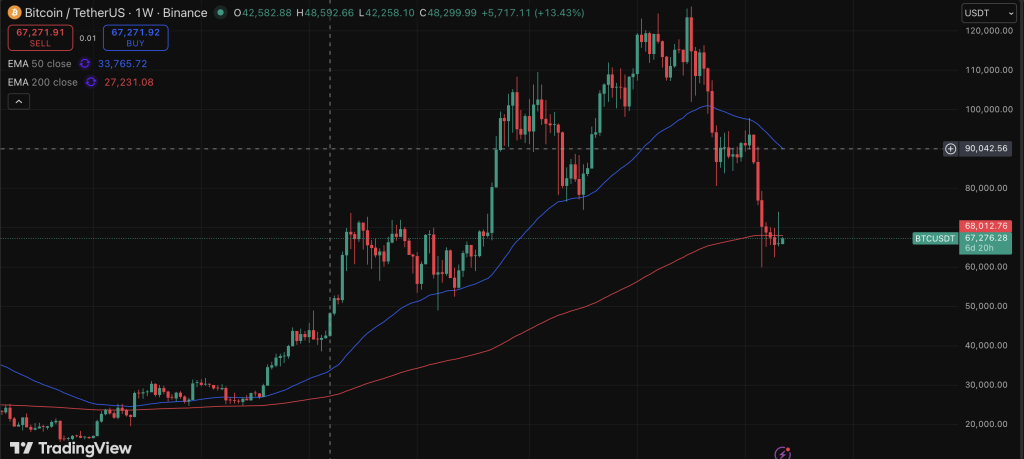
Bitcoin’s Strength Comes From Simplicity and Scarcity
Bitcoin’s biggest advantage is almost paradoxical. It doesn’t really try to do everything. In fact, its design is intentionally simple compared with many newer crypto platforms.
The supply of Bitcoin is permanently capped at 21 million coins. That number will never change, and the issuance of new coins continues to slow over time through the network’s halving events. Every few years the reward for mining gets cut in half, which gradually tightens supply.
That predictable scarcity is one of the core reasons investors treat Bitcoin as a digital store of value. Its price can fluctuate wildly in the short term, sure — that’s crypto — but the long-term narrative around limited supply remains strong.
There’s also another major factor supporting demand. Since 2024, spot Bitcoin exchange-traded funds have made it dramatically easier for investors to buy and hold BTC through traditional brokerage accounts. Retirement funds, institutions, and everyday investors suddenly gained access without needing to navigate crypto exchanges.
Even though early 2026 saw a rough stretch, with roughly $1.1 billion flowing out of U.S. Bitcoin ETFs between Feb. 10 and Feb. 23, those outflows may not change the long-term trend. Historically, Bitcoin’s scarcity narrative tends to bring investors back once market conditions stabilize.
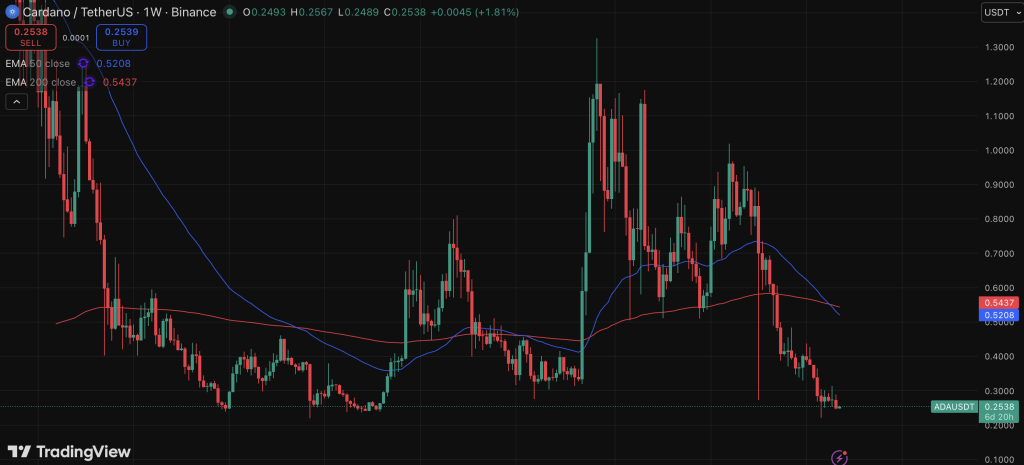
Cardano’s Challenge: Features Without Enough Adoption
Cardano, on the other hand, is trying to solve a different problem entirely. Unlike Bitcoin, which focuses mainly on being a decentralized store of value, Cardano is built as a smart-contract platform. Its goal is to support decentralized applications — things like financial tools, NFT platforms, and blockchain-based services that run directly on its network.
Technically speaking, Cardano has a lot going on under the hood. The network has been under active development for years, and its research-heavy approach emphasizes academic review and careful engineering.
The problem is that technical features don’t always translate into real usage.
Right now, Cardano’s decentralized finance ecosystem remains relatively small. The network holds roughly $121 million in total value locked across its DeFi protocols. Stablecoin liquidity on the chain sits around $37 million — a number that’s fairly modest compared with competing platforms.
That lack of capital creates a kind of feedback loop. Without large pools of liquidity, institutional investors aren’t particularly interested. And without institutional capital flowing into the ecosystem, developers and users have fewer incentives to build applications there.
Why Bitcoin Still Looks Like the Safer Bet
For someone allocating a relatively small investment like $1,000, risk management becomes important. And in that context, Bitcoin simply carries a stronger track record.
It has the longest history, the largest market capitalization, and the clearest investment narrative in the crypto space. Institutional adoption is already underway, infrastructure around Bitcoin continues expanding, and its scarcity model remains easy for investors to understand.
Cardano could absolutely develop into something larger over time. The technology is still evolving, and new use cases could emerge that strengthen its ecosystem. But at the moment, it doesn’t occupy a clear leadership position in any major segment of the blockchain market.
So if the goal is building the foundation of a crypto portfolio, Bitcoin likely remains the more reliable starting point.