

- Bitcoin has fallen nearly 40% from its peak, but Raoul Pal argues the decline is driven by temporary liquidity constraints rather than a broken market cycle.
- Correlated weakness between Bitcoin and SaaS stocks points to U.S. liquidity tightening as the primary driver of recent losses.
- With multiple liquidity tailwinds expected ahead, Pal remains strongly bullish on Bitcoin and broader markets in 2026.
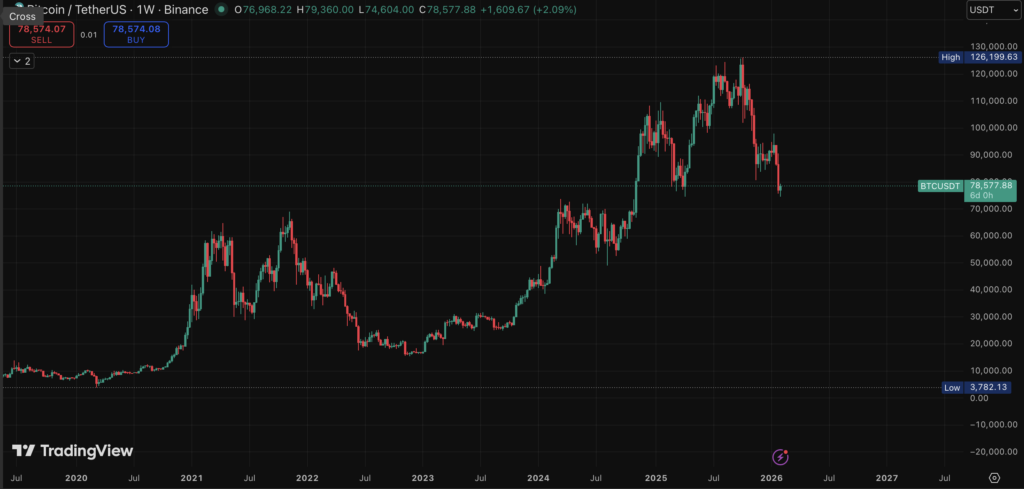
Bitcoin has dropped nearly 40% from its peak near $126,000, a move that has rattled confidence across the market. While price is still holding slightly above $77,000, the structure looks fragile, and many investors are bracing for the possibility of a deeper drawdown. Sentiment, for now, is clearly leaning bearish.
Still, Raoul Pal, founder and CEO of Global Macro Investor, argues that the growing narrative claiming Bitcoin and the broader crypto market are “broken” is deeply misleading. In his view, the weakness isn’t the result of a failed cycle or structural flaws, but rather a temporary liquidity shock that’s distorting price action across multiple asset classes.
Bitcoin and SaaS Move in Lockstep
According to Pal, the dominant story circulating right now suggests the crypto cycle is over. Prices are falling, the thinking goes, because of exchange issues, institutional exits, or something fundamentally wrong with the asset class. Pal describes this as an “alluring narrative trap,” one that feels convincing simply because prices keep sliding day after day.
To challenge that idea, he points to an interesting comparison. Bitcoin and the UBS SaaS Index have followed almost identical price patterns during this downturn. That kind of correlation suggests a shared underlying driver, rather than isolated problems specific to crypto or tech stocks.
In Pal’s view, that driver is U.S. liquidity.

Liquidity, Not Structure, Is the Real Constraint
Pal explains that U.S. liquidity has been tightening due to a series of technical and fiscal developments. The U.S. Reverse Repo facility was largely drained in 2024, and that was followed by Treasury General Account rebuilds in July and August. Those rebuilds weren’t offset by fresh liquidity injections, effectively pulling money out of the system.
This liquidity drain has shown up elsewhere too. Weak ISM readings, for example, reflect the same pressure. While Global Total Liquidity usually has the strongest long-term correlation with Bitcoin and U.S. equities, Pal argues that U.S. Total Liquidity matters more right now, simply because the U.S. remains the primary source of global liquidity.
He also noted that global liquidity actually led U.S. liquidity earlier in this cycle and is now starting to turn higher again. If that trend continues, it should eventually feed back into U.S. liquidity and broader economic indicators, though not overnight.
Why Bitcoin Feels the Pain More
Bitcoin and SaaS stocks have been hit especially hard because they are long-duration assets. That makes them highly sensitive to changes in liquidity conditions. When liquidity tightens, these assets tend to feel it first and most aggressively.
Pal also pointed to gold’s recent strength as part of the equation. Gold absorbed marginal liquidity that might otherwise have flowed into riskier assets like Bitcoin or high-growth tech. With limited liquidity available, not every asset class can be supported at the same time, and something has to give.
The current U.S. government shutdown has only made things worse. Instead of drawing down the Treasury General Account, the Treasury added to it, further draining liquidity. Pal described the result as a temporary “air pocket,” one that has created intense price pressure across markets.
Hawkish Fed Fears Miss the Mark
Some commentators have suggested that fears of a more cautious pace of rate cuts under incoming Fed chair Kevin Warsh have also weighed on markets. Pal pushed back on that idea, calling it a misunderstanding rooted in outdated comments.
In his view, Warsh is not inherently hawkish. Instead, Pal believes his approach aligns with policies that favor rate cuts and economic expansion, while still maintaining balance sheet discipline due to reserve constraints. In other words, the fear may be overstated.
Looking Ahead to 2026
Despite the turbulence, Pal remains firmly optimistic about what lies ahead. He described the current shutdown as likely the final major liquidity obstacle and suggested it could be resolved relatively soon.
Beyond that, several potential liquidity tailwinds remain on the horizon. These include adjustments to the enhanced supplementary leverage ratio, partial TGA drawdowns, fiscal stimulus, and eventual rate cuts. Taken together, Pal believes these factors set the stage for a much stronger environment down the line.
Even with Bitcoin under pressure today, Pal said he remains strongly bullish on 2026. For him, this phase isn’t the end of the cycle. It’s just the uncomfortable part in the middle.