

- Around 47% of Bitcoin supply is currently in unrealized losses
- Long-term holders are increasingly underwater, signaling weakening conviction
- Divergence between price and on-chain data may point to rising downside risk
A new report suggests something a bit unusual is happening beneath Bitcoin’s surface. Around 9.4 million BTC, roughly 47% of the circulating supply, is currently sitting in unrealized losses. That’s not just short-term traders either, a significant portion of long-term holders are now underwater too.
In fact, over 30% of long-term holdings, valued at around $304 billion, are in the red. That’s the highest level seen since 2023, which… doesn’t exactly inspire confidence. And according to the data, some of these long-term holders have even started selling at their deepest losses in years, which signals a shift in sentiment that’s hard to ignore.
Price Stability Masks Underlying Weakness
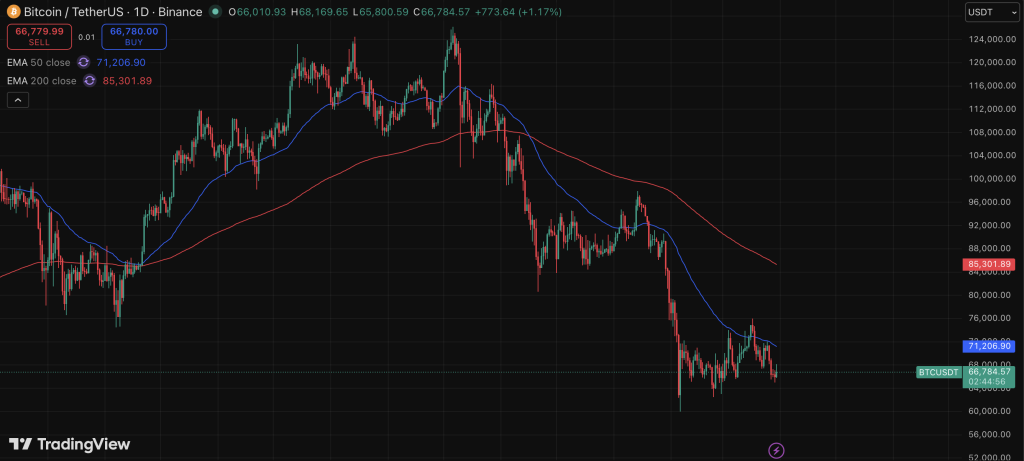
What makes this situation a bit more concerning is how it contrasts with price action. Bitcoin has been drifting slightly higher in recent weeks, or at least not collapsing outright, hovering around $66,500. But at the same time, fewer holders are actually in profit.
That divergence is where things get tricky. On the surface, price looks stable, maybe even mildly positive. But underneath, conviction seems to be fading. And historically, when price and on-chain sentiment start moving in opposite directions, it doesn’t usually end quietly.
Stress Levels Begin to Rise Across the Market
CEX.io’s Bitcoin Impact Index, which tracks stress among holders and institutions, has now shifted into what they call a “high impact” zone. That essentially means pressure is building, not just among retail investors, but across larger players too.
There’s also the broader backdrop to consider. Bitcoin has slipped around 6% over the past week, partly tied to geopolitical tensions, which adds another layer of uncertainty. It’s not a full breakdown, but it’s enough to keep the market on edge, and that tension tends to show up in behavior before it shows up in price.
A Pattern That Feels Familiar
Analysts pointed out that similar conditions have appeared before, notably in mid-2018 and mid-2022. In both cases, price held up for a while even as underlying conviction weakened… and then eventually, things gave way, leading to drops of over 25%.
If something similar were to happen now, Bitcoin could potentially fall below $50,000, a level it hasn’t touched since early 2024. That would also push it significantly further away from its all-time high near $126,000, where it’s already down about 47%.
Not All Signals Point to Immediate Panic
That said, there’s one important difference this time. So far, holders aren’t rushing to send Bitcoin to exchanges in large volumes. That lack of panic selling helped limit downside during the February drop, and it seems to be playing a similar role now.
If that trend holds, there’s still a chance the market stabilizes rather than spirals lower. It’s a fragile balance though, because if selling pressure suddenly increases, things could shift quickly.
Mixed Outlook as Analysts Weigh In
Other analysts are also leaning cautious. VanEck has pointed to unusually strong demand for downside protection, which suggests investors are preparing for potential volatility. Meanwhile, estimates from CryptoQuant and Standard Chartered place possible downside targets around $55,000 to $50,000 before any meaningful recovery.
So, the picture isn’t entirely bearish, but it’s definitely not comfortable either. Bitcoin is sitting in that in-between phase, where stability exists, but confidence is quietly eroding underneath.