

- Bitcoin has gained 17% in Q2 but still remains trapped below major resistance.
- More than $10 trillion recently flowed into U.S. equities, dwarfing crypto inflows.
- Strong STRC activity continues fueling expectations of future corporate Bitcoin accumulation.
The rotation back into risk assets is clearly happening across global markets right now, but the pace has been far from equal. While equities continue absorbing massive amounts of liquidity, Bitcoin is still stuck fighting through a stubborn consolidation phase despite recovering strongly during Q2.
So far this quarter, Bitcoin has climbed roughly 17%, which on paper looks impressive enough. But structurally, the market still feels more like a prolonged consolidation than the beginning of a true expansion phase. Traders continue watching the $80,000–$85,000 region closely because that range has repeatedly blocked BTC from transitioning into stronger price discovery territory.
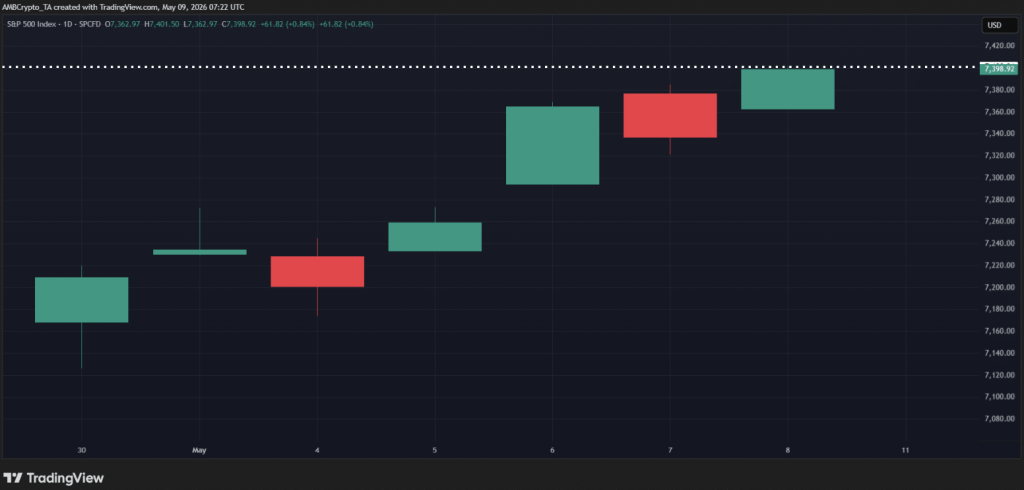
Bitcoin Lags Behind Explosive Equity Market Momentum
From a technical perspective, Bitcoin still remains roughly 35% below its previous $126,000 peak, even as broader market sentiment improves. Meanwhile, traditional equity markets have been absorbing liquidity at an entirely different scale.
The NASDAQ has already rallied more than 22% during Q2, while the S&P 500 recently climbed to a fresh record high near 7,400 on May 8. Those gains haven’t happened in isolation either. According to market flow estimates, more than $10 trillion has rotated into U.S. equities in roughly a month alone, fueling continued upside momentum across major indexes.
Compared to that, crypto inflows have looked relatively modest. Over the same period, approximately $300 billion entered digital assets, pushing total crypto market capitalization back above the $2.6 trillion level. That’s still significant capital, obviously, but the liquidity imbalance between equities and crypto remains pretty clear right now.
Because of this, the argument that Wall Street liquidity conditions are heavily influencing Bitcoin flows is starting to gain more credibility among traders and analysts alike. Traditional markets currently dominate the broader risk-on environment, and Bitcoin is partially moving inside that shadow for now.
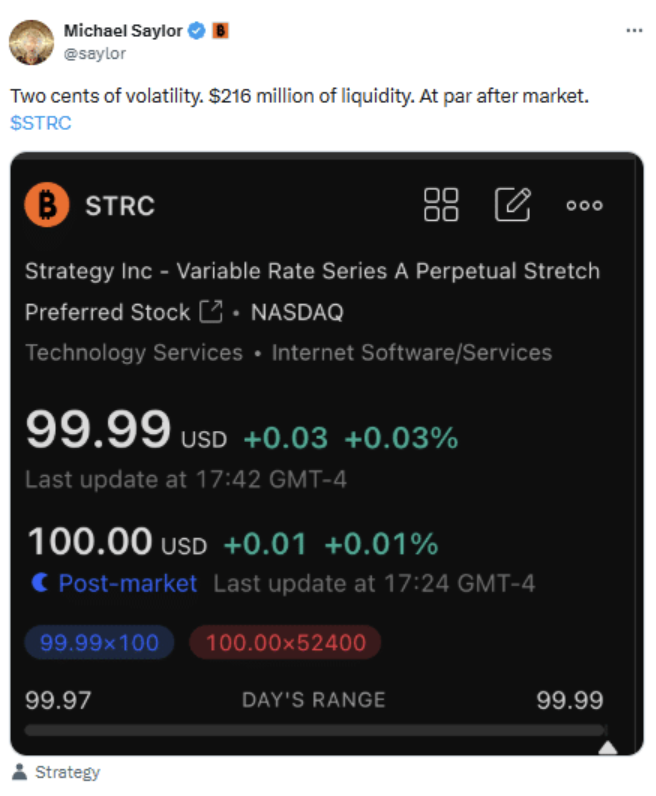
Corporate Bitcoin Accumulation Narrative Remains Strong
Still, the relationship between equities and Bitcoin isn’t necessarily bearish for crypto long term. In fact, stronger stock market conditions may actually support future BTC accumulation indirectly through corporate treasury activity.
One of the clearest examples of this dynamic is the Stretch Index, or STRC, which is closely tied to Strategy’s broader Bitcoin acquisition model. Recently, Michael Saylor pointed toward roughly $126 million in sell-side liquidity sitting near the $100 level.
Despite that visible supply overhead, STRC has continued trading tightly around the same zone, which many market participants interpret as a sign of strong institutional demand steadily absorbing available liquidity. In other words, buyers continue stepping in aggressively even while broader crypto liquidity conditions remain somewhat constrained.
That’s important because historically, sustained activity around the $100 region has often coincided with additional Bitcoin purchases. Capital raised through STRC-linked mechanisms tends to eventually flow back into BTC accumulation strategies.
Can Bitcoin Finally Break Above $85K?
Right now, the market seems stuck between two competing forces. On one side, capital rotation into equities is limiting immediate crypto inflows and slowing Bitcoin’s expansion phase. On the other hand, stronger Wall Street liquidity is improving conditions for institutions and corporate players to continue raising capital for future Bitcoin exposure.
That dual effect creates an interesting setup for BTC moving forward.
If equity markets continue attracting strong inflows while corporate Bitcoin accumulation remains active underneath the surface, the current consolidation around $80K–$85K may eventually resolve higher despite crypto’s relative liquidity disadvantage. Traders are still waiting for confirmation, though, because repeated rejections around resistance have made the market increasingly cautious lately.
For now, Bitcoin remains trapped just below a critical breakout region. But with institutional structures like STRC continuing to show resilience and broader risk appetite strengthening across markets, the argument for a larger BTC move above $85,000 is definitely not disappearing anytime soon.