

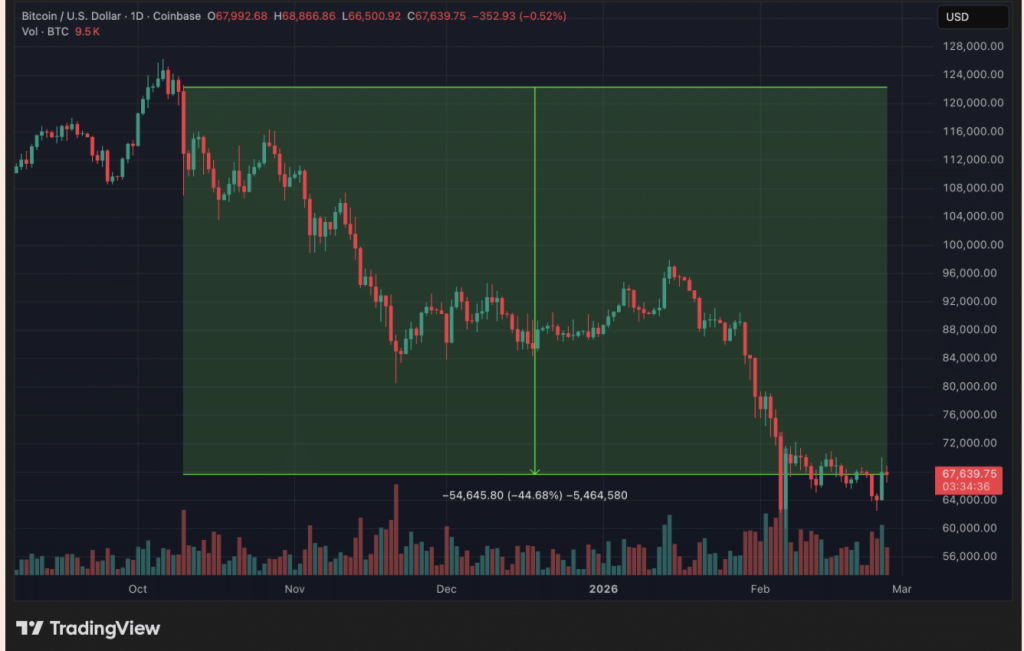
- Bitcoin’s decline began months before February, signaling gradual distribution rather than a sudden coordinated dump.
- February’s sharp drop showed signs of forced liquidations and leverage unwinding, not controlled institutional selling.
- The 45% pullback fits historical mid-cycle crypto resets, suggesting a structural cooldown rather than manipulation.
Bitcoin’s latest pullback has done what crypto pullbacks usually do — it stirred up suspicion almost instantly. When price starts sliding fast, the market doesn’t just look for support levels, it looks for villains.
This time around, names like Jane Street, Binance, Wintermute, and even shadowy macro hedge funds have been tossed into the conversation, accused of offloading BTC at carefully timed hours during U.S. trading. It sounds dramatic. It always does.
But when you actually zoom out and study Bitcoin’s structure, the chart tells a quieter story — one that’s less cinematic, and honestly, far more typical.
The Downtrend Started Well Before February
The sell-off didn’t suddenly appear out of nowhere in February. Bitcoin had already topped out in the fourth quarter, and what followed wasn’t panic — it was a gradual shift in behavior. Lower highs crept in. Momentum stalled. Price began chopping sideways in a way that felt heavy, almost tired.
That kind of action usually signals distribution, not coordinated dumping. Big holders don’t typically smash the market in one dramatic move. They scale out. They trim exposure slowly, hedge with options, reduce leverage, write calls — the kind of activity that doesn’t scream on a chart but quietly weighs on it over time.
By the time BTC slipped into the low-$60,000 range, a lot of structural damage had already been done. February didn’t start the fire, it just revealed how much had already burned.
February Looked Forced, Not Planned
When the sharper leg down hit, volume spiked and volatility expanded quickly. That combination tends to point toward forced selling — liquidations, margin calls, and fast de-risking — rather than a smooth, calculated distribution by one entity.
If a single major firm had engineered the drop, price action would likely have looked more controlled. More orderly. Instead, the move was jagged and emotional, with heavy volume clustering near the lows. That’s the kind of signature you see during cascades, not coordinated exits.
Once key support levels break, things compress fast. Liquidation engines kick in, leverage unwinds, and what might have started as weakness turns into acceleration. It doesn’t need a mastermind, it just needs positioning that’s too crowded.
Why the Blame Game Keeps Coming Back
Speculation around major trading firms isn’t entirely random. Recent regulatory scrutiny and lawsuits tied to past market events have kept certain names in headlines. When markets wobble, those narratives resurface almost automatically.
There’s also lingering trauma from previous crashes where billions vanished in hours. So when Bitcoin drops hard, it feels familiar, and people look for a familiar cause. But correlation isn’t causation, even if the timing feels suspicious.
This drawdown unfolded over months, not minutes. That alone weakens the argument for a single actor pulling strings. As Bitwise CIO Matt Hougan recently pointed out, the explanation is probably less exciting: investors who were long simply decided to sell — whether due to macro uncertainty, cycle timing, or reallocating capital elsewhere. Not thrilling, but realistic.
A Reset Within the Cycle
Bitcoin has gone through deep pullbacks before, especially during mid-cycle resets. A roughly 45% peak-to-trough decline, while uncomfortable, sits well within historical norms. It tends to follow periods of heavy leverage and overly crowded positioning — which we clearly had.
What’s more telling is that selling pressure appears to be cooling. Price has begun stabilizing, suggesting that much of the forced unwinding may already be behind us. Sentiment is still fragile, sure, but structure matters more than mood.
None of this guarantees an immediate rebound. Markets rarely move in straight lines, and crypto especially doesn’t. But the evidence leans toward a cycle-driven reset rather than a structural break — and far away from the idea that one institution secretly engineered the entire decline.