

- Versan Aljarrah argues gold has already replaced the dollar as the true measure of value
- He believes XRP will power real-time movement of gold-backed liquidity in a digital system
- Rising debt, asset inflation, and central bank gold accumulation point to an ongoing monetary reset
Versan Aljarrah, founder of Black Swan Capitalist, has delivered a blunt assessment of where the global monetary system may already be headed. His view is that gold has effectively replaced the U.S. dollar as the true measure of value, even if that shift hasn’t been openly acknowledged yet. According to Aljarrah, the signs are there for anyone willing to look past headlines and official narratives.
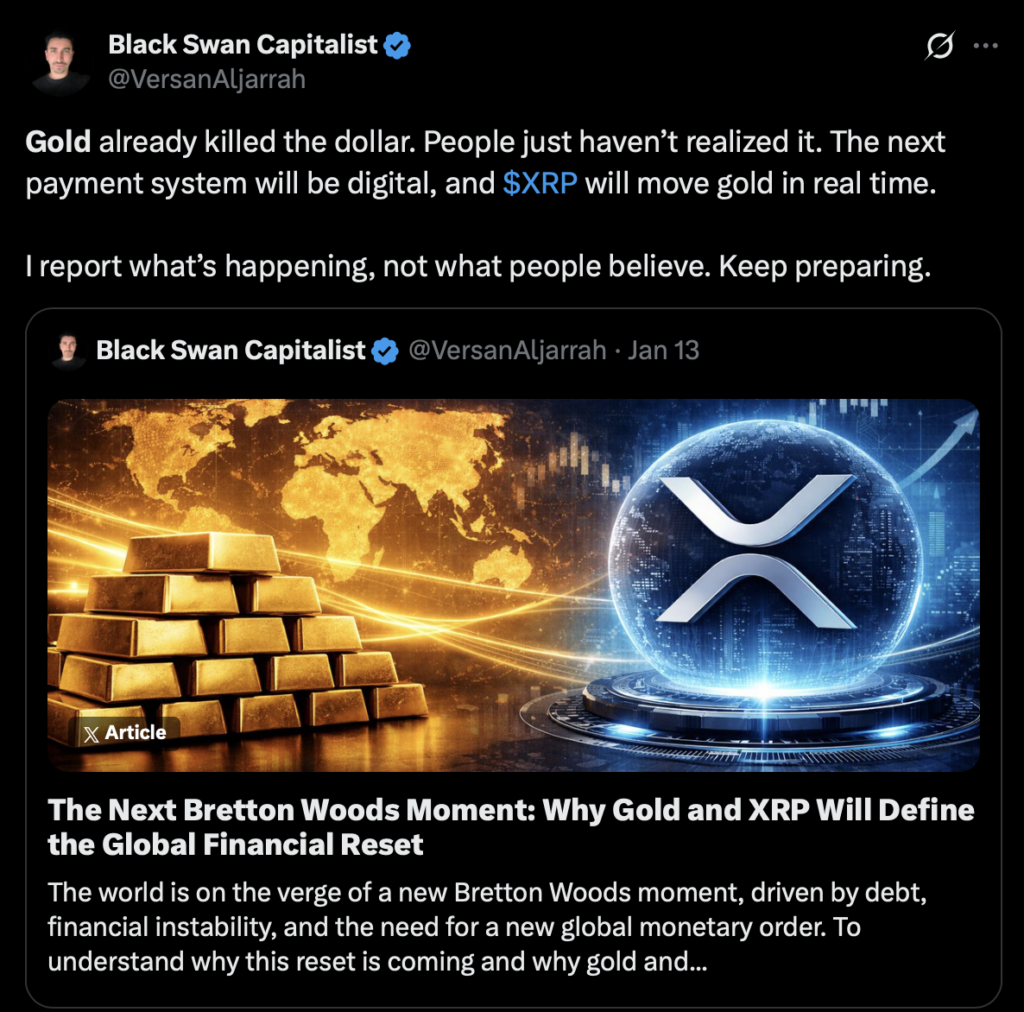
In a recent post, he argued that the next global payment system will be digital by design, and that XRP will play a role in moving gold-backed value in real time. He stressed that this isn’t about belief or speculation. In his words, it’s about observing what institutions are already doing and preparing for structural change rather than reacting to it later.
That message was paired with a longer breakdown explaining why he believes the world is approaching a modern version of a Bretton Woods-style reset. In his view, mounting debt, financial instability, and eroding confidence in fiat systems are pushing the global economy toward a forced redesign.
Debt Growth and the Fragility It Creates
At the core of Aljarrah’s argument is debt. He points out that global debt has grown to levels that simply cannot be repaid within the current credit-based framework. Every unit of currency, he says, represents someone else’s liability, which makes it mathematically impossible for all obligations to be settled at the same time.
That reality creates a system that survives only by expanding. Debt must keep growing to service existing debt. If that expansion slows or stops without a reset, Aljarrah argues the result would be widespread defaults, bank failures, and a cascading breakdown of the financial system. In that sense, stability becomes conditional, not structural.
He also takes aim at asset inflation. Rising prices in stocks, bonds, and real estate, he suggests, are often mistaken for economic strength. In his view, they function more as a support mechanism, keeping collateral values high enough to prevent systemic failures. Central bank interventions and bailouts, he argues, are less about growth and more about maintaining the appearance of solvency.
Gold as Trust, XRP as the Plumbing
In Aljarrah’s framework, gold serves as the anchor of trust, especially in environments where fiat currencies are being steadily devalued. Its scarcity and resistance to debasement make it a neutral reference point during periods of monetary transition. He points to the steady accumulation of gold by central banks as a signal that institutions are quietly preparing for change.
But trust alone isn’t enough in a modern system. Capital also needs to move quickly, cleanly, and at scale. This is where Aljarrah positions XRP. He describes it not as a speculative asset, but as infrastructure designed to move liquidity instantly across borders, reducing friction during periods of repricing or restructuring.
In that model, gold provides stability of value, while XRP handles velocity. One anchors the system, the other keeps it moving.
A Transition Already in Motion
According to Aljarrah, the convergence of rising debt, asset inflation policies, central bank gold accumulation, and the push toward digital settlement all point to the same conclusion. The existing system cannot hold indefinitely. Adding more debt or printing more money only delays the problem, it doesn’t solve it.
He believes a coordinated reset, one that leans on gold for value stability and XRP for liquidity movement, is a logical response to a structural imbalance that has been building for decades. Whether that transition unfolds smoothly or through disruption remains uncertain.
For those watching closely, Aljarrah’s message is clear. The shift isn’t something that will start someday. In his view, it’s already underway, and positioning comes down to recognizing the forces driving it before they become impossible to ignore.