
- Czech central bank governor supports adding Bitcoin to reserves
- Research shows 1% BTC allocation boosts returns without increasing risk
- Low correlation with traditional assets drives the diversification case
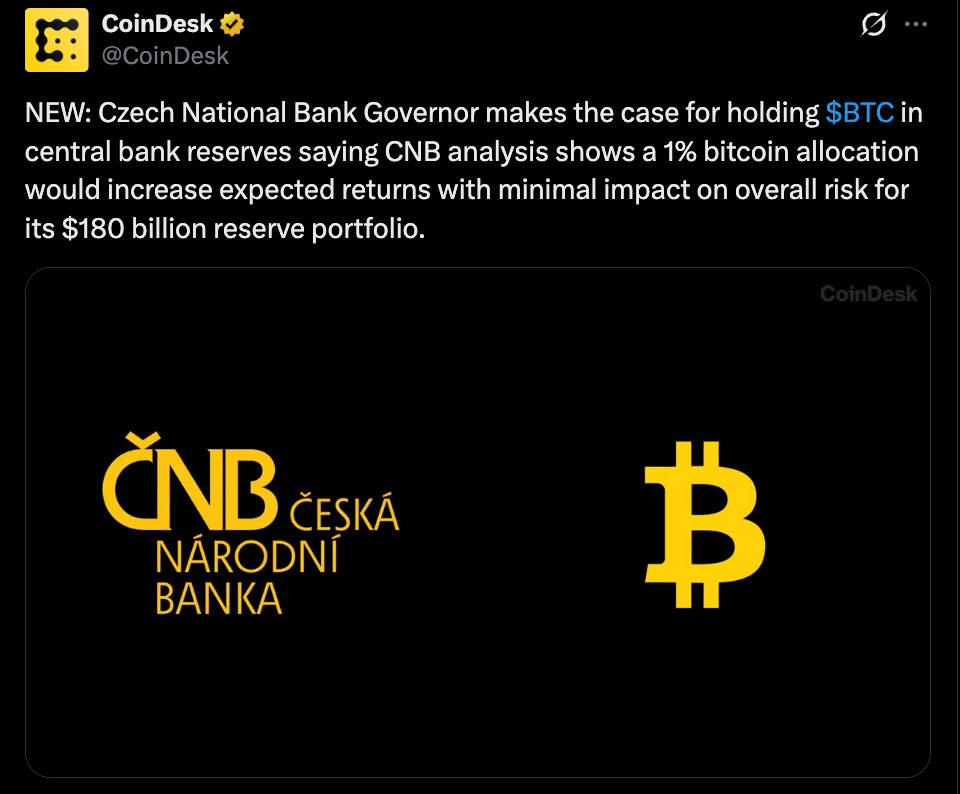
A central bank governor openly supporting Bitcoin is still… unusual, and yet that’s exactly what happened. Aleš Michl of the Czech National Bank stood on stage and made a case that most policymakers wouldn’t even say privately, that Bitcoin can actually improve a central bank portfolio.
Not replace it, not dominate it, just… quietly make it better.
The Math Behind the Argument
Michl’s point wasn’t built on hype or ideology, it was based on portfolio math. According to the bank’s own analysis, allocating just 1% of reserves to Bitcoin increases expected returns while leaving overall risk unchanged.
That’s not a bold crypto narrative, it’s basic diversification theory playing out in a place people didn’t expect to see it.
Diversification, Not Speculation
The key idea here is correlation, or more specifically, the lack of it. Bitcoin doesn’t move in lockstep with traditional assets like bonds or equities, and that independence is what gives it value in a portfolio context.
It’s not about volatility, which Michl acknowledged openly, it’s about how that volatility interacts with everything else in the mix.
A Quiet Shift From Theory to Practice
What makes this more than just a conference talking point is that the Czech National Bank has already taken small steps in this direction. A test allocation was made late last year, framed as an operational exercise, but still, it shows the idea is moving beyond theory.

Once central banks start testing something, even at small scale, it tends to mean the conversation is further along than it appears publicly.
A Growing Divide Among Policymakers
Not everyone agrees, of course. The European Central Bank has been clear that Bitcoin doesn’t belong in reserves, which sets up an interesting contrast within the same region.
That divergence highlights where things stand right now, some institutions are beginning to explore the data, while others are still dismissing the idea entirely.
A Signal That’s Hard to Ignore
Whether other central banks follow or not, this moment matters because it shifts the conversation. Bitcoin isn’t just being discussed as a speculative asset anymore, it’s being evaluated as part of formal reserve strategy.
That doesn’t guarantee adoption, but it does change the starting point. And once the discussion moves into portfolio math instead of opinion, it tends to stick around a lot longer.