

- Ethereum is stuck between fear-driven liquidations and greed-fueled positioning near the $3,000 level
- Whale realized price is being tested, a rare setup that has historically led to strong accumulation
- A breakdown could trigger capitulation, while a rebound may mark Ethereum’s fifth major accumulation phase
The market is drifting into one of those moments where buying fear, not chasing hype, starts to matter again. Traders watching smart money flows are trying to balance catching upside momentum while surviving sharp volatility, which hasn’t been easy lately. For Ethereum, this dynamic feels especially intense, mostly because positioning across the board is stretched and emotional.
Arkham Intelligence recently flagged an ETH whale opening a massive $537 million long around the $3,175 level. That looked confident at first, but Ethereum’s 4.7% drop on December 12 quickly flipped the trade into roughly $20.5 million in unrealized losses. It’s a reminder that even the biggest players aren’t immune to fast market shifts, especially when sentiment turns shaky.
Liquidations Start to Pile Up
As ETH pulled back, the pressure showed up almost immediately in liquidation data. CoinGlass reveals that Ethereum led total liquidations over the past 24 hours, with combined losses climbing above $120 million. The single largest hit came from Hyperliquid, where one ETH-USD position worth about $5.6 million was wiped out, not exactly a small number.
All of this paints a clear picture of a market caught in a tug-of-war. Fear is creeping in, greed hasn’t fully left, and the $3,000 level is sitting right in the middle as a fragile line in the sand. Traders are watching that zone closely, knowing a clean break either way could flip sentiment fast, maybe faster than most expect.
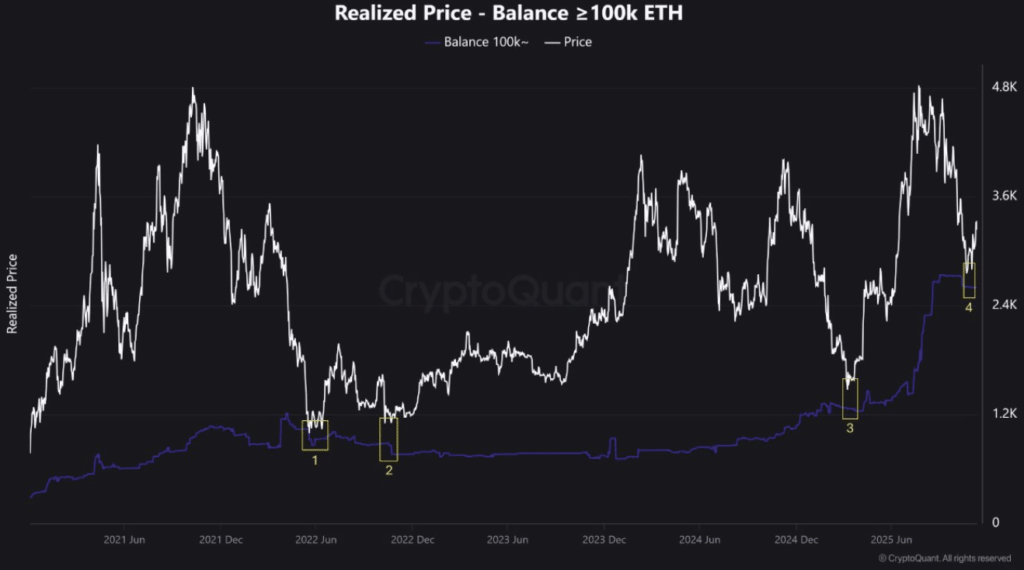
A Rare Test for Ethereum Whales
One of the more interesting signals is coming from whale behavior itself. According to CryptoQuant, Ethereum whales holding over 100,000 ETH are seeing their realized price converge with the current market price, something that rarely happens. In the last five years, this setup has appeared only four times, and each time it preceded strong accumulation phases.
Historically, whales tend to step in during these moments, absorbing sell pressure and protecting their cost basis. But this time, there’s a catch. With leverage still high and greed not fully flushed out, a slip below the whale realized price could trigger another wave of liquidations. For now, Ethereum is hovering at a critical crossroads, where either panic accelerates, or accumulation quietly begins again.