- Farmers in Brazil have completed the world’s first tokenized dairy cattle financing on the country’s B3 stock exchange.
- The pilot allowed producers to unlock nearly $20,000 in credit by using tokenized cows as loan collateral.
- Supporters believe the model could expand access to financing while showcasing the growing potential of real-world asset (RWA) tokenization.
Brazilian dairy farmers have completed what is believed to be the world’s first tokenization of livestock for financing, marking another milestone in the evolution of real-world assets (RWAs).
The pilot project took place in the state of Paraná, where farmers struggling to secure traditional bank loans tokenized 10 dairy cows and used them as collateral to obtain nearly $20,000 in financing through Brazil’s B3 national stock exchange.
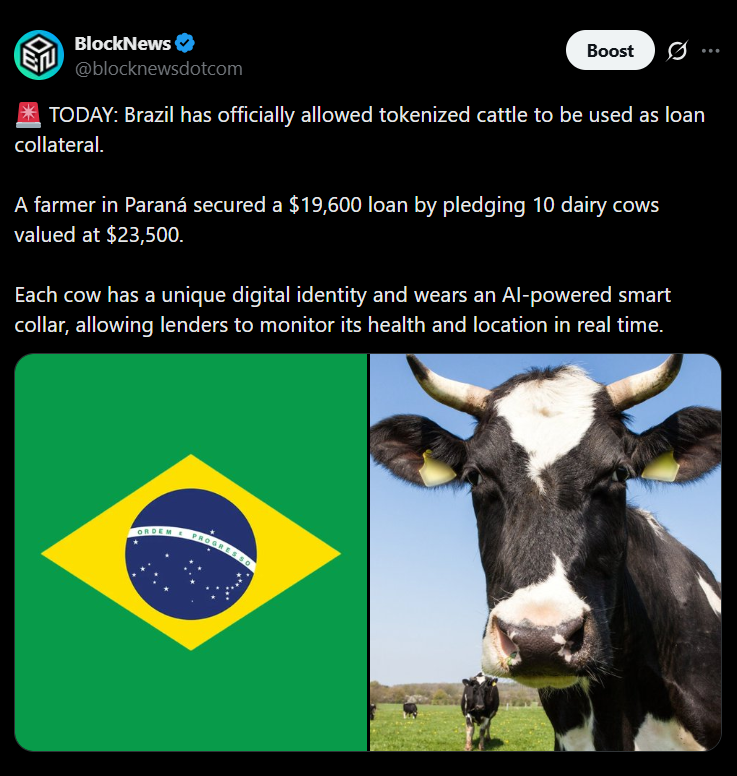
The initiative highlights how blockchain technology could create new funding opportunities for industries that have historically faced limited access to credit.
How Tokenized Cattle Financing Works
The project was developed by Brazilian AgTech company Cowmed, which transforms physical livestock into digitally registered collateral.
Each cow is equipped with an AI-powered Smarty Collar that continuously monitors the animal’s health, movement, and location.
That information is converted into an encrypted digital identity linked directly to the financing agreement, allowing lenders to verify the collateral in real time without requiring on-site inspections.
The system also includes safeguards to prevent the same livestock from being pledged across multiple loans and allows farmers to replace an animal if one dies during the lending period.
Blockchain Opens New Credit Opportunities
According to Cowmed, digitizing livestock enables cattle to be formally registered as movable assets that can serve as collateral in financial markets.
The company says this creates an alternative funding source at a time when many small agricultural businesses are facing tighter lending standards from traditional banks.
Cowmed currently monitors approximately 100,000 dairy cows across more than 1,000 farms, representing an estimated $395 million in livestock value.
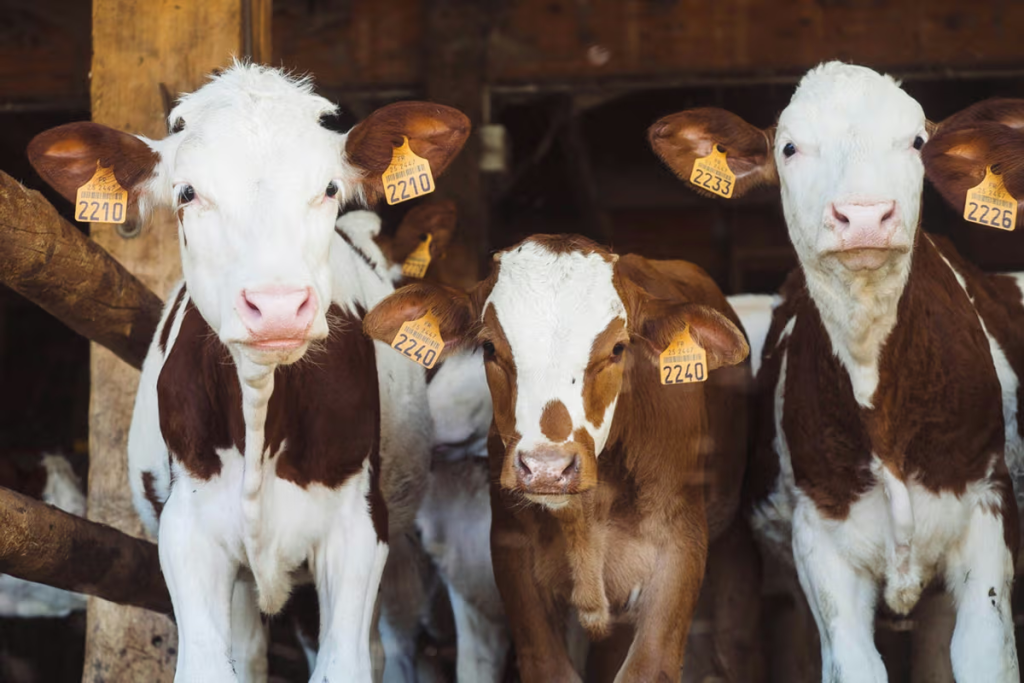
The company believes that if roughly 20% of its existing network adopts the tokenized financing model, it could unlock nearly $77.6 million in additional agricultural credit.
Tokenized Real-World Assets Continue to Grow
The dairy cattle pilot reflects the broader expansion of tokenized real-world assets across global financial markets.
Industry forecasts continue to project significant long-term growth. McKinsey & Company estimates the tokenized asset market could reach approximately $4 trillion by 2030, while Standard Chartered has projected the market could grow to $30 trillion by 2034.
Despite those optimistic forecasts, the market remains in its early stages, with tokenized real-world assets valued at roughly $25 billion as of March 2026.
Agriculture Could Become a New Blockchain Frontier
While tokenization has largely focused on financial assets, real estate, and government securities, the Brazilian pilot demonstrates that agricultural assets may also become part of the expanding digital economy.
If successful, similar financing models could provide farmers with faster access to capital while giving lenders greater transparency through real-time monitoring and blockchain-backed asset registration.
As institutions continue exploring real-world asset tokenization, projects like Cowmed’s dairy cattle initiative offer another example of how blockchain technology is beginning to reach industries far beyond traditional finance.