

- Bitwise CIO Matt Hougan believes Strategy’s influence on Bitcoin demand will fade as institutions step in.
- Major banks, pension funds, sovereign wealth funds, and financial advisers are already increasing Bitcoin exposure.
- Analysts say slower Strategy buying could actually strengthen Bitcoin by creating a healthier, more sustainable market.
Michael Saylor’s Strategy has been the face of corporate Bitcoin accumulation for years. Whenever the company announced another massive BTC purchase, the market paid attention. But according to Bitwise Chief Investment Officer Matt Hougan, that era may slowly be coming to an end.
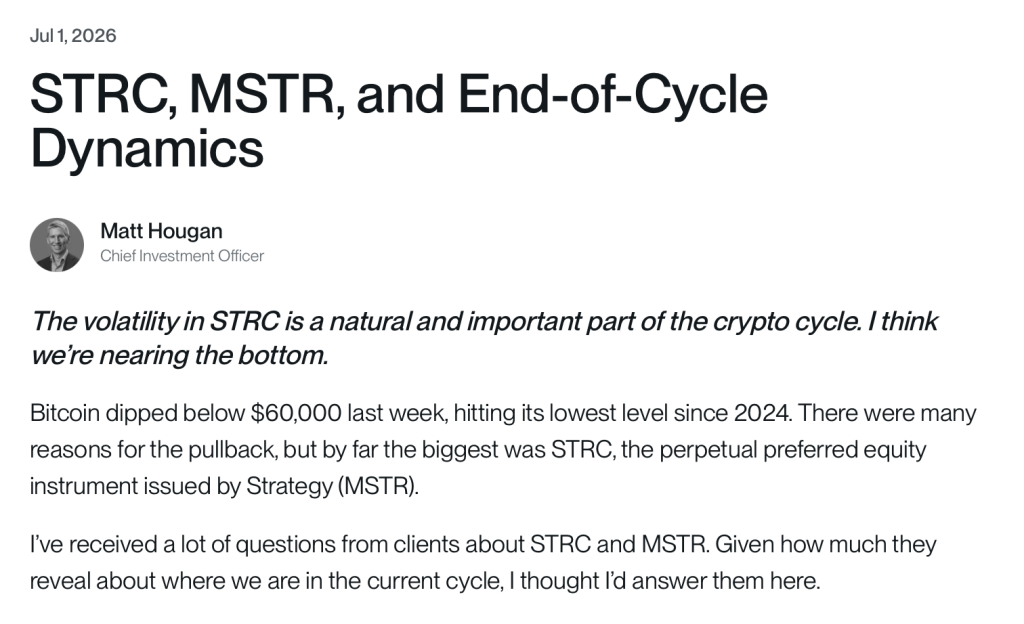
In his latest market commentary, Hougan argued that Strategy is unlikely to remain the dominant force behind Bitcoin demand during the next major market cycle. Instead, he believes a much bigger class of investors is preparing to take over.
Strategy isn’t disappearing from the picture, far from it. But its role is evolving.
Institutions Could Become Bitcoin’s Largest Buyers
Hougan explained that Strategy’s recent adoption of its STRC framework changes how the company manages its Bitcoin holdings. Under the structure, Strategy can periodically sell Bitcoin if needed to help meet dividend obligations.
That doesn’t mean Hougan expects the company to suddenly dump large amounts of BTC onto the market. In fact, he still believes Strategy will likely remain a net buyer over time, especially if Bitcoin prices continue climbing.
Still, the difference is important.
Rather than acting as a nearly constant source of buying pressure, Strategy now has the flexibility to both buy and sell depending on market conditions. That alone makes its future influence less predictable than it was during the previous cycle.
Hougan also pointed out that there’s no built-in mechanism forcing Strategy to sell more than a few billion dollars in Bitcoin each year. Even so, he doesn’t expect the company to have the same outsized impact it once had.
Instead, he sees the baton being passed to institutions with significantly deeper pockets.
Wall Street and Governments Are Already Moving In
According to Hougan, Bitcoin’s history has always been defined by changing waves of buyers.
First it was cypherpunks. Then came investors across Asia. After that, U.S. retail traders took center stage, followed by Grayscale’s Bitcoin Trust and eventually Strategy itself.
Now, another shift appears to be underway.
Hougan believes the next chapter will be driven by global banks, asset managers, pension funds, university endowments, sovereign wealth funds, sovereign banks, and financial advisers. Together, these groups control vastly more capital than previous buyer segments, making their long-term impact potentially much larger.
He pointed to several developments that support the idea.
Morgan Stanley has rolled out proprietary Bitcoin ETF offerings, while Wells Fargo has started incorporating Bitcoin exposure into select model portfolios. Texas also became the first U.S. state to fund a strategic Bitcoin reserve, and several sovereign wealth funds have either begun accumulating Bitcoin or are actively evaluating allocations.
Meanwhile, despite periods of heavy ETF outflows throughout 2026, Hougan noted that U.S. spot Bitcoin ETFs have attracted more than $50 billion in net inflows since launching in 2024. Most major financial adviser platforms now provide access to these investment products, something that wasn’t possible just a few years ago.
A Strategy Slowdown May Actually Help Bitcoin
Interestingly, not everyone believes slower buying from Strategy would be a negative development.
HashKey Group Senior Researcher Tim Sun argued that a moderation in the company’s accumulation could actually benefit Bitcoin over the long run.
Speaking with CryptoPotato, Sun said that if Strategy slows or temporarily pauses its purchases, it could help unwind some of the supply-and-demand imbalance created by the company’s financing-driven buying strategy.
Instead of relying heavily on one corporate buyer or periodic ETF inflows, Bitcoin would have more room to establish a price floor based on organic market demand.
In Sun’s view, that would create a healthier market structure, one that depends less on a handful of large buyers and more on broad participation across the financial system.
If Hougan’s outlook proves accurate, the next Bitcoin bull market won’t be defined by a single company making headlines. It could be shaped by Wall Street, pension funds, governments, and institutions quietly deploying trillions of dollars into the world’s largest cryptocurrency.