- Binance has launched U.S. stock and ETF trading for eligible users as it expands beyond crypto.
- The rollout gives access to more than 7,000 U.S.-listed stocks and ETFs through Binance’s platform.
- Binance also plans to introduce tokenized securities called bStocks, pending regulatory approval.
Binance is taking another major step toward becoming more than a crypto exchange. The company has unveiled U.S. stock trading for eligible users, giving them access to thousands of traditional financial assets directly through its ecosystem. It is a move that pushes Binance further into the growing overlap between Wall Street-style investing and blockchain-based finance.
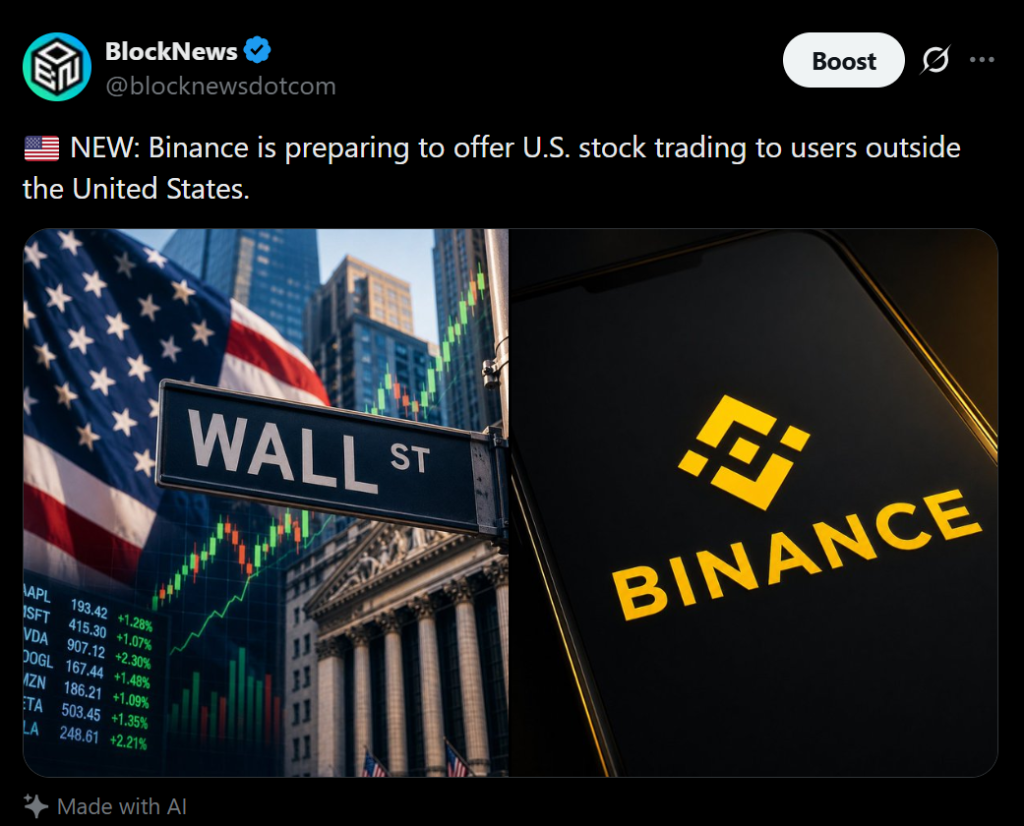
The launch follows days of speculation after Binance posted a haystack-themed teaser on X, which many users quickly interpreted as a hint toward stock-related products. That speculation turned out to be close. With the new rollout, Binance is giving eligible users access to more than 7,000 U.S.-listed stocks and ETFs, while also preparing to launch tokenized securities that could bring traditional assets closer to on-chain markets.
Binance Wants to Become a Multi-Asset Platform
Binance co-founder and co-CEO Yi He said the company is focused on helping users move more easily between traditional investment products and on-chain financial services. The goal is simple, but ambitious: make Binance a multi-asset financial platform where users can trade crypto, stocks, ETFs, and eventually tokenized assets in one place.
That strategy reflects a broader shift happening across the digital asset industry. Crypto platforms are no longer only competing with each other. They are increasingly trying to become gateways into a wider financial ecosystem. For Binance, adding stock trading is not just another product launch, it is part of a much larger push to reach users who want simpler access to different asset classes.
What Users Can Access
The new stock trading service is powered by Binance’s ADGM-regulated broker-dealer, Nest Trading Limited. Eligible users will be able to trade U.S. stocks commission-free, buy fractional shares starting from $5, and retain direct ownership of securities held through a U.S.-regulated clearing broker.
Users may also be eligible for dividends and corporate actions where applicable. Certain securities will support 24/5 trading, giving users more flexibility than traditional market hours usually allow. Purchases will mainly be funded with USDC, while Binance also plans to support BNB, USDT, USD1, and $U as funding options.

Tokenized Securities Could Be the Bigger Story
Alongside the stock trading launch, Binance also announced plans for bStocks, a new tokenized securities product linked to selected U.S. stocks and ETFs. These products are expected to be issued by BTECH Holdings Ltd in ADGM, pending regulatory approval, and would trade on Binance Exchange.
This is where the story becomes more interesting for crypto investors. Stock trading gives users access to traditional markets, but tokenized securities could eventually bring those assets into blockchain-based environments with greater flexibility, faster settlement, and potential on-chain utility. That is the bridge Binance appears to be building.
Traditional Finance and Crypto Keep Moving Closer
Binance co-CEO Richard Teng said tokenization could transform financial markets by improving accessibility, flexibility, and interoperability between traditional finance and digital systems. That idea has become one of the biggest narratives in crypto, especially as exchanges, asset managers, and institutions explore how real-world assets can move on-chain.
The launch does not mean tokenized stocks will immediately reshape global finance. Regulation still matters, and approval processes can move slowly. But Binance’s direction is clear. The company wants to reduce the barriers between crypto markets and traditional investing, giving users a single platform for both worlds.
If successful, this could mark another step toward a future where stocks, ETFs, stablecoins, crypto assets, and tokenized securities exist side by side. For Binance, the message is clear enough: the next phase of crypto adoption may not be about replacing traditional finance. It may be about connecting to it.