

- ECB Executive Board member Isabel Schnabel says a digital euro is needed to counter the growing influence of dollar-backed stablecoins.
- Stablecoins are approaching a $300 billion market value, with USDT and USDC dominating the sector.
- European officials worry that rising stablecoin adoption could further strengthen U.S. monetary influence globally.
The European Central Bank has made its position increasingly clear over the past few years: digital money is no longer a future discussion, it’s a present-day challenge. Now, as stablecoins continue expanding at a rapid pace, European policymakers are becoming more vocal about what they see as a growing threat to the euro’s influence in the global financial system.
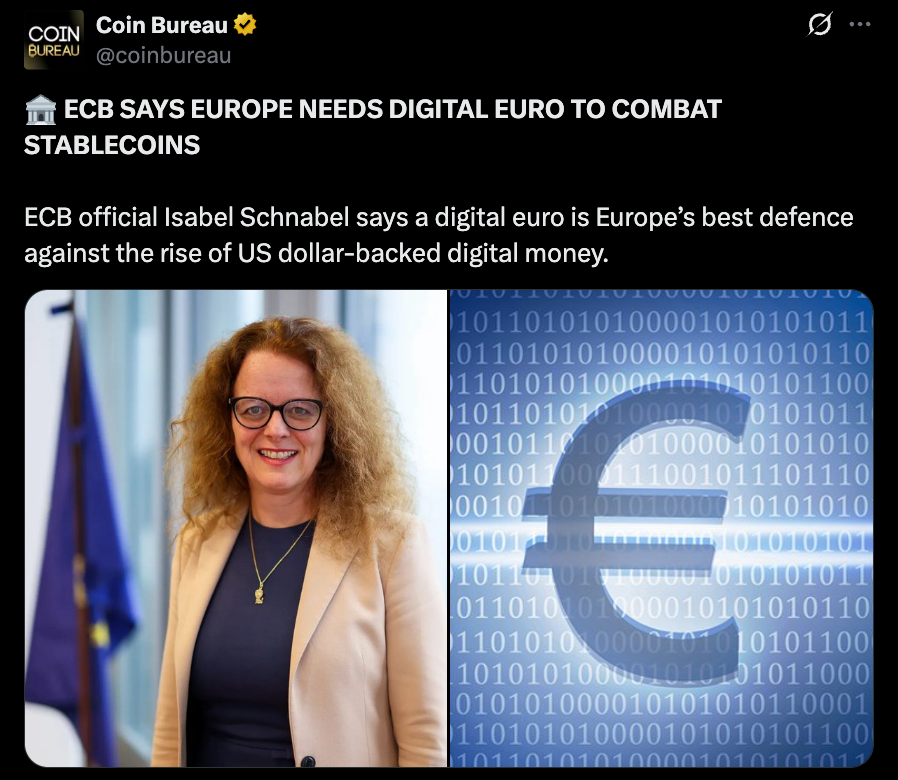
Speaking at the Bank of Korea International Conference on June 1, ECB Executive Board member Isabel Schnabel argued that a digital euro may be Europe’s strongest defense against the rise of dollar-backed stablecoins. Her concern is not simply that stablecoins are becoming popular. It is that nearly all of the largest and most widely used stablecoins are tied directly to the U.S. dollar, giving America an increasingly dominant position in the emerging world of digital finance.
Stablecoins Continue Expanding Worldwide
The stablecoin market has grown from a niche crypto product into one of the industry’s most important sectors. According to Schnabel, the total stablecoin market is now approaching $300 billion in value. The overwhelming majority of that market is controlled by Tether’s USDT and Circle’s USDC, two dollar-backed assets that have become essential tools for traders, investors, and businesses operating across blockchain networks.
European alternatives remain relatively small by comparison. As adoption grows, policymakers worry that global users may increasingly rely on digital dollars rather than local currencies when conducting transactions, storing value, or moving funds internationally. For central banks, that raises questions about monetary sovereignty and long-term influence.
Why Europe Is Concerned
At the core of the ECB’s argument is the belief that money carries influence. If digital payments increasingly flow through dollar-backed stablecoins, the United States could gain even greater monetary reach beyond its borders. While the dollar already serves as the world’s primary reserve currency, blockchain technology may be creating new channels that reinforce that dominance.

European officials fear that relying too heavily on foreign-issued digital assets could weaken the euro’s role in international commerce over time. That concern has helped accelerate discussions around a digital euro, which would allow the European Union to offer a blockchain-compatible alternative backed directly by its central bank.
Stablecoins Are Winning the Adoption Race
Ironically, the ECB’s concerns may be viewed by many crypto investors as one of the strongest endorsements stablecoins have ever received. Governments typically do not rush to develop competing products unless they believe the existing market is gaining meaningful traction. The fact that central banks are openly discussing digital currencies as a strategic response suggests stablecoins have already proven their utility.
For years, critics questioned whether blockchain-based money would ever find real-world demand. Today, stablecoins are processing billions of dollars in daily transactions, supporting decentralized finance, facilitating cross-border payments, and serving as a bridge between traditional finance and digital assets. Their growth has become difficult for policymakers to ignore.
The Battle for Digital Money Is Just Beginning
Whether a digital euro can compete with the network effects already enjoyed by USDT and USDC remains uncertain. Stablecoins benefit from deep liquidity, broad exchange support, and years of established market presence. Any central bank digital currency entering the space will need to convince users that it offers meaningful advantages beyond government backing.
What is becoming increasingly clear, however, is that the future of money is moving on-chain. The ECB’s latest comments highlight a growing competition over who will shape that future. While European officials frame the digital euro as a tool for protecting monetary sovereignty, the broader message is impossible to miss: stablecoins have become too important to dismiss. For the crypto industry, that may be one of the most bullish signals yet that blockchain-based money is becoming a permanent part of the global financial system.