- Grayscale paused its IPO plans as investor appetite for crypto stocks weakened
- The firm’s revenue dropped 20% despite Bitcoin remaining relatively strong
- Growing competition from BlackRock and Fidelity is pressuring crypto asset managers
Grayscale Investments, one of the largest and most recognizable crypto asset managers in the industry, has officially hit pause on its long-anticipated IPO plans. The company, which manages roughly $35 billion in assets across 45 investment products, is now unlikely to debut publicly before at least the fourth quarter of 2026.
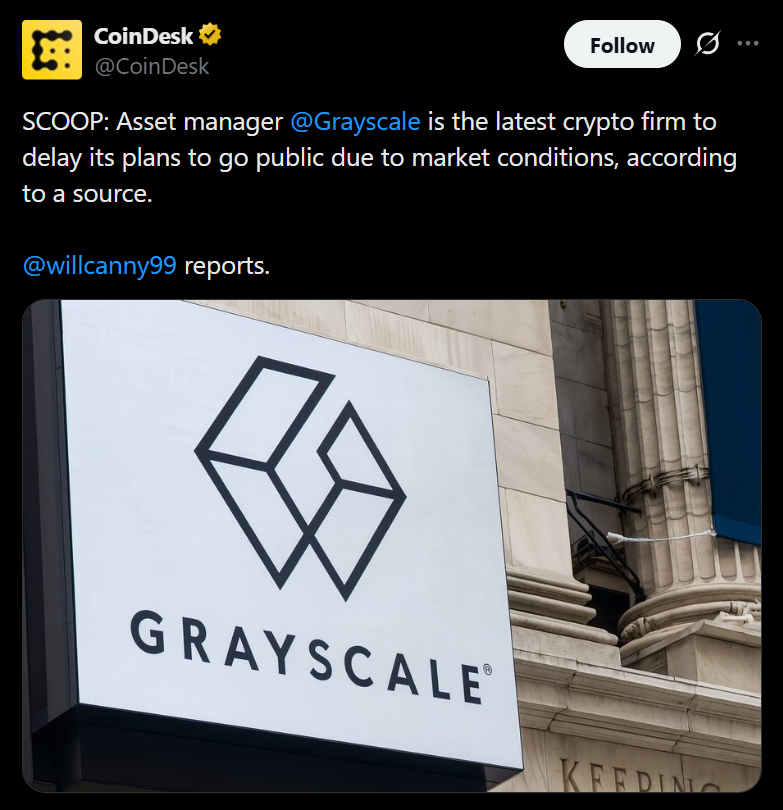
For a firm that seemed perfectly positioned to ride crypto’s institutional boom into Wall Street, the delay says quite a bit about the current market mood. And honestly, it’s not exactly screaming confidence right now.
Grayscale Quietly Started Preparing Last Year
Grayscale’s path toward going public began back in July 2025 when the company confidentially submitted a draft S-1 registration statement with the SEC. The filing later became public in November as the firm prepared for a potential New York Stock Exchange listing under the ticker “GRAY.”
The structure itself was already mapped out using an Up-C arrangement, a setup often used by companies balancing public market access with existing ownership structures. At the time, crypto IPO momentum looked strong.
Circle, Kraken, and several other major crypto firms were also exploring public market debuts as regulatory clarity around digital assets improved considerably during 2025.
Then market sentiment shifted.
Investor Appetite For Crypto Stocks Suddenly Cooled
The broader problem Grayscale ran into was that investor enthusiasm for crypto-related equities weakened materially over recent months. Kraken reportedly delayed its own IPO ambitions for similar reasons, suggesting the issue extends beyond just one company’s internal timing.
Wall Street appears increasingly selective about crypto exposure now, especially after the initial excitement surrounding spot Bitcoin ETFs started normalizing. Investors who once chased nearly every crypto-adjacent stock aggressively are becoming far more cautious about valuations, fee structures, and long-term profitability.
That caution becomes even more understandable once you look directly at Grayscale’s numbers.
Revenue Declines Are Starting To Matter
For the first nine months of 2025, Grayscale reported roughly $318.7 million in revenue, representing a 20% decline compared to the same period a year earlier.
That’s a pretty notable drop considering Bitcoin prices themselves remained relatively strong during much of that timeframe. Normally, stronger crypto prices tend to support higher asset management revenues through increased assets under management and stronger investor activity.
Instead, Grayscale now faces structural pressure from traditional finance giants like BlackRock and Fidelity, both of which aggressively entered the spot Bitcoin ETF market with lower fees and enormous distribution power.
And that changes the economics considerably.
The ETF Era Is Reshaping Crypto Asset Management
For years, Grayscale essentially dominated institutional crypto exposure products through vehicles like the Grayscale Bitcoin Trust. But the arrival of spot Bitcoin ETFs from major Wall Street firms fundamentally changed the landscape.
Traditional asset managers now offer similar exposure products with tighter fee structures, broader institutional trust, and easier integration into existing financial systems. That puts firms like Grayscale in a much more competitive environment than they operated in previously.
The 20% revenue decline during a relatively healthy Bitcoin market is probably one of the clearest signs yet that the business model itself is undergoing major pressure.
Crypto asset management isn’t disappearing obviously, but the easy-money phase tied to limited competition may already be over.
The Crypto IPO Window Is Narrowing Again
Grayscale delaying its IPO also carries symbolic importance beyond just one company. For a while, it looked like crypto firms were finally preparing to flood public markets following improved regulation and growing institutional adoption.
Now, that IPO window appears to be narrowing again temporarily as investors grow more selective and broader market uncertainty increases.
That doesn’t necessarily mean Grayscale’s public listing is dead. The company still controls enormous assets and operates one of the strongest brands in crypto finance. But waiting until late 2026 gives management time to see whether market conditions improve and whether the firm can stabilize revenue trends in an increasingly crowded ETF environment.
For now though, the message from Wall Street feels pretty clear. Crypto exposure is still attractive, but investors suddenly care a lot more about profitability, competition, and sustainable business models than they did during previous cycles.