
- Crypto influencer Nick O’Neill told struggling memecoin traders to “get out of the trenches and go get a job”
- The viral comment reflects growing burnout across Solana’s hyper-speculative memecoin ecosystem
- Despite the chaos, Solana still dominates crypto’s retail attention economy
Crypto Twitter had another collective existential crisis this week after influencer Nick O’Neill, better known online as “chooserich,” unloaded on underwater Solana memecoin traders refusing to let go of collapsing positions.
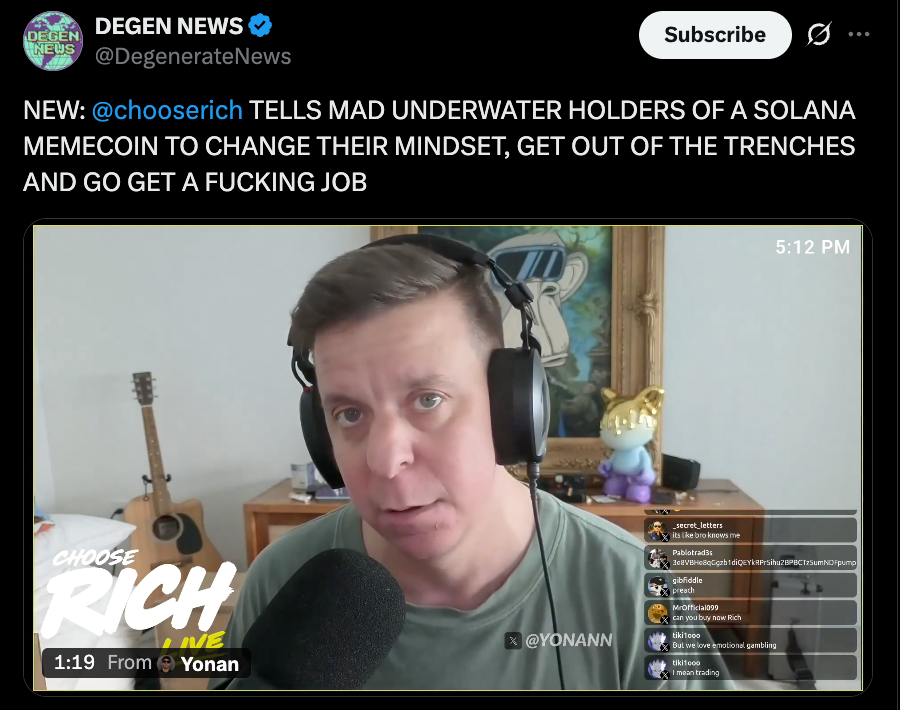
His advice was not exactly wrapped in motivational poster energy. Instead of endlessly averaging down into dying tokens, O’Neill bluntly told traders to “change their mindset,” leave the trenches, and “go get a f-cking job.”
Harsh? Absolutely. But the reason the clip spread so quickly is because it touched a nerve many traders quietly recognize already.
The Memecoin Trenches Have Become Financial Survival Mode
The Solana memecoin ecosystem increasingly feels like a strange collision between internet culture, high-speed gambling, financial nihilism, and collective emotional damage.
One day somebody turns $400 into six figures trading a coin named after a cartoon pigeon wearing sunglasses. The next day liquidity evaporates instantly while Telegram moderators disappear into witness protection programs.
That emotional whiplash is exactly what makes the “trenches” so psychologically exhausting for many traders. Most memecoins die almost immediately after launch, leaving huge numbers of retail participants stuck chasing losses, rotating between narratives, or trying to recover capital from projects that already effectively stopped existing.
And yet people keep coming back anyway.
Attention Became The Entire Market
Part of what makes memecoin culture so addictive is that fundamentals barely matter anymore. The real currency inside these ecosystems is attention itself.
Platforms like Pump.fun dramatically lowered the barrier for launching tokens, creating an endless conveyor belt of speculative assets competing for social media mindshare every single day. Most disappear within hours. A tiny percentage survive long enough to become viral. Even fewer develop enough liquidity to function like actual markets afterward.
In many ways, the entire ecosystem behaves more like a live-streamed internet casino powered by memes, influencers, and algorithmic dopamine cycles than traditional finance.
And honestly, Solana accidentally became the perfect blockchain for that environment. Cheap fees, instant settlement, fast trading, and frictionless wallet interaction created ideal conditions for high-frequency speculative behavior to explode at internet speed.
Solana Still Owns Retail Crypto Attention
Despite the growing exhaustion, Solana continues dominating crypto’s retail attention economy almost entirely. The majority of viral token launches, memecoin speculation, and retail trader activity still clusters around the ecosystem because the infrastructure simply works well for fast-moving speculative markets.
That dominance matters because attention itself increasingly drives liquidity in crypto. Traders follow activity, narratives, influencers, and momentum more than traditional valuation metrics.
Even many traders criticizing the trenches publicly continue participating in them privately because the upside still feels intoxicating enough to justify the risk psychologically.
That’s the uncomfortable reality of speculative markets. Rational behavior often loses badly to hope during strong attention cycles.
The Burnout May Actually Signal Market Maturity
Ironically, the growing frustration around memecoin trading could also signal crypto markets maturing underneath the surface.
Retail traders are slowly relearning lessons traditional finance figured out decades ago: surviving long term usually requires discipline, risk management, position sizing, and occasionally stepping away from emotionally destructive behavior entirely.
Meanwhile, institutions increasingly focus on entirely different parts of crypto, ETFs, stablecoins, tokenized assets, payment infrastructure, and blockchain-based financial systems rather than memecoin speculation.
The casino is still very much open, obviously. Crypto probably will not lose its degenerate side anytime soon.
But the people lasting longest in the market increasingly look like the ones treating crypto less like a lottery ticket and more like an actual financial ecosystem.