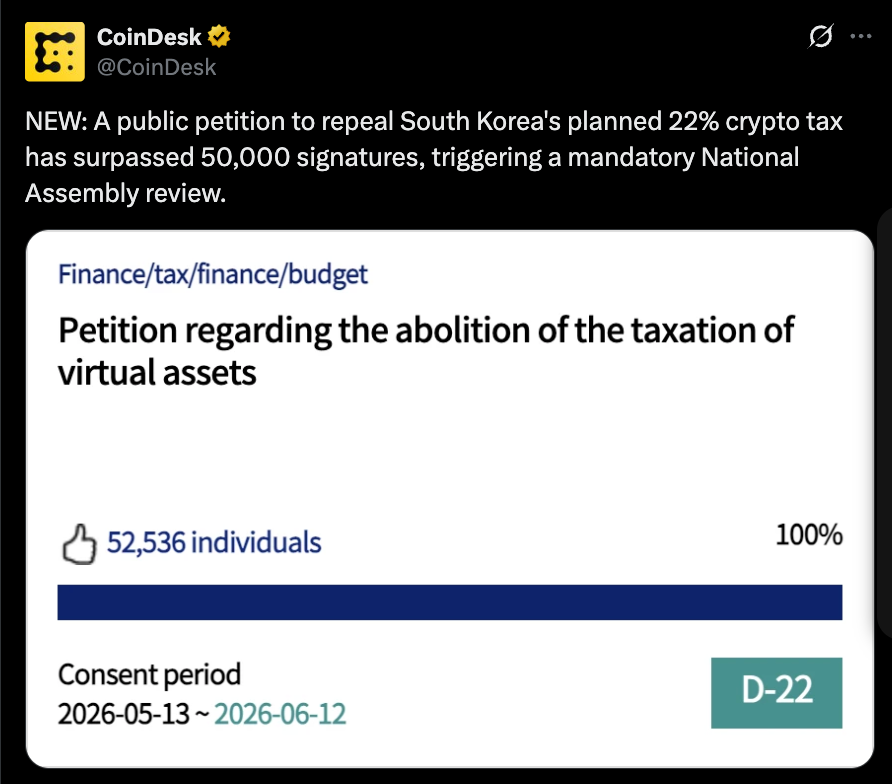
- A petition to abolish South Korea’s 22% crypto tax has surpassed 52,000 signatures
- The ruling People Power Party introduced legislation to fully scrap the tax in March
- The crypto tax has already been delayed three separate times since 2022
South Korea’s long-delayed crypto tax is once again facing serious resistance, and this time there’s growing speculation it may never actually take effect at all. A public petition calling for the full abolition of the planned 22% crypto tax has now crossed 52,000 signatures, automatically triggering a mandatory review by the National Assembly.
The tax, originally proposed back in 2020, would impose a 20% national tax plus a 2% local tax on crypto profits exceeding 2.5 million won, roughly $1,800. Since then, implementation has already been delayed three separate times and is currently scheduled for January 2027.
At this pace, many investors are starting to think the government may simply abandon the plan entirely.
Politicians Are Now Actively Trying to Kill It
Momentum against the tax increased sharply after South Korea’s ruling People Power Party introduced legislation in March aimed at removing all crypto taxation provisions from the Income Tax Act.
Party leaders argue digital assets are already treated as commodities subject to value-added tax, making an additional income tax effectively a form of double taxation. That argument has gained traction politically, especially after South Korea abolished its Financial Investment Income Tax in late 2024, leaving crypto investors facing rules no other major investment sector currently deals with.
That imbalance has become increasingly difficult for lawmakers to defend publicly.
The Crypto Market Is Already Cooling
The timing also matters because South Korea’s crypto market has slowed considerably over the past year. Total crypto holdings by South Korean residents reportedly fell from around 121.8 trillion won in January 2025 to roughly 60.6 trillion won by February 2026.

Trading volume dropped heavily too, with daily activity across the country’s largest exchanges falling from approximately $11.6 billion in late 2024 to around $3 billion earlier this year.
Trying to introduce a new tax during a contracting market environment is rarely politically popular, especially when retail participation already appears to be cooling significantly.
The Government Still Wants the Tax
Despite growing opposition, South Korea’s finance ministry continues defending the proposal. Officials argue removing the crypto tax would unfairly favor digital asset investors while regular workers and businesses continue paying taxes normally.
From a policy perspective, that argument makes sense on paper. But politically, the momentum increasingly appears to favor the crypto industry rather than tax authorities.
Between repeated delays, a ruling party abolition bill, and public backlash now forcing parliamentary review, the odds of this tax surviving unchanged until 2027 look increasingly uncertain.