
- XRP ETFs pulled in $60.5 million in net inflows during the week ending May 18
- Bitcoin and Ethereum ETFs saw net outflows during the same period
- Institutions appear to be steadily accumulating XRP amid regulatory optimism
XRP ETFs just recorded their strongest seven-day inflow streak since launching in November 2025, pulling in roughly $60.5 million while Bitcoin and Ethereum investment products simultaneously posted net outflows. That divergence is what suddenly has institutional traders paying much closer attention to XRP again.
For the first time in months, XRP stood out as the only major digital asset product category consistently attracting fresh capital while broader crypto ETF flows weakened. Whether this reflects temporary rotation or something more structural is still up for debate, though the timing is difficult to ignore.
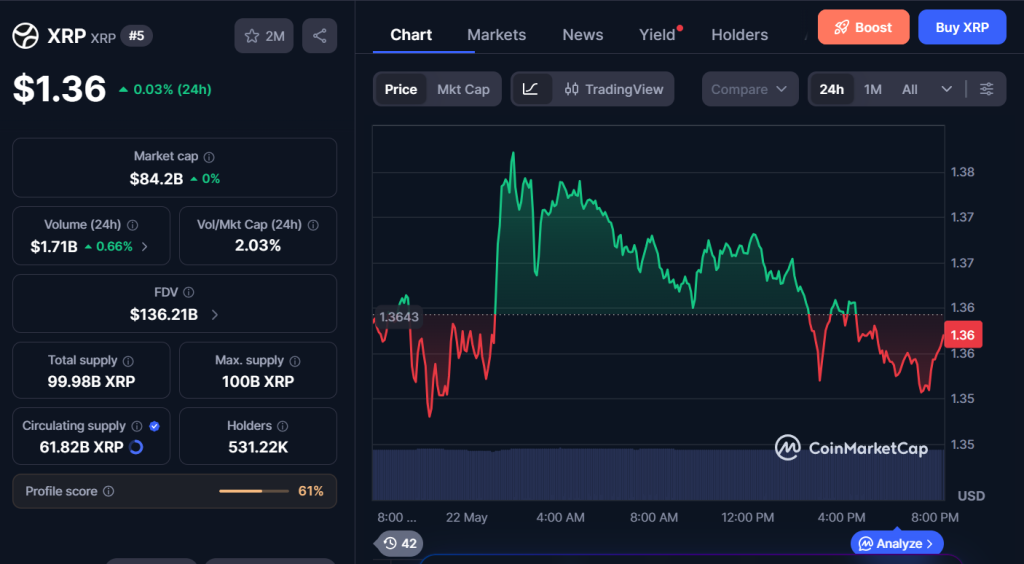
XRP ETF Flows Have Quietly Recovered
Since launch, U.S. spot XRP ETFs have accumulated roughly $1.39 billion in total net inflows, with around 889 million XRP now locked across seven products. Assets under management currently sit near $1 billion after previously peaking above $1.5 billion earlier this year before cooling during Q1.
The more important shift appears to have started in April. From April 9 onward, XRP ETFs reportedly avoided a single daily net outflow while steadily bringing in over $81 million throughout the month. That kind of consistency tends to look more like institutional positioning than short-term retail speculation.
And honestly, the flow patterns between providers support that idea too.
Institutions Are Picking Different XRP ETF Strategies
Bitwise is quickly becoming the dominant XRP ETF provider by cumulative inflows, approaching Canary Capital’s lead while benefiting from stronger liquidity conditions that appeal to larger allocators. Meanwhile, Franklin Templeton continues attracting longer-term investors with the category’s lowest fee structure at roughly 0.19%.
That split matters because institutions are not all chasing the same thing. Some prioritize liquidity and execution efficiency for larger allocations, while others focus more heavily on minimizing fees over longer holding periods. XRP ETFs now appear large enough for both strategies to coexist meaningfully.
The result is a market that increasingly resembles mature institutional allocation behavior instead of launch-phase speculation alone.
Regulatory Clarity Still Sits At The Center
A major reason institutions appear increasingly comfortable with XRP specifically comes back to regulation. Analysts continue pointing toward the Digital Asset Market Clarity Act and broader regulatory shifts in Washington as key drivers behind renewed interest in Ripple-related products.
Because XRP spent years at the center of Ripple’s SEC legal battle, institutional investors naturally view the asset as more sensitive to regulatory developments than many competing cryptocurrencies. That history created hesitation previously, but it may now be creating upside if institutions believe clearer crypto frameworks are finally approaching.
In many ways, XRP ETFs seem positioned directly around that thesis.
XRP Is Becoming A Different Kind Of ETF Story
The early launch period for XRP ETFs was explosive, briefly pushing assets above $1 billion faster than almost every digital asset product outside Ethereum itself. But launch excitement eventually faded, and Q1 reminded investors that initial demand spikes do not always translate into sustainable long-term flows.
What’s happening now looks different. The inflows are smaller than launch-period frenzy levels, but far steadier and arguably more meaningful because of that consistency.
If institutions are truly accumulating XRP ahead of anticipated regulatory clarity and broader crypto market integration, the current flow patterns may end up mattering far more than the original launch headlines did.