

- Ripple secured a $200 million debt facility to expand its institutional prime brokerage business.
- The financing will support Ripple Prime as demand for crypto margin and liquidity services grows.
- Traditional finance firms continue increasing involvement in digital asset infrastructure and brokerage markets.
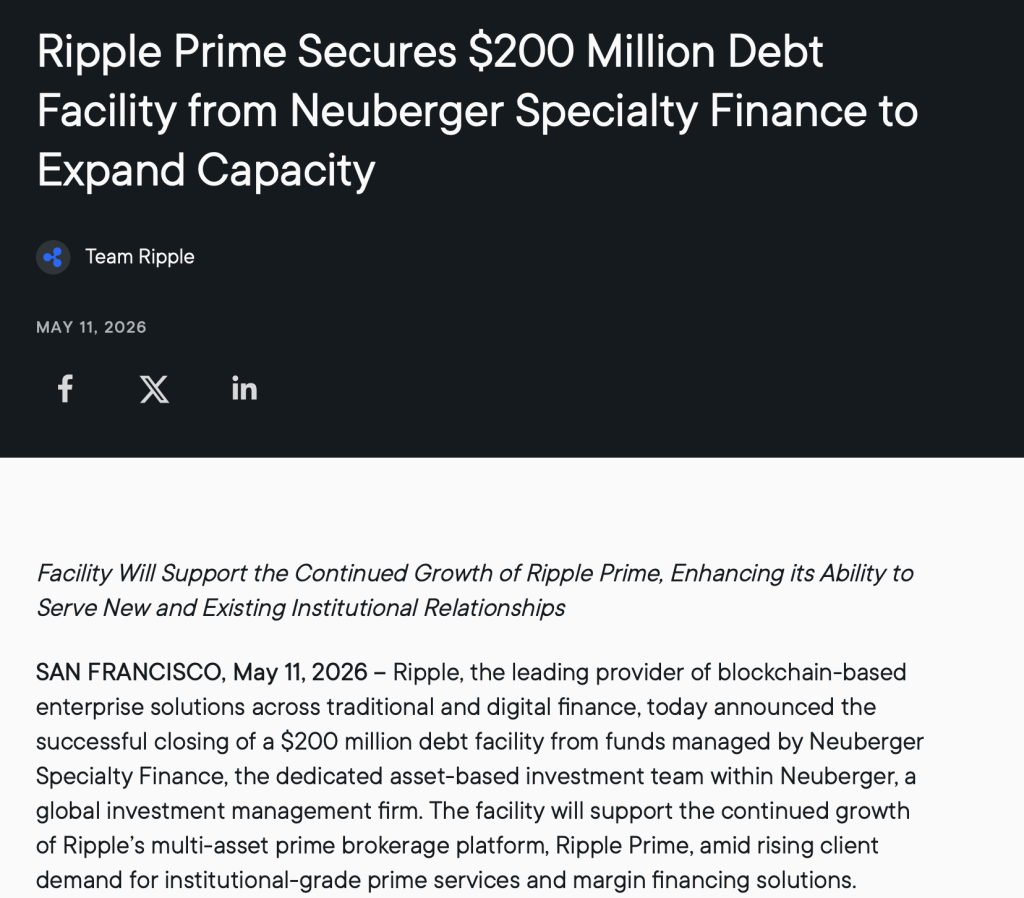
Ripple is making another aggressive move deeper into institutional crypto finance after securing a $200 million debt facility tied to its expanding prime brokerage business. The company behind XRP and the RLUSD stablecoin confirmed that funds managed by Neuberger Berman will back the facility, adding another strong signal that traditional finance firms are becoming increasingly comfortable working alongside crypto infrastructure companies.
The financing will support the continued growth of Ripple Prime, Ripple’s multi-asset prime brokerage platform that emerged after the company acquired Hidden Road and rebranded the business last year. According to Ripple, the platform has seen steadily increasing demand from institutional clients looking for margin financing, liquidity solutions, and professional-grade prime services across digital asset markets.
What makes the development important is not just the size of the facility itself, but who’s providing it. Neuberger Private Markets has spent decades operating across global investment strategies and institutional finance sectors, managing capital for some of the world’s largest institutions and sophisticated investors. For a firm like that to deepen involvement with Ripple reflects how much institutional attitudes around crypto infrastructure have evolved lately.
Ripple Prime Continues Expanding Institutional Presence
Ripple said the new financing arrangement gives Ripple Prime access to as much as $200 million in additional capital as client demand continues growing. The company believes the facility will help improve flexibility around lending, margin capacity, and capital efficiency while scaling alongside institutional participation entering digital assets.
According to Ripple Prime President Noel Kimmel, reliable access to financing has become increasingly critical as institutional crypto markets mature. He noted that the partnership with Neuberger reflects confidence in the brokerage platform Ripple has been building and the larger opportunity surrounding institutional digital asset services.
Kimmel also emphasized that strong balance sheet support and responsive liquidity solutions matter heavily for institutional participants navigating volatile markets. That’s especially true as traditional financial firms increasingly expect crypto infrastructure providers to operate with standards closer to what they’re already familiar with in conventional finance.
The timing of the deal is notable too. Ripple Prime reportedly tripled its revenue during 2025, suggesting institutional demand for crypto prime brokerage services has accelerated faster than many initially expected. As more firms move into tokenized assets, stablecoins, and digital settlement systems, infrastructure providers capable of supporting large-scale institutional activity are becoming increasingly valuable.

Traditional Finance Firms Continue Moving Into Crypto Infrastructure
The partnership also highlights a broader trend happening across the industry right now — traditional finance institutions are becoming more deeply integrated into crypto infrastructure rather than simply observing from the sidelines.
Peter Sterling, Head of Neuberger Specialty Finance, described Ripple Prime as an “innovative brokerage platform” combining fintech-level speed and technology with compliance standards and operational rigor more commonly associated with major banking institutions. That kind of language matters because it reflects how crypto firms are increasingly being evaluated through an institutional finance lens rather than purely speculative market narratives.
Ripple has been pushing aggressively toward this institutional positioning for years now. Beyond XRP itself, the company has expanded into stablecoins, enterprise payment systems, custody infrastructure, tokenization initiatives, and institutional liquidity products. Ripple Prime appears to be another major piece of that broader strategy.
The firm’s growing ecosystem has also benefited from rising institutional interest surrounding blockchain-based settlement systems and real-world asset tokenization. As crypto markets mature, many large firms seem less focused on speculative trading alone and more interested in the infrastructure layer supporting global financial operations.
Ripple Continues Building Beyond XRP Speculation
For years, Ripple was often viewed primarily through the lens of XRP price action and its legal battles with regulators. But the company’s recent expansion efforts show a much broader ambition taking shape underneath the surface. Ripple increasingly appears focused on becoming a full-scale institutional crypto infrastructure company rather than simply an issuer tied to one digital asset ecosystem.
The launch of RLUSD, institutional brokerage expansion, tokenization initiatives, and partnerships across financial services all point toward that direction. The latest $200 million facility strengthens Ripple’s ability to compete directly within institutional digital finance markets where liquidity access and financing flexibility matter heavily.
At the same time, competition inside the institutional crypto sector is becoming more intense. Traditional banks, fintech firms, and crypto-native companies are all racing to position themselves as core infrastructure providers as digital asset adoption expands globally.
For Ripple though, securing backing from a major institutional finance player like Neuberger Berman adds another layer of credibility at a time when trust and operational reliability are becoming increasingly important across crypto markets.