

- Kraken’s parent company applied for a national trust charter with the US OCC
- The proposed entity would focus on federally regulated digital asset custody services
- Kraken continues expanding aggressively through acquisitions while preparing for a future IPO
Kraken’s parent company, Payward, is making another major move deeper into the US financial system, this time by applying for a national trust company charter with the Office of the Comptroller of the Currency. The proposed entity, called Payward National Trust Company, or PNTC, would operate as a federally regulated digital asset custody business if approved.
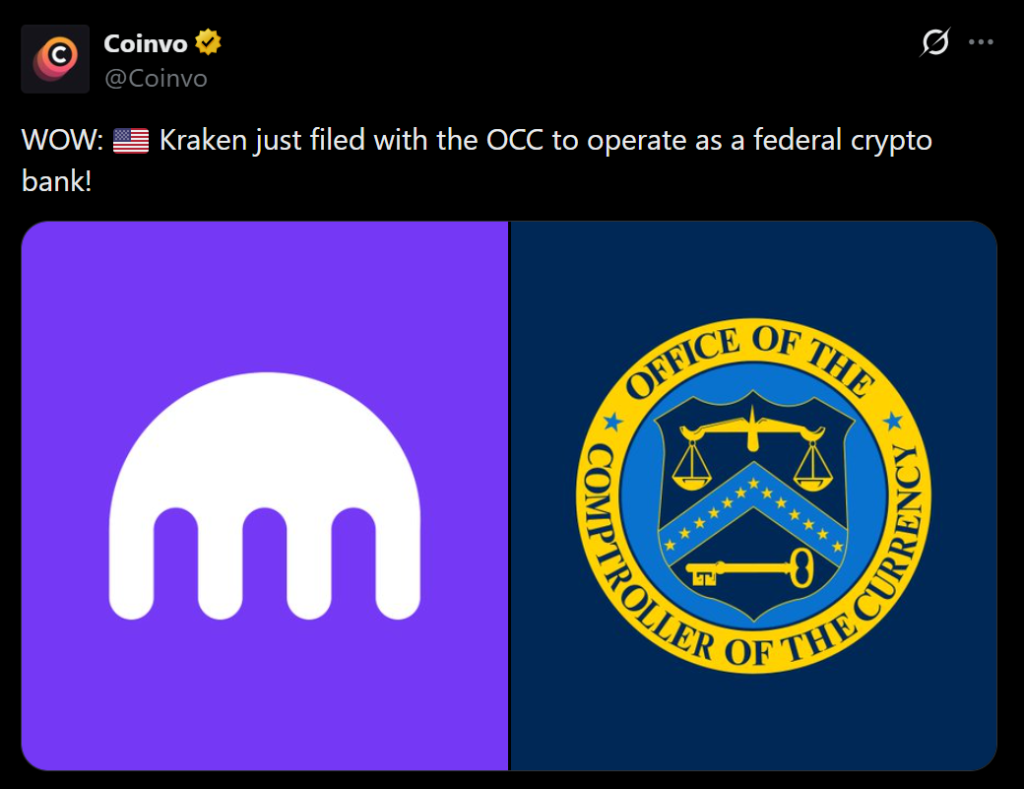
The application marks another sign that major crypto firms are increasingly trying to integrate directly into traditional banking infrastructure rather than operating around it. And honestly, under the current political environment, those ambitions suddenly look far more achievable than they did just a couple years ago.
Kraken Wants Federal Banking Reach
Kraken already operates Kraken Financial under a Wyoming charter, but state-level licenses come with geographic and operational limitations. A national trust charter would allow Payward to expand its presence across federal banking frameworks while complementing its existing Wyoming structure.
That distinction matters because federally regulated trust companies gain broader legitimacy with institutional clients, regulators, and eventually public market investors. For crypto firms trying to position themselves as long-term financial infrastructure companies, federal oversight increasingly looks less like a burden and more like a competitive advantage.
Kraken Financial also made history earlier this year after reportedly receiving a Federal Reserve master account, giving the company direct access to core US payment infrastructure for the first time. That alone was already a major milestone for the digital asset industry.
The Regulatory Climate Has Shifted Fast
Part of what’s driving this wave of applications is the changing political climate around crypto regulation in the United States. Under the Trump administration’s more favorable stance toward digital assets, federal trust charters have shifted from nearly impossible to suddenly realistic pathways for large crypto firms.
Between late 2025 and early 2026, the OCC reportedly advanced or conditionally approved 11 crypto-related trust charter applications. That group included major industry names like Circle, Ripple, BitGo, Fidelity Digital Assets, Paxos, Crypto.com, Bridge, and Zerohash.
Just a few years ago, many crypto firms viewed federal banking licensing as politically blocked territory. Now, companies are actively racing to secure those approvals before the regulatory environment potentially shifts again later.
Kraken Is Spending Aggressively
At the same time, Payward has been expanding through acquisitions at a surprisingly aggressive pace. Just this week, the company announced plans to acquire Asia-focused stablecoin firm Reap Technologies for roughly $600 million.
That deal pushes Payward’s total acquisition spending to around $2.7 billion within roughly a year. It’s a level of consolidation that signals Kraken is trying to evolve far beyond simply being a crypto exchange.
The company appears focused on building a broader financial ecosystem spanning custody, payments, stablecoins, infrastructure, and institutional services across multiple jurisdictions simultaneously.
Kraken’s Financials Still Look Strong
Financially, the company continues showing strong growth despite the broader volatility across crypto markets. Payward reportedly generated around $2.2 billion in adjusted revenue during 2025, up roughly 33% year over year. Adjusted EBITDA climbed to approximately $531 million, reflecting continued operational expansion.
Kraken also finished the year with roughly 5.7 million funded accounts and about $2 trillion in platform transaction volume. Those numbers help explain why the company still remains one of the most closely watched private firms in the crypto industry.
Its valuation reportedly reached around $20 billion in late 2025 before secondary market activity implied a lower valuation closer to $13 billion earlier this year. Still, Kraken remains one of the largest private crypto infrastructure companies globally.
The IPO Conversation Is Still Alive
Kraken has also acknowledged it remains roughly 80% prepared for a future public offering, though management says IPO plans are currently paused rather than abandoned entirely.
Securing a federal trust charter could become an important step toward that eventual goal. Public market investors generally prefer regulated financial infrastructure businesses with stronger oversight, especially in sectors as volatile as crypto.
If approved, the Payward National Trust Company would strengthen Kraken’s positioning as one of the few crypto-native firms operating across both state and federal financial frameworks simultaneously. And honestly, that’s probably exactly where the industry’s biggest players believe the future is heading.