- The Senate Banking Committee may begin marking up the CLARITY Act this week
- New draft language reportedly addresses stablecoin yield and SEC-CFTC oversight concerns
- The bill remains the leading framework for US crypto market structure regulation
Momentum around US crypto regulation may finally be returning after months of delays and political friction. According to reports shared by former Fox Business journalist Eleanor Terrett, the Senate Banking Committee is preparing to notice a markup for the CLARITY Act as soon as tomorrow, with draft legislative text already circulating among select industry participants.
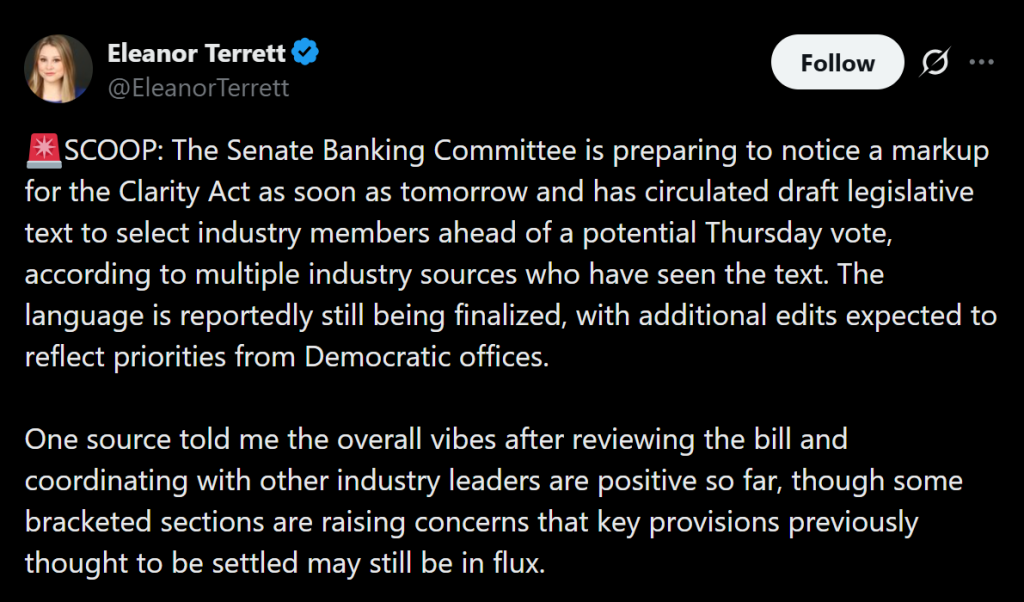
The updated draft reportedly remains unfinished, though additional revisions are expected before a possible committee vote later this week. Even so, the development marks one of the strongest signals yet that lawmakers may finally be moving the long-stalled crypto market structure bill forward again.
Why The CLARITY Act Matters So Much
The CLARITY Act has become one of the most closely watched crypto bills in Washington because it aims to create a formal federal framework for digital asset regulation in the United States. More specifically, the legislation attempts to define how oversight responsibilities would be divided between the SEC and the CFTC.
That jurisdiction battle has remained one of the biggest unresolved issues hanging over the crypto industry for years. Companies still operate in an environment where regulators often disagree about whether certain digital assets qualify as securities, commodities, or something else entirely.
The House already passed the bill back in July 2025 with bipartisan support in a 294-134 vote, but Senate progress slowed significantly afterward. Since then, negotiations have been messy, slow, and honestly pretty political.
Coinbase And Stablecoin Disputes Delayed Everything
One major setback came earlier this year when Coinbase CEO Brian Armstrong publicly withdrew support for the Senate draft version of the bill. Armstrong raised concerns surrounding tokenized equities, decentralized finance provisions, stablecoin reward structures, and how much authority would ultimately remain with the SEC versus the CFTC.
That public criticism reportedly contributed to the Senate Banking Committee postponing discussions on the legislation back in January. Since then, lawmakers and industry groups have spent months trying to negotiate compromises, especially around stablecoin yield provisions.
Stablecoin rewards became particularly controversial because some policymakers worried they could function too similarly to bank deposit interest products without equivalent banking regulation. Others argued restricting rewards too aggressively would hurt innovation and consumer adoption.
A New Stablecoin Compromise Revived Talks
Recent negotiations between Senators Thom Tillis and Angela Alsobrooks appear to have helped restart progress. According to reports, the latest compromise would prevent stablecoin issuers from offering yields that resemble traditional bank deposit interest while still allowing certain user-activity-based rewards.
That middle-ground approach reportedly improved sentiment enough to reopen discussions around moving the bill through committee markup. Still though, parts of the draft apparently remain bracketed, meaning some previously negotiated sections could still face additional edits or disagreements before final approval.
One industry source reportedly described the overall reaction to the draft as positive, although concerns remain that unresolved provisions could reopen old disputes. In Washington, nothing really feels final until the vote actually happens.
The Road To Final Approval Is Still Long
Even if the Senate Banking Committee advances the bill this week, the process is far from over. The CLARITY Act would still need approval from the full Senate before eventually being reconciled with the House version if differences between the two chambers remain.
That means negotiations could continue for months, especially as election-year politics and shifting regulatory priorities keep influencing the broader crypto conversation. Still, after months of stagnation, the fact that lawmakers are actively circulating updated text again feels significant on its own.
For the crypto industry, the stakes remain extremely high. The CLARITY Act is widely viewed as the most important attempt yet to create a workable long-term regulatory structure for digital assets inside the United States.