
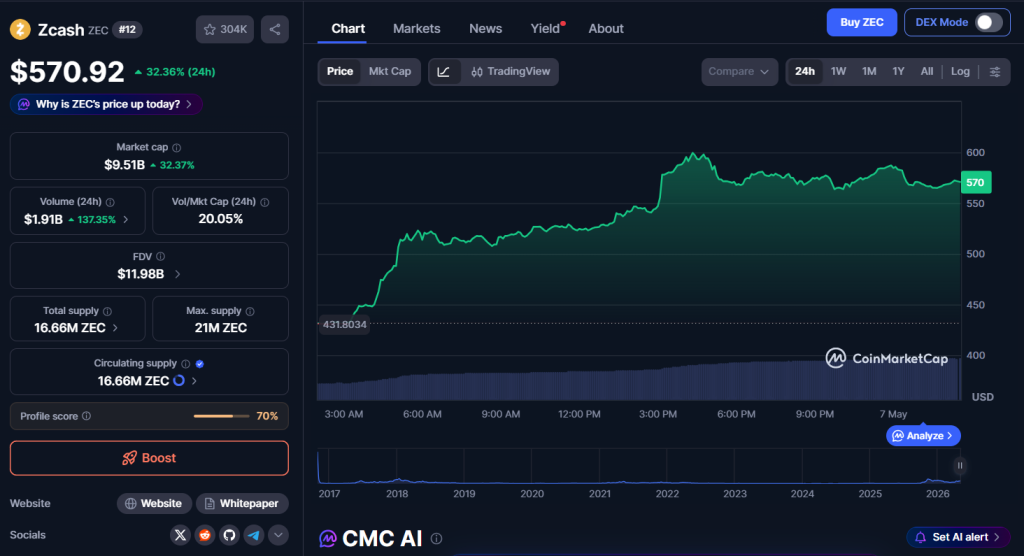
- Zcash surged nearly 40% after Multicoin Capital revealed a major ZEC position
- The fund argues privacy coins become more valuable as governments expand financial surveillance
- Shielded Zcash transactions now account for roughly 31% of circulating supply, a record high
Zcash just delivered one of the strongest moves in crypto this year, and interestingly, the catalyst was not a protocol upgrade, exchange listing, or viral meme cycle.
It was a macro thesis.
Multicoin Capital co-founder Tushar Jain revealed the firm has been aggressively accumulating ZEC since earlier this year, arguing that growing government surveillance and wealth-tax discussions create real demand for financial privacy assets. The market reacted immediately.
The Core Argument Is About Privacy, Not Speculation
Jain’s thesis centers on a distinction many crypto investors ignore. Bitcoin is censorship-resistant, but it is not private by default. Governments may not be able to stop Bitcoin transactions directly, but if authorities know what you own, taxation and legal seizure remain possible.
That’s where privacy-focused assets like Zcash enter the conversation.
Why Wealth Tax Discussions Matter
Multicoin specifically pointed to proposals like California’s billionaire wealth tax as examples of broader political trends toward increased financial oversight and asset visibility.
Whether those policies ultimately pass matters less than the direction they signal. According to the thesis, growing surveillance naturally increases demand for assets that offer stronger transactional privacy.
Zcash Is Seeing Real Usage, Not Just Trading
What makes the ZEC rally more interesting is that the onchain data supports the narrative to some extent. Roughly 5.18 million ZEC now sit inside shielded pools, representing around 31% of circulating supply, the highest level ever recorded.
That suggests users are actively utilizing privacy functionality rather than simply speculating on price movements.
Institutions Need Regulatory Flexibility
One reason Zcash may appeal to institutional investors more than some competitors is its optional privacy model. Unlike Monero, which enforces privacy by default and has faced delistings across several exchanges, Zcash allows both transparent and shielded transactions.
That flexibility creates a potential middle ground between privacy and regulatory compatibility.

The Grayscale Factor Matters Too
The existence of the Grayscale Zcash Trust also gives institutions a regulated pathway for exposure without directly handling privacy infrastructure themselves.
That matters because many funds remain unable or unwilling to interact with assets lacking compliant custody and reporting frameworks.
Privacy Coins Are Becoming a Macro Trade
For years, privacy coins mostly appealed to hardcore cypherpunks and crypto privacy advocates. The broader market largely ignored the sector.
Now the narrative is shifting toward macroeconomic concerns, financial surveillance, capital controls, and wealth protection. That changes the audience completely.
Risks Still Exist
The risks here remain substantial. Privacy-focused assets operate under constant regulatory pressure, and any aggressive crackdown targeting shielded transactions or exchange access could heavily damage the sector.
There’s also the possibility that the rally simply became overheated after Multicoin’s public disclosure. Momentum-driven moves can reverse quickly in crypto, especially after large one-day gains.
The Bigger Shift Is About Perception
Still, the most important development may simply be that institutional investors are openly discussing financial privacy as a legitimate investment theme rather than a fringe ideological issue.
That’s a meaningful shift in tone.
If governments continue expanding reporting requirements, surveillance systems, and taxation frameworks, privacy assets may increasingly move from speculative niche to strategic allocation for certain investors. And right now, Multicoin is betting that transition has already started.