- PayPal creates a dedicated Payment Services & Crypto division
- PYUSD stablecoin grows past $3.3B market cap since launch
- New leadership and AI-focused roles aim to accelerate innovation
PayPal is reshuffling its entire structure, and this time, crypto isn’t sitting on the sidelines anymore. The company is moving to a simplified three-division model, and one of those divisions is explicitly built around payments and crypto.
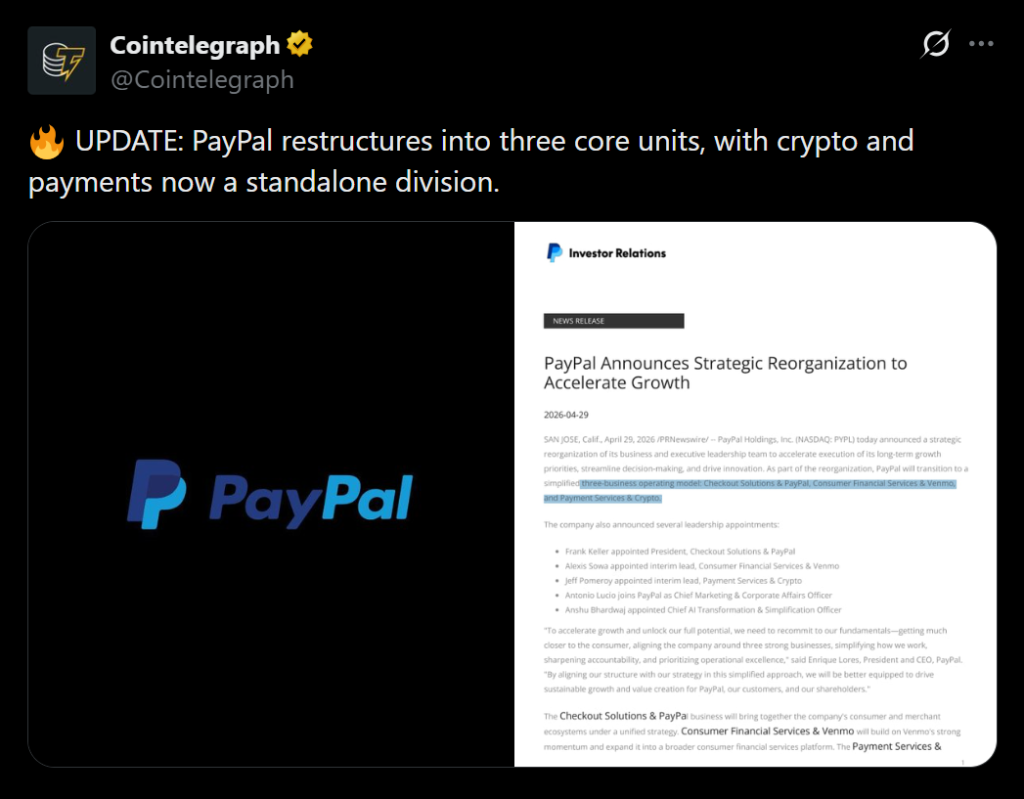
That alone says quite a bit about where PayPal thinks the next phase of growth is coming from.
A Cleaner Structure With Clear Priorities
The new setup splits the business into three main areas, Checkout Solutions, Consumer Financial Services, and Payment Services & Crypto. It’s a more focused approach, designed to cut down internal complexity and make execution faster.
And importantly, crypto is now grouped alongside core payment infrastructure, not treated as an experimental add-on.
Crypto Moves Closer to the Core
The Payment Services & Crypto division will handle everything from processing to platform services, including Braintree and PayPal’s stablecoin, PYUSD.
That consolidation matters. It puts crypto directly into the flow of merchant payments, which is where real adoption tends to happen, not just inside trading apps or isolated wallets.
PYUSD Quietly Gaining Ground
PayPal’s stablecoin has been growing steadily, now sitting above a $3.3 billion market cap. It’s fully backed by dollar reserves and short-term Treasuries, with regular transparency reports, which helps position it as a compliant and reliable option.
It’s not dominating the market, but it doesn’t need to, it just needs to integrate well with PayPal’s existing ecosystem.
Leadership Changes Signal Urgency
Alongside the restructure, PayPal is bringing in new leadership across divisions and even introducing a Chief AI Transformation role. That’s a strong signal the company is trying to move faster, not just reorganize for optics.
When companies add roles focused on simplification and AI at the same time, it usually means they’re trying to fix inefficiencies while building new capabilities.
A Broader Push Into Financial Services
The changes also hint at a bigger ambition. Venmo is being positioned as more than just a payment app, moving toward a broader financial services platform.
At the same time, crypto and stablecoins are being integrated into merchant solutions, which could quietly expand their use without needing massive user behavior changes.
What This Means Going Forward
PayPal isn’t making loud promises here, it’s restructuring the foundation instead. That kind of move tends to matter more over time, because it changes how products get built and delivered.
If execution improves and crypto continues to integrate into everyday payments, this could be one of those shifts that looks small now but becomes more obvious later.