

- Dogecoin price drops 17% as momentum weakens across the market
- Social activity declines, signaling reduced retail interest
- Derivatives surge while spot demand falls, raising downside risk
Dogecoin hasn’t had the smoothest run lately, and that’s becoming harder to ignore. Over the past few months, price has slipped around 17%, which doesn’t exactly scream strength, especially for a memecoin that usually thrives on momentum. The bigger issue, though, is what’s happening underneath, there’s a growing gap between real demand and speculative activity, and that’s not always a good mix.
Right now, it feels like the structure is a bit… off. Leveraged traders are getting more active, but the actual demand driving price, the kind that sticks, seems to be fading.
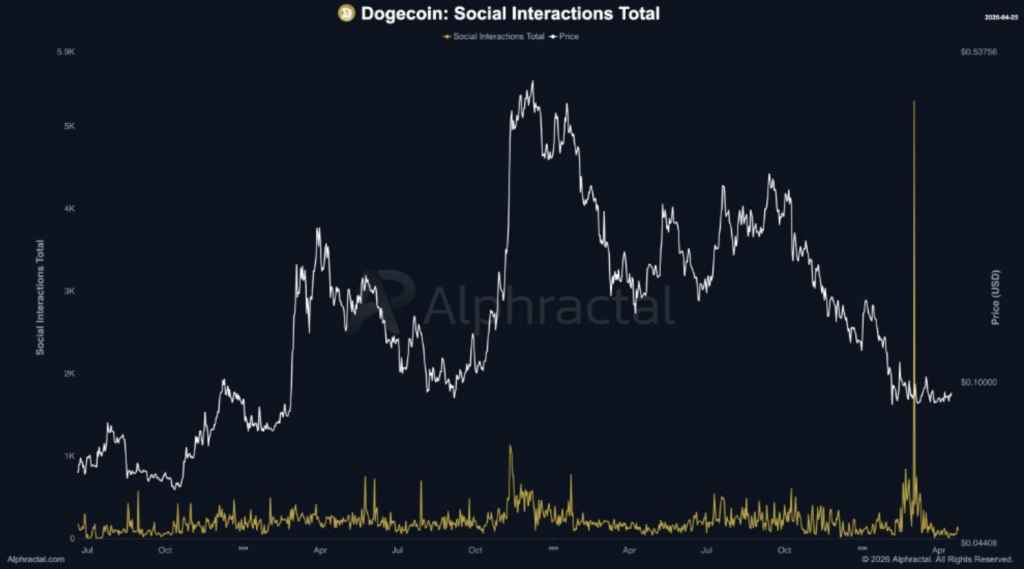
Social Activity Drops, Interest Cools Off
One of the clearer signs comes from social activity, which has been trending downward. Metrics tracking engagement across platforms like X, forums, and search interest are showing less buzz around DOGE. That matters more than it might seem, because for memecoins especially, social attention often fuels price action.
When that activity starts to fade, it usually points to weakening retail interest. And historically, that kind of drop tends to come before either sideways movement or further declines. It’s not a guarantee, of course, but it’s a pattern that shows up often enough to take seriously.
That said, not everything is completely bearish. Some sentiment data suggests a small pocket of optimism remains, with only about 15% of users leaning bearish. So there’s still some belief out there, just… not as loud as before.
Derivatives Activity Rises, But Feels Overextended
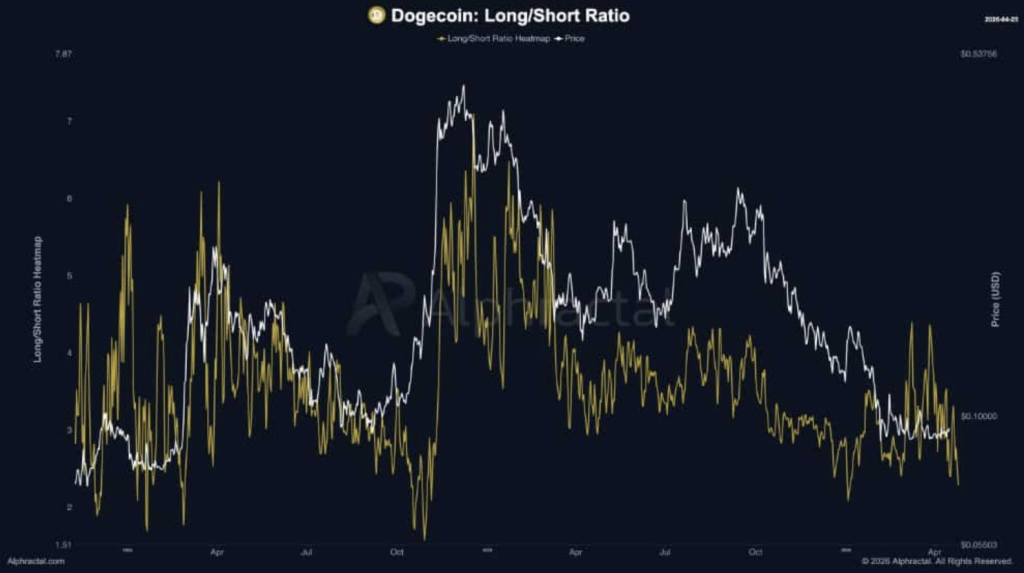
On the flip side, the derivatives market is telling a completely different story. Activity there has picked up quite a bit, with traders increasing exposure through perpetual futures. The long-to-short ratio has climbed to around 2.6, which means long positions are heavily outweighing shorts.
In simple terms, a lot of traders are betting on upside, aggressively so. Funding rates back that up too, sitting in positive territory, which means longs are paying shorts to hold positions. That usually reflects bullish sentiment, at least in the short term.
But here’s the catch, this kind of imbalance can also mean the market is getting a bit crowded on one side. And when that happens, moves can reverse quickly if things don’t go as expected.
Weak Spot Demand Raises Red Flags
While derivatives heat up, the spot market is doing the opposite, cooling down. Participation has dropped, and for the first time in a while, Dogecoin recorded a negative weekly netflow, around $6.4 million more sellers than buyers. That’s not exactly the kind of support you want to see during a potential rally.
This creates a bit of a structural problem. When price moves are driven more by leverage than actual buying, they tend to be fragile. It’s like building momentum on a shaky foundation, it can work for a while, but it doesn’t always hold.
A Market Caught Between Speculation and Reality
Right now, Dogecoin feels stuck in between two forces. On one side, you’ve got rising speculation, traders piling into long positions, expecting a bounce. On the other, real demand is fading, with less social activity and weaker spot flows.
Neither side has fully taken control yet, which leaves the market in a kind of neutral phase. But that divergence, between hype and actual demand, suggests that downside risk is still there, maybe even increasing.
For now, it’s a waiting game. But the imbalance is there, and sooner or later, it usually resolves.