

- S&P 500 perpetual contracts are now available for 24/7 trading on-chain
- Traders can take leveraged positions without expiry using crypto infrastructure
- This signals a major step toward bringing traditional markets into DeFi
The S&P 500 has officially entered the crypto world in a way that feels… pretty significant. Through a new licensing deal, the benchmark index can now be traded as a perpetual contract on-chain, giving investors round-the-clock access to one of the most important financial indicators globally.

Unlike traditional futures, these contracts don’t expire. That means traders can go long or short at any time, using leverage, without worrying about rolling positions. It’s a structure that crypto markets are already familiar with, now applied to traditional finance.
Traditional Markets Meet Crypto Rails
This move is less about adding another trading product and more about merging two financial systems. The S&P 500 has long been the backbone of global equity markets, with trillions in daily exposure across derivatives and ETFs.
Now, that same benchmark is accessible through decentralized infrastructure. Using institutional-grade data from S&P Dow Jones Indices, the product aims to maintain the same standards expected in traditional markets, just delivered through a different medium.
That combination matters. It brings credibility to on-chain trading while expanding access to a broader, digitally native audience.
24/7 Trading Changes the Dynamic
One of the biggest differences here is availability. Traditional stock markets operate within fixed hours, with limited after-hours activity.
On-chain perpetual markets remove those boundaries. Traders can react instantly to global events, macro data, or geopolitical developments without waiting for markets to open.
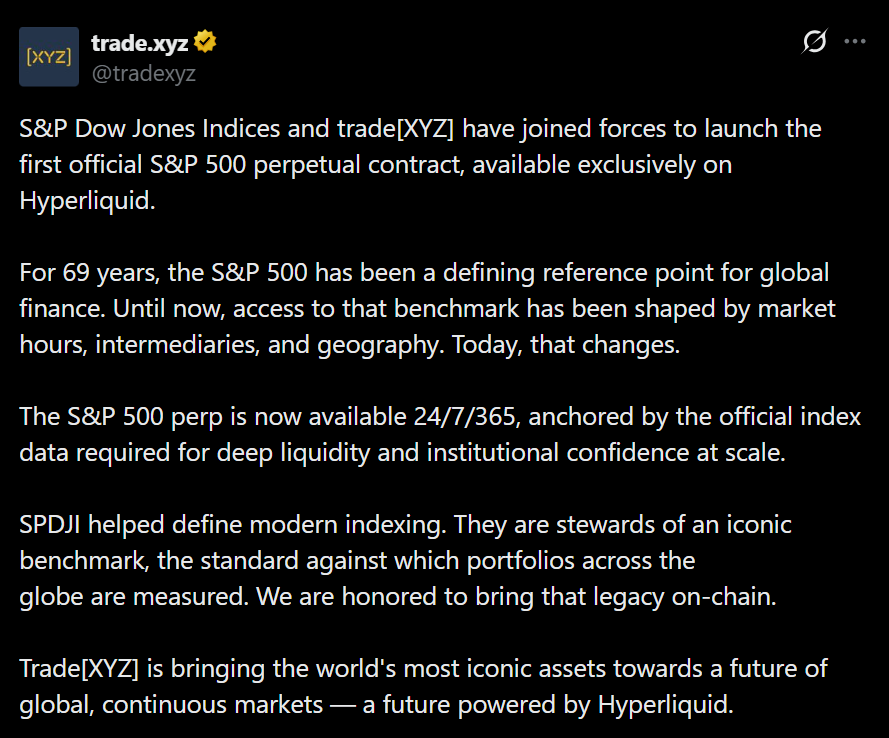
That always-on structure is one of crypto’s defining features, and now it’s being applied to one of the world’s most tracked indices.
The Rise of Real-World Assets On-Chain
This launch fits into a larger trend of tokenizing real-world assets (RWAs). Instead of building entirely new markets, crypto is increasingly pulling existing financial instruments onto blockchain rails.
Platforms like XYZ are positioning themselves at the center of that shift. With over $100 billion in trading volume since late 2025 and rapid growth, they’re proving there’s real demand for on-chain access to traditional assets.
The S&P 500 is just the starting point. If this model gains traction, more indices, commodities, and financial products could follow.
A Glimpse of the Future Market Structure
What’s emerging here is a hybrid system. Traditional financial benchmarks, combined with crypto-native infrastructure, creating markets that are more accessible, flexible, and continuous.
For traders, it opens new opportunities. For the industry, it signals where things might be heading.
The line between traditional finance and crypto is getting thinner… and in some cases, it’s starting to disappear entirely.