- Ripple has invested over $4 billion in acquisitions since 2023
- Major purchases include Metaco, Hidden Road, Rail, and GTreasury
- Each acquisition expands infrastructure designed to support XRP adoption
Over the past few years, Ripple hasn’t just been fighting legal battles or pushing partnerships — it’s been quietly assembling something much bigger. Since 2023, the company has deployed more than $4 billion into acquisitions spanning custody, brokerage services, payments infrastructure, and treasury management software.
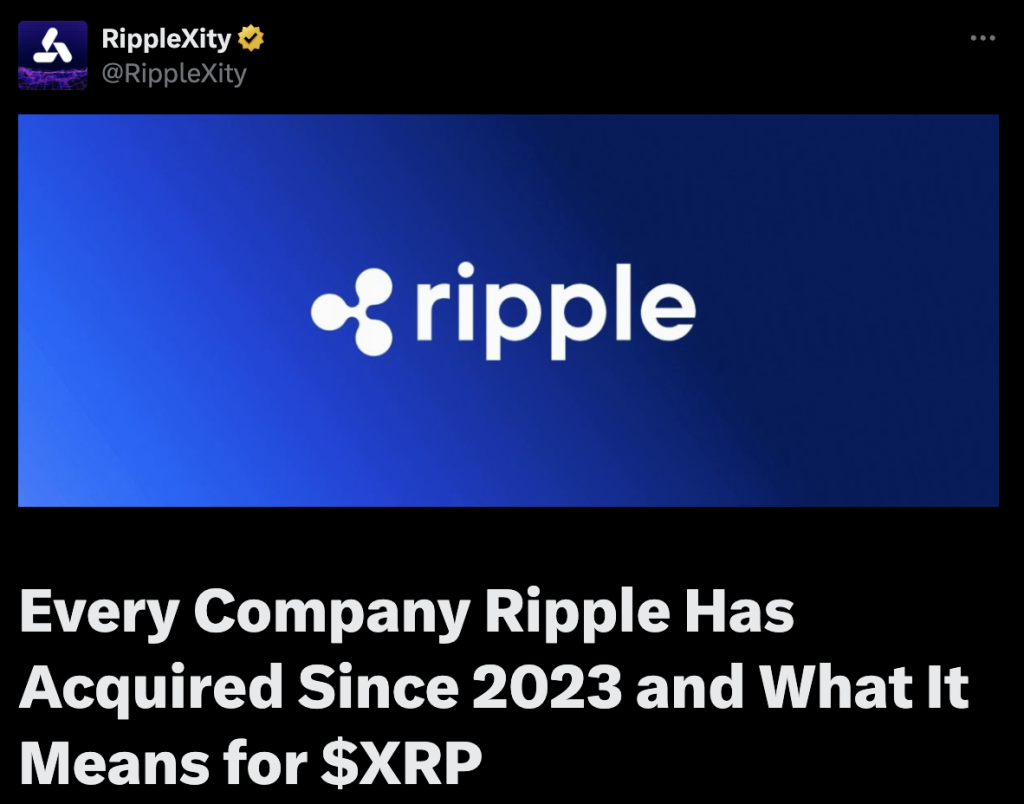
One community researcher on X, known as “RippleXity,” recently broke down the timeline of those deals and what each one brings to Ripple’s ecosystem. Taken together, they paint a clear picture. Ripple isn’t buying companies randomly. It’s stacking pieces of financial infrastructure.
And if CEO Brad Garlinghouse’s recent comments are any indication, the spending spree might not be finished yet. He hinted that 2026 could become another major expansion year.
2023: Building the Institutional Foundation
Ripple’s acquisition push really began in 2023, starting with a move that immediately caught the attention of traditional finance.
The company acquired Metaco in May 2023 for $250 million. Metaco is a major digital asset custody platform already trusted by several global banks. For Ripple, the deal added instant credibility with institutional clients.
More importantly, it created a secure and regulated pathway for institutions to hold digital assets — including XRP. Banks and asset managers generally won’t touch crypto unless custody is handled properly. Metaco solved that problem almost overnight.
A few months later, Ripple picked up Fortress Trust in September 2023. The purchase price wasn’t publicly disclosed, but the strategic value was obvious.
Fortress Trust came with regulatory licenses and compliance infrastructure inside the United States. That matters because regulatory clarity has long been one of the biggest barriers preventing institutions from engaging with XRP.
With Fortress in the picture, Ripple suddenly had stronger footing inside the U.S. regulatory environment.
2024: Expanding Regulated Custody
Ripple’s next move came in 2024 with the acquisition of Standard Custody, a New York-regulated digital asset trust company.
New York’s regulatory framework — particularly the BitLicense — is widely considered one of the strictest crypto regulatory systems in the world. Obtaining access to that framework gives Ripple something extremely valuable: legitimacy in the largest financial hub in the United States.
For XRP, that translates into something simple but powerful. Financial institutions now have regulated channels through which they can store, settle, and potentially move XRP.
And in traditional finance, access matters almost as much as demand.
2025: Ripple’s Biggest Acquisition Year
If 2023 and 2024 were about building foundations, 2025 was about scaling the infrastructure. Ripple closed four major deals in a single year, spending well over $2 billion in the process.
The largest acquisition came in April 2025 when Ripple purchased Hidden Road for $1.25 billion. Hidden Road operates as a prime brokerage platform — essentially a bridge connecting large institutional traders to financial markets.
Prime brokers play a crucial role in liquidity. By acquiring Hidden Road, Ripple made it easier for large institutions to access and trade assets like XRP.
Liquidity attracts participation. And participation often supports price stability.
A few months later, Ripple acquired Rail for $200 million. Rail specializes in stablecoin payment infrastructure, something that fits neatly into Ripple’s broader cross-border payments vision.
Stablecoins and XRP can work together inside settlement systems. When the rails connecting them are optimized — or owned — by the same company, the entire system becomes faster and more efficient.
In October 2025 Ripple made another huge move, acquiring corporate treasury platform GTreasury for roughly $1 billion.
GTreasury is widely used by multinational corporations to manage their financial operations. That connection is extremely important. If companies already use GTreasury to handle their treasury functions, adding XRP-based payment capabilities becomes far easier.
It’s not a new system. It’s simply a feature upgrade.
Ripple’s final deal of the year came in November with the acquisition of Palisade, a London-based digital asset custody provider. While the price was not disclosed, the strategic value is clear.
Palisade expands Ripple’s custody and security infrastructure into Europe — one of the world’s largest financial markets.
2026: Ripple Looks Toward Asia-Pacific
Ripple’s next expansion appears to be heading toward the Asia-Pacific region.
The company has announced plans to acquire BC Payments Australia, a payments firm that holds an Australian Financial Services License. If completed, the deal would strengthen Ripple’s regulatory presence across one of the fastest-growing digital asset markets in the world.
Australia has become an increasingly active hub for blockchain development and crypto adoption. A regulated payments foothold there could allow XRP-based settlement systems to operate through official financial channels across the region.
In cross-border finance, geography still matters.
The Bigger Strategy Behind Ripple’s Acquisitions
Viewed individually, each acquisition looks like a strategic improvement in a specific area — custody, brokerage, payments, treasury systems, compliance.
But taken together, they reveal something larger.
Ripple is constructing what could eventually become a full-stack financial network built around digital assets. Every component plays a role. Custody platforms allow institutions to safely store XRP. Prime brokerage connects institutional traders to liquidity. Treasury software integrates XRP into corporate finance. Regulatory licenses allow everything to operate within existing financial rules.
Each acquisition removes another barrier.
And that appears to be Ripple’s core strategy: build the infrastructure first, then let adoption follow naturally.
Three years, seven companies, and more than $4 billion later… the network is starting to take shape.