

- Bitcoin currently carries a harsh 1250% risk weighting under Basel rules
- The rule forces banks to hold full capital against any BTC exposure
- A new Federal Reserve proposal could open banks to Bitcoin services
Most investors rarely think about Basel banking rules, but these regulations quietly shape what assets banks are allowed to hold. The framework was created after the 2008 financial crisis to ensure financial institutions maintain enough capital to withstand risky exposures. In simple terms, the riskier an asset is considered, the more capital banks must set aside to support it.
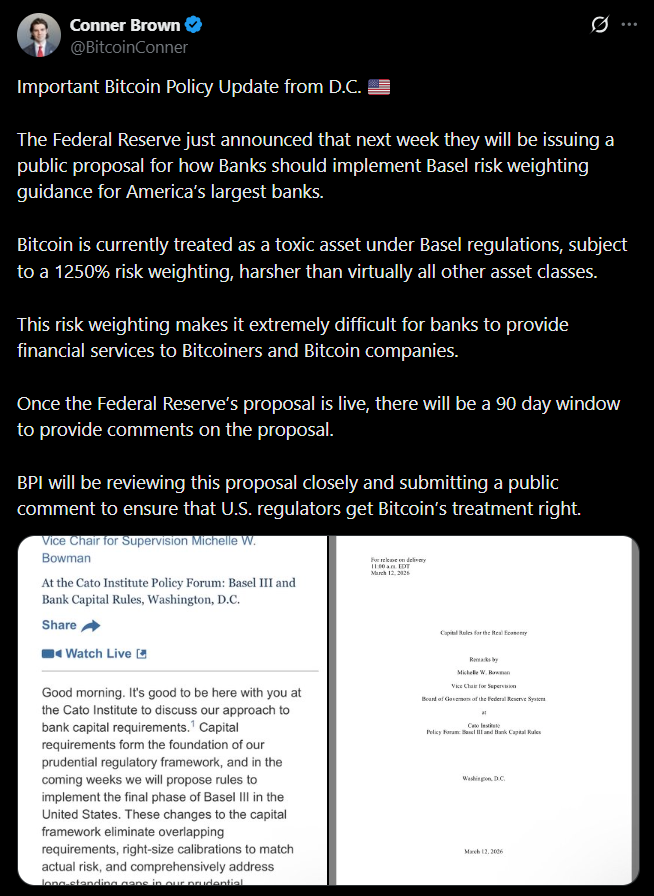
Right now, Bitcoin sits in the most restrictive category within this system. Under Basel guidelines, unbacked cryptocurrencies such as BTC receive a 1250% risk weight. That effectively means banks must treat every $1 of Bitcoin exposure as if it represented $12.50 in risk, making the asset extremely costly to hold on a balance sheet.
The Rule That Has Kept Banks Away From Bitcoin
This capital requirement creates a major barrier for banks considering Bitcoin exposure. If a financial institution wanted to hold $100 million worth of BTC, it would need to allocate roughly the same amount in regulatory capital to support that position.
Because that capital cannot be used for lending or other revenue-generating activities, the economics rarely make sense for banks. As a result, many institutions simply avoid direct Bitcoin exposure altogether.
This restriction has also shaped the structure of the crypto industry. Services that banks might normally provide, such as custody, lending, or market-making, have largely been handled by crypto-native companies instead.
The Federal Reserve Proposal Could Change the Landscape
That situation could soon shift. The Federal Reserve is expected to release a proposal outlining how the United States will implement the Basel crypto capital rules for major banks.
Even modest adjustments to the 1250% risk weighting could dramatically change how banks interact with Bitcoin. If regulators soften the requirement or provide a more flexible interpretation, financial institutions may finally gain the ability to integrate Bitcoin services into traditional banking operations.
This could include Bitcoin custody for institutional clients, BTC-backed lending products, and internal trading desks within major banks.

Institutional Capital Could Flow More Easily
Greater regulatory clarity would likely make it easier for banks to participate directly in crypto markets. Once institutions can hold Bitcoin more efficiently on their balance sheets, they may also begin building financial products around the asset.
That shift could increase liquidity across the market as traditional finance infrastructure begins connecting more closely with the crypto ecosystem.
Banks already manage trillions of dollars in assets globally. Even small allocations toward Bitcoin could significantly influence market dynamics over time.
Bitcoin’s Relationship With Banks May Be Changing
For years, Bitcoin has existed largely outside the traditional banking system. The reason was not necessarily a lack of interest from financial institutions but rather regulatory rules that made participation difficult.
If the Federal Reserve ultimately softens the Basel treatment of Bitcoin, the asset could gradually move closer to becoming a standard financial instrument held on bank balance sheets.
Such a shift would not transform the market overnight. But it could mark an important step toward deeper integration between traditional finance and the broader crypto economy.