

- Many corporate Bitcoin holders are currently underwater on their BTC positions
- Companies continue accumulating despite short-term market pressure
- Forecasts suggest Bitcoin could rebound toward $89K in 2026
Bitcoin has spent the last few years becoming the primary digital asset for corporations and institutions exploring crypto exposure. Massive capital inflows, ETF demand, and growing global awareness pushed the asset to the center of the financial conversation. But recent geopolitical tensions and broader bearish sentiment have slowed momentum, with BTC currently hovering around the $70,000 level.
The drop has been significant when compared to its earlier all-time high near $120,000. That pullback has created visible pressure for companies that accumulated Bitcoin during higher price periods. While the correction has triggered concerns across the market, it has also highlighted something interesting, Bitcoin is still holding relatively strong despite intense macroeconomic pressure.
Corporate Bitcoin Holders Are Feeling the Pressure
Corporate treasury strategies built around Bitcoin are now under scrutiny as prices remain below earlier highs. According to analysis shared by crypto analyst Crypto Patel, roughly 77% of Bitcoin treasury companies are currently sitting on unrealized losses.
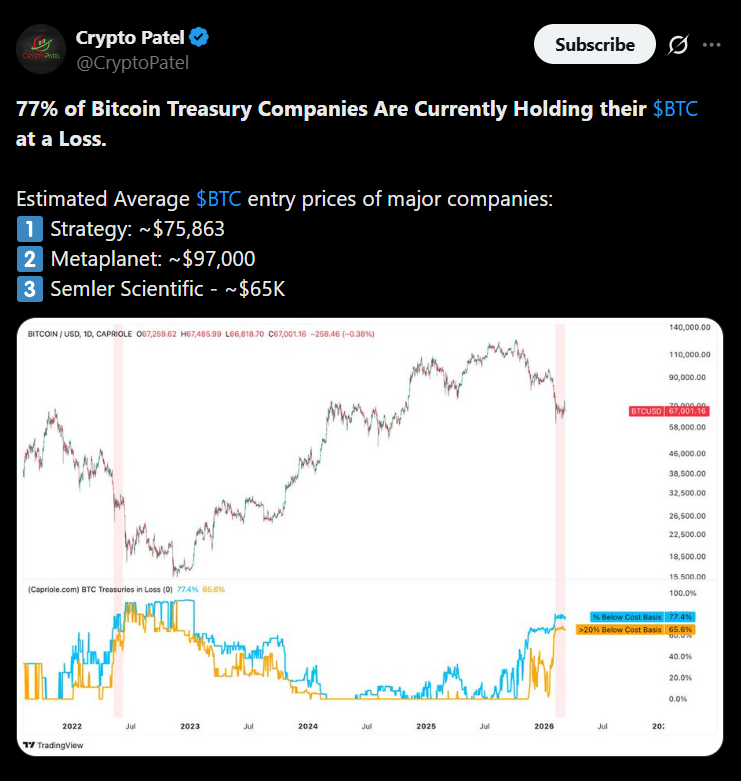
Some of the most well-known corporate buyers entered at higher levels. MicroStrategy’s estimated average entry price sits near $75,000, while companies like Metaplanet reportedly accumulated Bitcoin around $97,000. Semler Scientific’s average position is believed to be around $65,000.
Those numbers mean several major corporate holders are currently underwater or barely breaking even. Even so, most of these firms have not shown signs of abandoning their Bitcoin strategies.
Bitcoin Resilience Continues to Stand Out
Despite the pressure on corporate balance sheets, Bitcoin has continued to demonstrate notable resilience. Retail demand and long-term holders appear to be absorbing much of the selling pressure, helping the asset stabilize around the $70,000 range.
Historical context also helps explain the optimism surrounding BTC. During the COVID-19 market crash in March 2020, Bitcoin plunged roughly 53% in a single day, falling from around $8,000 to nearly $3,700. At the time, many critics declared the end of crypto.
Today, Bitcoin trades nearly twenty times higher than those levels. The comparison serves as a reminder that extreme volatility has always been part of Bitcoin’s lifecycle, while long-term adoption has continued to expand.
Companies Are Still Accumulating Bitcoin
Interestingly, corporate interest in Bitcoin has not slowed as much as some analysts expected. According to market observers, companies such as Strategy, Strive Asset Management, and Capital B continue exploring or expanding their Bitcoin exposure even amid market uncertainty.

For these firms, Bitcoin is increasingly viewed as a long-term strategic asset rather than a short-term trade. The willingness to accumulate during periods of weakness is often interpreted by investors as a sign that institutional conviction in the asset remains strong.
Forecasts Suggest a Potential Recovery Ahead
Looking ahead, several models suggest Bitcoin may regain momentum over the next few years. Data from CoinCodex estimates that BTC could rise toward approximately $89,000 around June 2026 if market conditions stabilize.
Long-term projections are even more ambitious. Some models place Bitcoin around $80,000 by the end of 2026, roughly $166,000 by 2030, and potentially close to $1 million by 2040 if global adoption continues accelerating.
While these projections remain speculative, they reflect the growing belief that Bitcoin’s long-term trajectory remains upward despite periodic corrections. If institutional accumulation continues and macroeconomic conditions improve, the next breakout phase could arrive sooner than many expect.