
- Retail investors are leading the latest wave of Bitcoin distribution
- On-chain data shows aggressive short-term selling across wallet groups
- Bitcoin holding near $70K signals strong underlying demand
Recent on-chain data from Glassnode suggests that Bitcoin holders across multiple wallet cohorts have shifted toward aggressive selling. The move comes as geopolitical tensions in the Middle East continue to create uncertainty across global markets. Yet even with distribution increasing, Bitcoin’s price action is telling a slightly different story, one that hints at deeper resilience underneath the surface.

Glassnode’s Accumulation Trend Score, a metric that tracks whether wallet groups are buying or selling, has fallen to around 0.04. That number signals strong net distribution across the network over the past couple of weeks. The score takes into account both the size of entities and how much Bitcoin they have accumulated during the previous 15 days.
Retail Investors Lead the Current Selling
Breaking down the data reveals that smaller holders appear to be driving most of the selling pressure. Wallets holding between 1 and 10 BTC, typically associated with retail investors, have entered heavy distribution territory. This group often reacts quickly to macro uncertainty, and geopolitical risks seem to be pushing many of them to reduce exposure for now.
Entities holding between 10 and 100 BTC are also selling at a noticeable pace. Even some larger participants are contributing to the trend. Wallets controlling 1,000 BTC or more have also moved into net selling mode, although their distribution appears less aggressive compared with the activity seen among smaller holders.
Bitcoin Shows Strength Despite Macro Pressure
What makes the current situation interesting is how Bitcoin is behaving relative to traditional macro assets. The U.S. dollar index has climbed above 99.5, the U.S. 10-year Treasury yield has risen to a one-month high above 4.2%, and Brent crude oil is hovering around the $100 mark. Under normal circumstances, this combination of a strong dollar, rising yields, and high energy prices creates strong headwinds for risk assets.
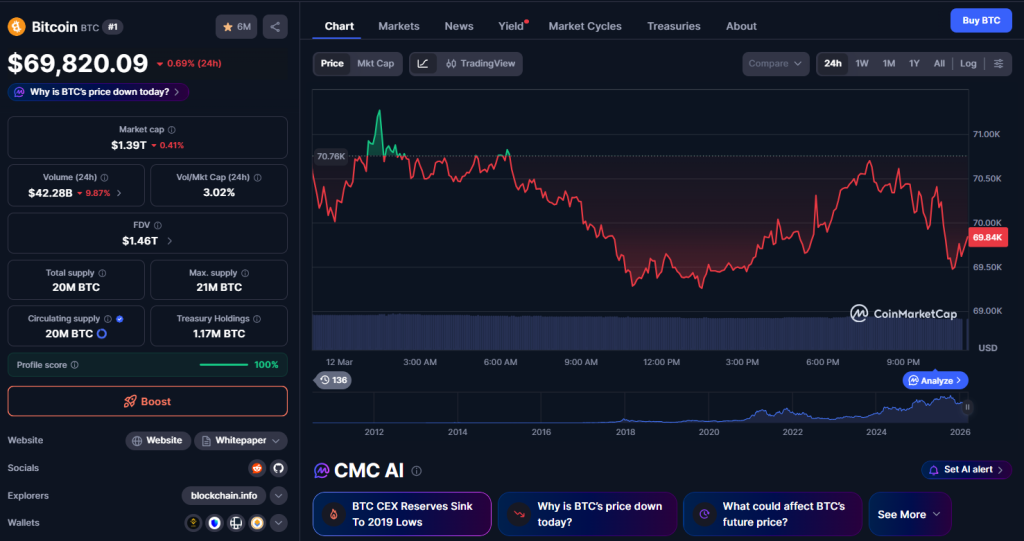
Yet Bitcoin has managed to hold near the $70,000 level even as on-chain metrics show short-term selling. That stability suggests that demand is quietly absorbing supply in the background. Institutional flows, long-term holders, and global investors may be stepping in where short-term traders are stepping out.
Distribution Cycles Often Precede Stronger Moves
Historically, periods of broad distribution do not always signal long-term weakness for Bitcoin. In many cases, they represent market rotation, where short-term participants exit while stronger hands accumulate quietly over time. These transitions can create temporary volatility but often reset the market structure before the next major move.
For now, the key takeaway is that Bitcoin’s ability to remain near major price levels despite macro pressure and active selling suggests underlying strength. Markets are still digesting geopolitical risk, but the foundation of demand appears to be holding steady.