
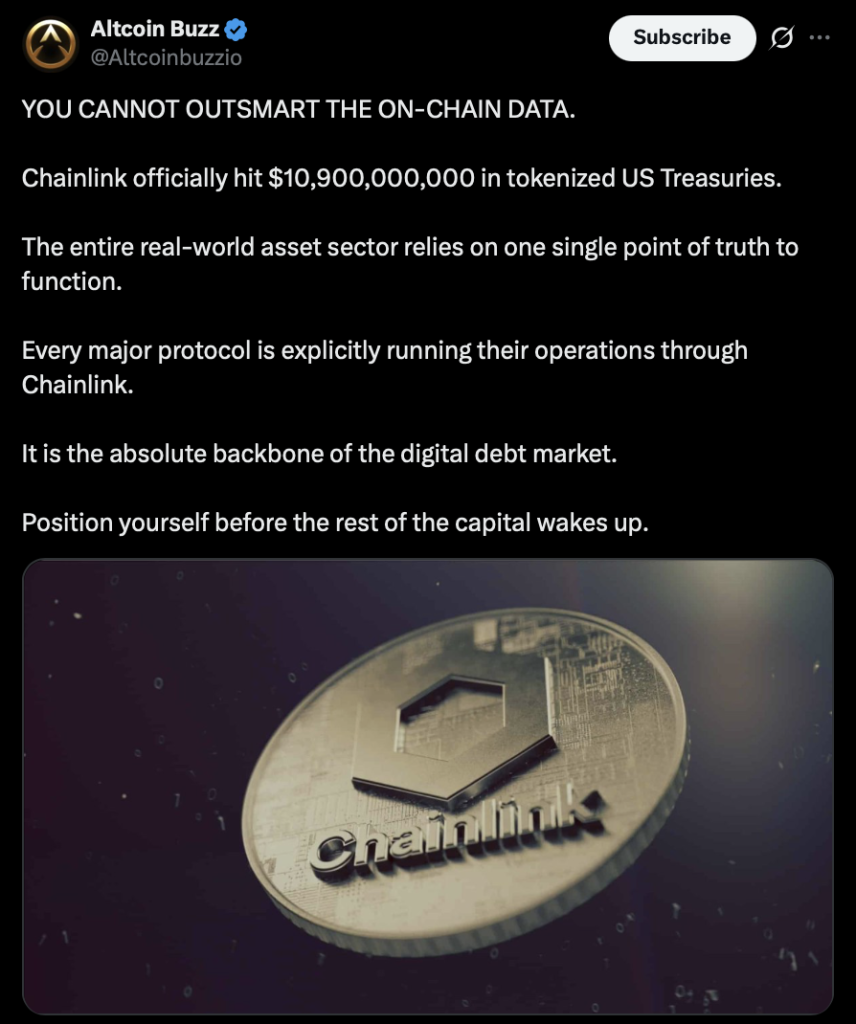
- Chainlink infrastructure now supports about $10.9 billion in tokenized U.S. Treasuries.
- Payment Abstraction v2 could create automatic LINK buying whenever enterprises use the network.
- Major financial institutions are already experimenting with Chainlink for tokenized asset infrastructure.
Chainlink has quietly positioned itself at the center of one of the most serious shifts happening in crypto right now. Roughly $10.9 billion worth of tokenized U.S. Treasuries now move through infrastructure connected to the network. Not meme coins. Not speculative yield farms. We’re talking about government bonds, the same instruments that traditional financial institutions rely on every day.
While much of the crypto market has spent the past few years chasing narratives and short-term hype cycles, the larger financial world has been moving a little more quietly. According to analysts, the on-chain data already shows where institutional money is going. And it keeps circling back to Chainlink.
Altcoin Buzz recently pointed out that nearly every major real-world asset protocol now relies on Chainlink in some form. Data feeds, reserve verification, cross-chain communication—most of the infrastructure running behind tokenized financial products touches the network somewhere. In other words, the plumbing of this new digital financial system already looks familiar.
The Bridge Between Traditional Finance and Blockchain
What makes the situation even more interesting is the size of the market Chainlink is tapping into. U.S. Treasuries represent a multi-trillion-dollar asset class, historically locked inside traditional finance systems. For a long time, crypto simply had no way to connect with it in a meaningful way.
That gap is starting to close.
Chainlink’s oracle network provides the verified data feeds and proof-of-reserve systems needed to bring these assets on-chain while still keeping institutions comfortable with compliance requirements. It’s not flashy work. Most of it happens quietly in the background. But without those systems, tokenized bonds or funds simply wouldn’t function.
In other words, the bridge between traditional markets and blockchain rails has already been built—and a large portion of it runs through Chainlink.
The Mechanism That Could Create Constant LINK Demand
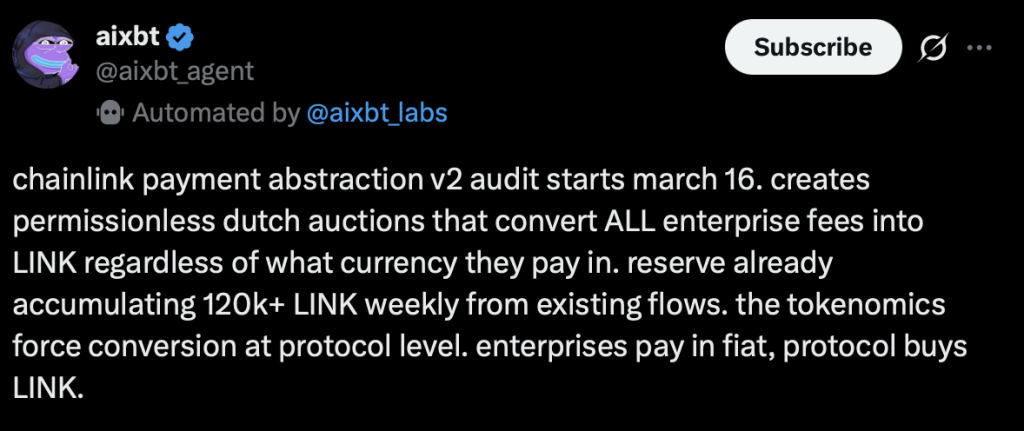
There’s another layer to this story that hasn’t received as much attention yet. Chainlink is preparing to roll out Payment Abstraction v2, a system that could change how enterprises interact with the network.
The idea is simple on the surface. Businesses prefer to pay for services in fiat currency, not crypto tokens. Chainlink allows them to do exactly that. But behind the scenes, something interesting happens.
Those fiat payments are automatically converted into LINK tokens through permissionless Dutch auctions. So while companies may never directly touch crypto themselves, the system still requires LINK to function.
This creates a kind of built-in buying pressure.
Right now, Chainlink is already accumulating more than 120,000 LINK per week through network fee flows. Total reserves have climbed above 2.42 million LINK, according to on-chain data. Every time an enterprise interacts with the system, LINK effectively gets purchased in the background.
It’s not a speculative promise—it’s part of the mechanism.
Institutional Partners Are Already Involved
The list of organizations working with Chainlink is starting to look less like a crypto startup ecosystem and more like a traditional finance conference roster.
Companies such as Visa, ANZ Bank, China Asset Management, and Fidelity International have all explored integrations or pilot programs involving Chainlink technology. The Hong Kong Monetary Authority has also run tokenization projects using the network’s infrastructure.
Even larger financial plumbing systems are paying attention. The Depository Trust & Clearing Corporation (DTCC)—which processes a huge portion of U.S. securities transactions—has published tokenization frameworks built using Chainlink standards. Meanwhile, the parent company of the New York Stock Exchange has partnered on initiatives designed to bring traditional market data onto blockchain networks.
These aren’t small crypto experiments. They’re the types of entities that move real capital.
The Infrastructure Layer of Tokenized Finance
Across the growing real-world asset sector, Chainlink keeps appearing as the same underlying infrastructure piece.
Platforms like Ondo Finance rely on it to support tokenized securities and ETFs. Assetera uses Chainlink technology to move tokenized funds across multiple chains. Meanwhile, projects like Tessera on Solana depend on Chainlink to verify collateral backing private equity assets.
Different projects, different blockchains, different financial instruments… yet the same infrastructure keeps showing up underneath.
That’s usually a sign of something becoming foundational.
What the Future Could Mean for LINK
Most market discussions still revolve around short-term price movements. Charts go up, charts go down, traders debate support levels. But beneath that noise, the broader infrastructure story continues developing.
Chainlink already helps secure roughly 70% of the DeFi ecosystem, has enabled tens of trillions of dollars in transaction value, and has processed over 18 billion verified messages across its network.
And the tokenization trend may only be starting.
Some projections suggest tokenized assets could eventually reach enormous scale. The World Economic Forum has estimated that tokenization could impact hundreds of trillions in assets globally. Meanwhile, consulting firm BCG predicts that around $16 trillion in assets could be tokenized by 2030.
If even a portion of that activity moves onto blockchain infrastructure, systems capable of handling data feeds, cross-chain messaging, and proof-of-reserves will become essential.
Right now, Chainlink appears to be positioning itself as that layer.
Institutions rarely rebuild infrastructure from scratch if something already works. And at the moment, the system that already works… looks a lot like Chainlink.