

- Cardano has struggled to keep pace with major crypto assets during the latest market cycle.
- Analysts argue low DeFi activity and limited on-chain usage may be holding the network back.
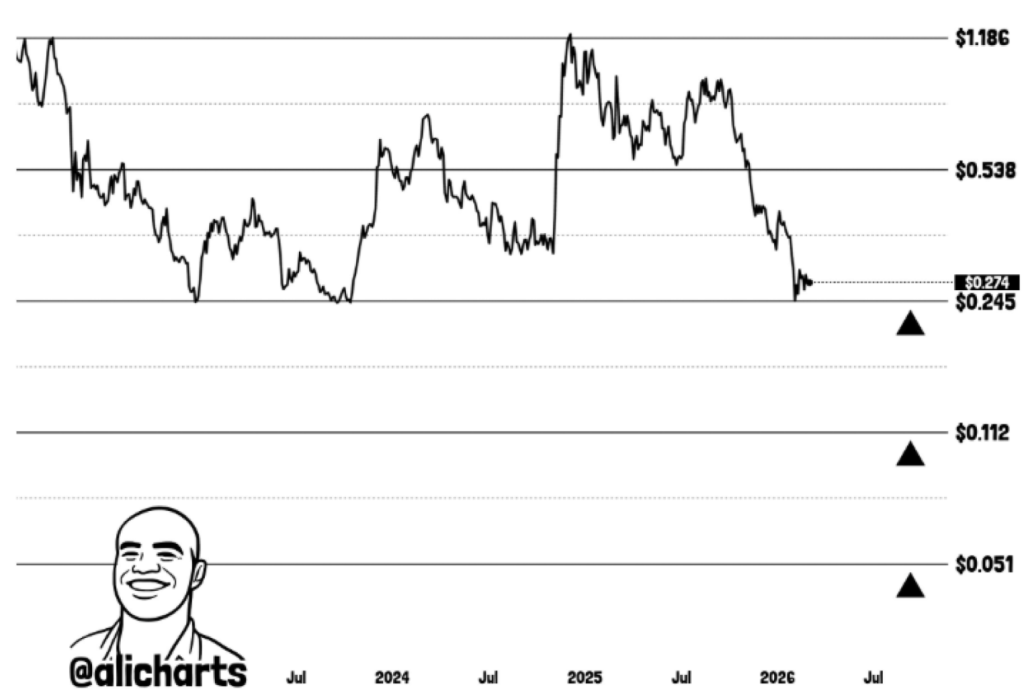
- Key technical support for ADA sits near $0.245, with deeper downside possible if it breaks.
Cardano has had a noticeably harder time keeping pace with the broader crypto market over the past cycle. While major assets like Ethereum, XRP, and Solana managed to either break their previous all-time highs or come very close, ADA never quite got there. The token stayed well below its 2021 peak near the $3 mark, and that lingering gap has left a fair number of investors scratching their heads, wondering what exactly went wrong.
For a project that spent years building and refining its technology, many expected stronger market performance once the broader bull run returned. Instead, momentum seemed to stall just when other ecosystems were accelerating. And according to some analysts, the explanation might lie deeper than price charts alone.
Analysts Point to Low Network Usage
Crypto analyst Ali Martinez recently shared a fairly blunt assessment of the situation in a thread on X. In his view, Cardano’s biggest challenge may not be short-term market sentiment, but rather the level of real activity taking place on the network itself.
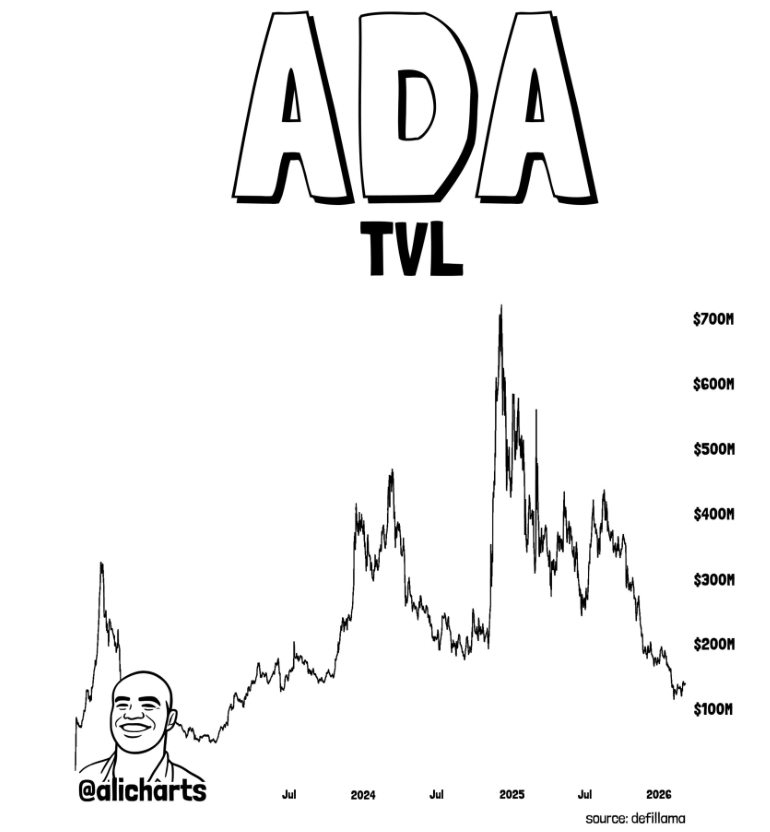
One of the metrics he highlighted was total value locked, or TVL, within Cardano’s decentralized finance ecosystem. At its peak, the network has never managed to push beyond roughly $1 billion in locked capital across its DeFi applications. That figure represents the total amount of funds currently being used in lending platforms, decentralized exchanges, and other blockchain-based financial tools.
On its own, a billion dollars sounds substantial. But once you compare it to competing ecosystems, the number suddenly feels… much smaller.
Rival Networks Continue Pulling Ahead
Ethereum, for example, hosts tens of billions of dollars in DeFi capital spread across a wide range of protocols, from lending markets to derivatives platforms. Even several newer networks have managed to grow faster in terms of ecosystem activity. Martinez pointed out that Sui, a relatively recent entrant in the blockchain space, has already surpassed Cardano in certain metrics tied to on-chain usage.
That raises a broader question about valuation. If a blockchain is worth tens of billions of dollars in market capitalization, yet only a fraction of that value is actively circulating within its ecosystem, some critics argue that price could be driven more by speculation than by organic demand.
That’s essentially the core argument Martinez is making — the gap between market value and network activity may simply be too wide.
Slow Development and Technical Risks
Part of the issue may come down to Cardano’s development philosophy. The project is built around a research-first model that emphasizes peer-reviewed academic work and formal verification before features are released. Supporters say this leads to more secure systems and fewer catastrophic bugs.
But the trade-off is speed.
Although Cardano first launched in 2017, smart contracts did not arrive until 2021. By that time, competing networks had already spent years building developer ecosystems, attracting capital, and growing user communities. Ethereum strengthened its dominance in decentralized finance, while Solana gained traction through high-performance applications and consumer-focused platforms.
Once a blockchain ecosystem gains momentum, it tends to compound quickly. More developers attract more applications, which in turn bring in more users and capital. And that cycle can be difficult for slower networks to break into later.
From a technical trading perspective, Martinez also pointed to an important support level around $0.245 for ADA. If the price were to fall below that zone, he suggested the next potential downside targets could appear near $0.112 or even $0.051. That scenario would imply a steep drop, possibly between 50% and 80% from the support level.
For now, that breakdown hasn’t happened. Still, the level remains one many traders are watching carefully, especially as the debate around Cardano’s long-term adoption — and whether it can regain momentum — continues.