

- BlackRock blocked $1.2 billion in withdrawals from private credit funds, raising concerns about liquidity pressure.
- The move comes as the private credit sector shows signs of stress, with BDCs trading at about 73% of their net asset value.
- Because BlackRock manages major Bitcoin ETFs, investors are watching whether financial stress could impact crypto markets.
Sometimes it’s the smallest signals that make people uneasy about the broader economy. A few numbers here, a sudden policy change there… and suddenly the market starts asking uncomfortable questions.
That’s roughly what’s happening with BlackRock right now. The world’s largest asset manager — overseeing trillions in assets and roughly $26 billion tied up in private credit funds — recently blocked about $1.2 billion in investor withdrawals. On the surface, that might sound like routine fund management. But to many observers, it feels like something else entirely.
And naturally, the crypto crowd noticed.
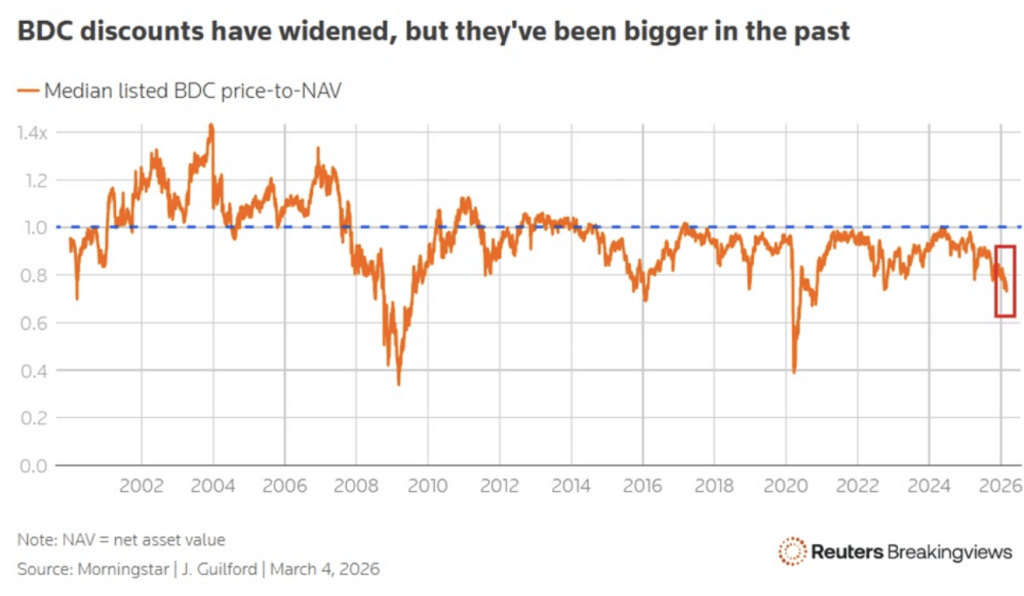
Private Credit Market Showing Signs of Stress
BlackRock isn’t the only name being discussed in this context. Analysts from The Kobeissi Letter recently highlighted concerns that the private credit sector may be heavily overvalued.
One example comes from Business Development Companies, often referred to as BDCs. According to recent market data, these firms are currently trading at about 0.73 times their reported net asset value.
In simpler terms, the market is valuing them at roughly 73% of what their assets are supposedly worth.
That gap tends to raise eyebrows. When investors start discounting valuations that heavily, it usually signals declining confidence in the sector’s underlying stability.
And BlackRock, despite its size, doesn’t seem immune to the pressure.
Liquidity Pressures Begin to Surface
The decision to restrict $1.2 billion in withdrawals has fueled speculation that liquidity inside certain private credit funds may be tightening.
Funds often place withdrawal limits when too many investors try to exit at the same time. It’s not unheard of. Still, when a firm as large as BlackRock makes that move, people tend to pay attention.
Some analysts believe the shift reflects broader economic stress — including disruptions caused by rapid technological changes, particularly those tied to artificial intelligence reshaping industries.
Whether or not AI is the main driver, one thing is clear: liquidity across several financial sectors appears to be getting thinner.
Market Reacts Quickly to the News
Investors didn’t wait long to respond.
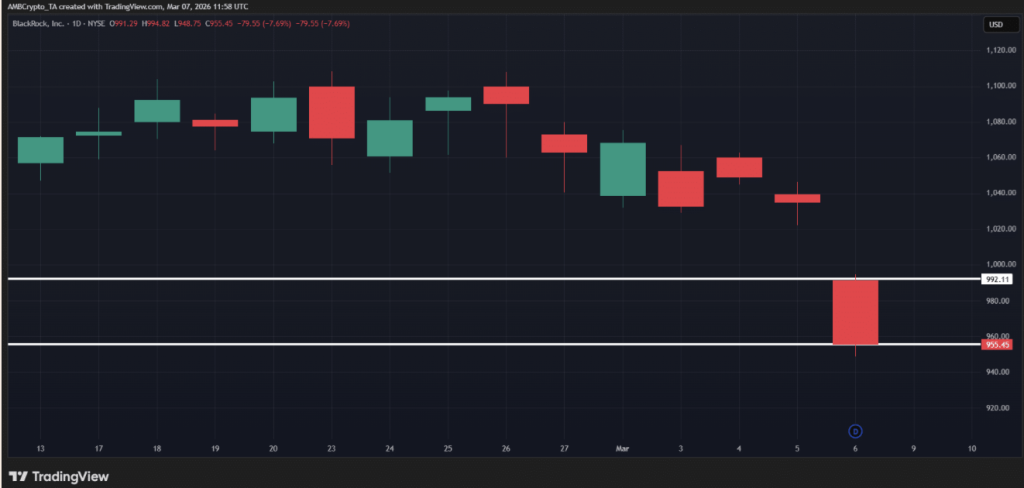
Following the withdrawal restrictions, BlackRock shares dropped sharply, closing the session down about 7.69%. That decline marked the largest single-day sell-off the stock has seen during the current cycle.
In fact, the move exceeded the decline BlackRock experienced during the broader market turbulence of late 2025.
When a financial giant takes that kind of hit, the ripple effects rarely stay confined to one sector.
Why Crypto Investors Are Paying Attention
For the crypto market, the situation introduces a new layer of uncertainty.
BlackRock isn’t just another financial institution. It’s also the largest manager of Bitcoin exchange-traded funds, including the widely followed IBIT spot Bitcoin ETF.
That connection raises a question traders are now debating quietly: if liquidity pressures continue building inside traditional finance, could asset managers begin shifting capital — or even selling positions — to stabilize their balance sheets?
There’s no clear evidence that anything like that is happening yet. But markets often react to possibility just as much as reality.
Institutional Confidence Could Become the Key Factor
If BlackRock’s share price continues sliding, it may signal a broader loss of confidence among institutional investors. And when institutions begin adjusting risk exposure, those shifts tend to spread across multiple asset classes.
Risk assets are usually the first to feel that pressure.
In that environment, outflows from Bitcoin ETFs could increase. Such a move might simply reflect portfolio rebalancing or capital preservation strategies. Still, even routine adjustments from firms this large can shake sentiment across the crypto market.
For now, the situation remains fluid.
But when liquidity starts tightening at the very top of the financial system… traders everywhere, crypto included, tend to start watching a little more closely.