

- Cardano dropped sharply alongside Bitcoin but found short-term support near $0.267
- Elevated open interest suggests bears still dominate, despite whale accumulation
- Holding current support is critical to avoid a much deeper downside scenario
The broader crypto market took another heavy hit as Bitcoin slid toward the $75k zone, and Cardano was pulled down with it. ADA dropped roughly 6% in a single day on February 2, briefly touching $0.267 before finding some footing. A small rebound followed, pushing price back toward $0.28, but the move did little to calm nerves across the market.
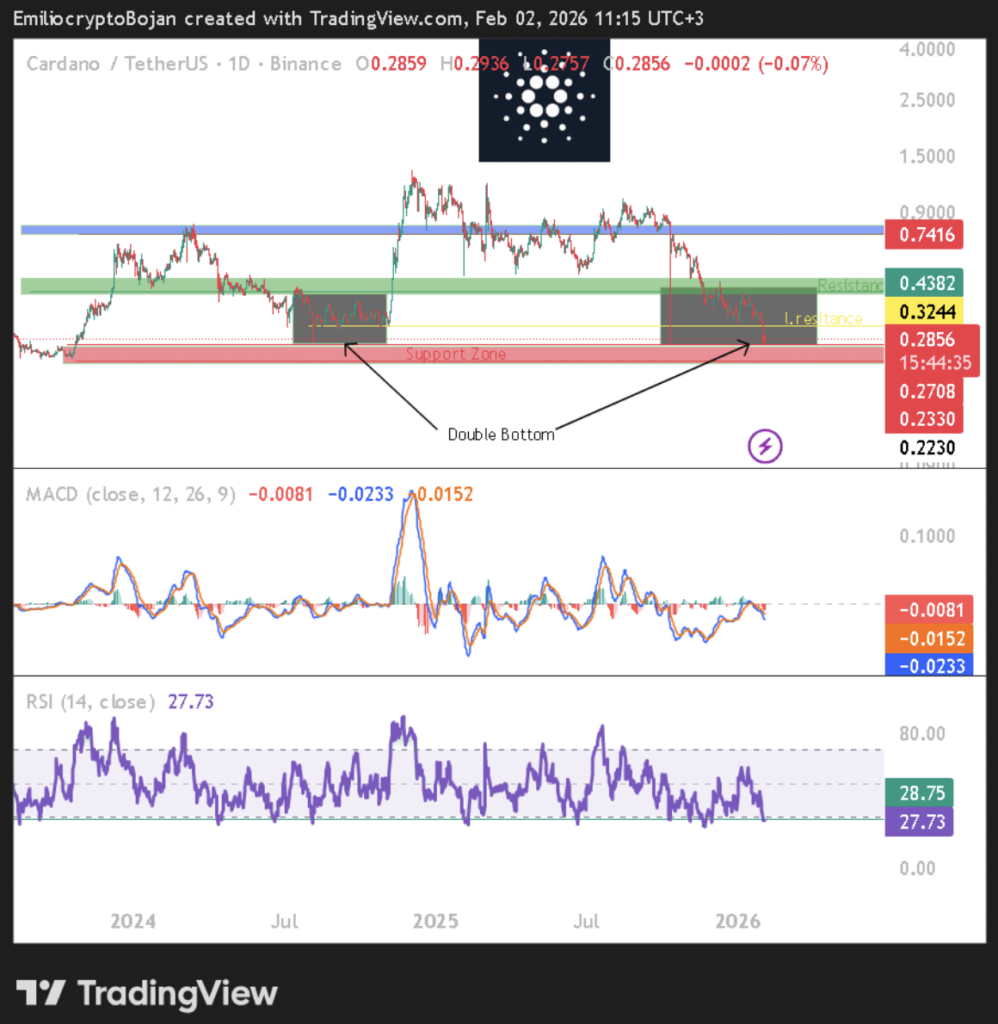
What made this dip uncomfortable was the context. The RSI fell below 30, a level that has historically marked bottoms below $0.30, yet previous rebounds from these zones were anything but smooth. Volatility followed almost every bounce, and this time didn’t feel much different, at least not yet.
A critical psychological shift for ADA traders
The breakdown below $0.30 marked a turning point for sentiment. For months, many traders treated dips into this range as straightforward buying opportunities. That confidence has started to crack, especially as the broader market remains under pressure and Bitcoin struggles to stabilize.
History hasn’t always been kind to early dip buyers during prolonged downtrends. While sharp rebounds are possible, they often come with false starts and quick reversals. That’s the tension hanging over Cardano right now, optimism versus exhaustion, and neither side has fully won.
Open interest stays high as bears dominate positioning
On February 2, Cardano’s open interest remained elevated even as price failed to move higher. In fact, OI had stayed consistently high throughout the entire decline, which is usually a warning sign rather than a bullish one. By mid-January, ADA’s open interest had surged to around $840 million, an eye-catching figure given the weak price action.
This increase wasn’t driven by bullish conviction. Instead, it reflected heavy bearish positioning, with traders leaning into downside momentum rather than betting on a recovery. A move back toward $0.32 alongside rising OI would suggest bulls stepping in with force, but until then, control still looks tilted toward sellers.
Whales quietly accumulate into weakness
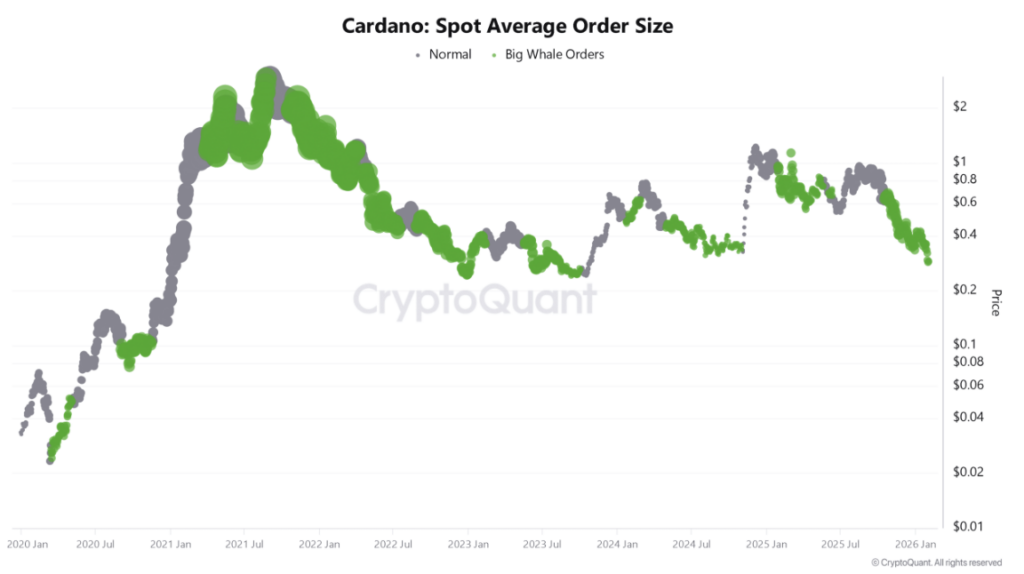
While retail traders appeared hesitant, on-chain data showed whales behaving very differently. According to CryptoQuant, large Cardano orders increased with nearly every dip, especially after ADA fell below $0.80. This pattern points to a classic front-running strategy, where larger players accumulate during fear, well ahead of any visible trend reversal.
It’s not a guarantee of an immediate bounce, but it does suggest longer-term confidence from deep-pocketed holders. Whales have been wrong before, sure, but historically, this kind of accumulation often shows up near major inflection points rather than random price levels.
Key support decides what comes next for Cardano
Everything now revolves around the $0.267 support zone, a level that played an important role throughout 2024. If ADA can hold above it, a rebound toward local resistance between $0.32 and $0.358 becomes possible, followed by a higher hurdle near $0.43. That sequence could form a double bottom structure, opening the door to a broader bullish reversal.
If this support fails, though, the picture darkens quickly. A deeper drop toward $0.13 enters the conversation, especially if Bitcoin continues to weaken. For now, bulls are fighting to defend this zone, knowing that losing it could shift Cardano into a much more painful phase.