

- Solana co-founder Anatoly Yakovenko claims Solana may be more decentralized than Ethereum and possibly even Bitcoin.
- He argues decentralization depends on network design and permissionless nodes, not just token distribution.
- The comments have reignited debate over how decentralization should be measured across major blockchains.
Solana co-founder Anatoly Yakovenko is back in the spotlight — and once again, it’s over decentralization. In a recent post on social media, he didn’t just defend Solana’s architecture. He went further. According to Yakovenko, Solana is not only more decentralized than Ethereum — it may even rival, or surpass, Bitcoin in terms of distributed structure.
That’s not a small claim. In crypto, decentralization is almost sacred.
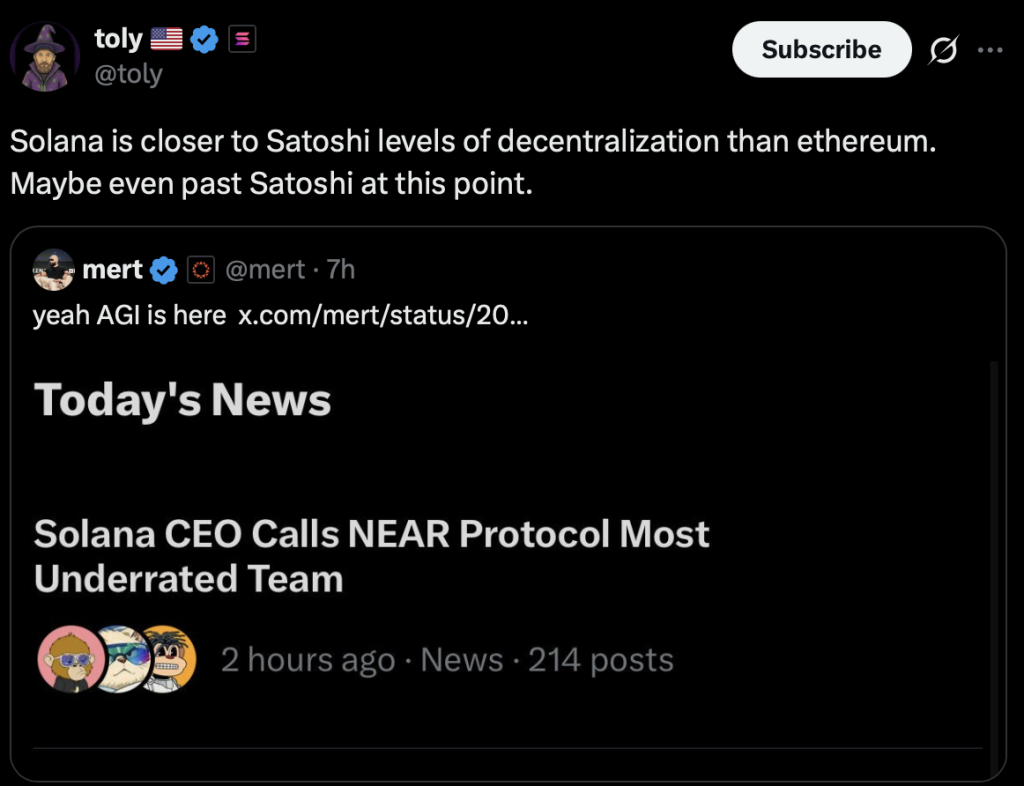
“Solana is closer to Satoshi’s levels of decentralization than Ethereum. Maybe even past Satoshi at this point,” Yakovenko wrote. Predictably, that lit up timelines almost instantly.
The “Laptop” Argument Returns
Critics were quick to bring up Solana’s history of network outages. The chain has suffered several high-profile downtimes over the years, often tied to technical congestion or validator coordination issues. For some observers, those events contradict any claim of superior decentralization.
Yakovenko, however, focused on hardware accessibility. He argued that running a Solana node does not require industrial server racks or data center-scale infrastructure. In his view, anyone can operate a node on a sufficiently capable laptop.
Now, that statement usually refers to light clients or non-voting nodes — systems that allow users to independently verify the ledger’s state without participating in consensus voting. It’s not the same as running a high-performance validator, but it does expand verification access.
And in decentralization debates, access matters.
Token Distribution vs. Network Design
Yakovenko has also pushed back against the idea that decentralization hinges primarily on token distribution. In late 2025, he made what he called a “hot take,” arguing that any properly designed proof-of-stake network can be sufficiently decentralized regardless of how tokens are distributed or concentrated.
That perspective challenges a common narrative. Many critics argue that stake concentration undermines decentralization, even in technically open systems. Yakovenko’s stance is that architecture — not ownership — defines resilience.
Last August, he doubled down, stating that Solana “had and had always been decentralized.” According to him, the key distinction lies in permissionless participation. Anyone can run a full node and independently verify transactions. More importantly, he emphasized that no centralized security council or multisig group has the authority to seize funds or override ledger state.
That’s a pointed comparison.
A Broader Industry Tension
The debate isn’t really just about Solana versus Ethereum. Or even Solana versus Bitcoin. It’s about how decentralization should be measured in 2026. Is it validator count? Hardware accessibility? Stake distribution? Governance structures? There’s no universal metric.
Ethereum has long leaned into validator diversity and ecosystem breadth. Bitcoin remains the gold standard in terms of proof-of-work resilience and simplicity. Solana, by contrast, optimizes for throughput and performance — sometimes at the cost of complexity.
Yakovenko’s comments reflect confidence in Solana’s evolution. The network today is not the network it was during its earlier outages. Performance has improved. Validator tooling has matured. But perception lags behind reality, and bold statements like this don’t exactly lower the temperature.
At the end of the day, decentralization isn’t binary. It’s a spectrum. And in crypto, that spectrum is constantly shifting.
What Yakovenko did wasn’t just defend Solana. He reframed the argument. Whether the broader community agrees — that’s a different story.