

- Tron recorded record transaction volumes and active addresses in 2025, signaling sustained network usage and growing user engagement.
- A major fee reduction boosted throughput and activity, even as fee revenue declined due to lower per-transaction costs.
- Tron solidified its role as the dominant USDT transaction rail, processing more transfers than Ethereum by year-end.
The Tron network quietly put together a strong performance in 2025, marked by consistently high throughput and steady on-chain activity. Over the year, Tron showed that it could scale without sacrificing usage, while staying competitive in an increasingly crowded blockchain landscape. User retention and real economic utility were also key themes, not just raw transaction counts.
A new report from market research firm CryptoQuant took a closer look at Tron’s progress over the past year. Shared with CryptoPotato, the analysis examined how lower fees, growing network usage, and TRX’s performance as a native asset shaped Tron’s trajectory. The findings suggest a network leaning into volume and accessibility, even when that came with trade-offs.
Tron Network Activity Surges
According to CryptoQuant, Tron reached structural highs in network activity throughout the year. Monthly transaction volume hit an all-time high of 323 million in December, up 39% compared to December 2024. At the same time, monthly active addresses peaked at 35.5 million and closed the year at 31.3 million, reflecting a solid 24% year-over-year increase.
More interestingly, transactions per active address climbed to a two-year high of 10.5, up from 9.2 a year earlier. This pointed to deeper user engagement rather than simple address growth. People weren’t just showing up, they were actually using the network more often.
In August 2025, Tron implemented a major fee adjustment, cutting the unit energy price by 60%. That move reduced average transaction fees by roughly 65%, bringing them down to $0.53, the lowest level seen since September 2023. While monthly fee revenue dropped sharply, from $399 million before the cut to $183 million in December, analysts viewed it as a deliberate shift toward maximizing throughput and usage over short-term fee income.
DeFi and Liquidity Continue to Expand
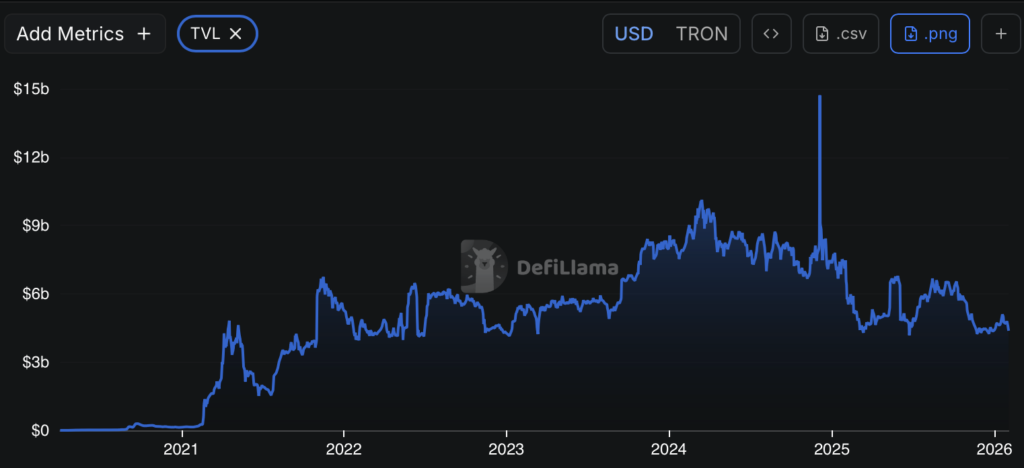
Looking beyond base-layer activity, Tron’s broader ecosystem also showed signs of expansion. Decentralized finance and liquidity layers continued to grow, with platforms like SunSwap and JustLend playing a central role. SunSwap maintained an average monthly swap volume of $3.1 billion in wrapped TRX, which is no small number.
JustLend, on the other hand, saw deposits rise 56% year over year, reaching $12.8 billion. Together, these platforms helped anchor Tron’s DeFi presence, providing liquidity and utility that extended beyond simple transfers. It wasn’t explosive growth, but it was steady, and that tends to matter more over time.
The Dominant USDT Rail
In dollar terms, TRX transfers totaled $85.2 billion last year, representing a 44% increase from 2024. Analysts attributed much of that growth to price appreciation, as TRX reached a monthly average all-time high of $0.34 in September 2025. Price clearly played a role here, even if usage stayed consistent.
Interestingly, total transfers measured in native TRX units fell to 309 billion, down 27% from the previous year. This wasn’t driven by declining interest, but by increased staking activity. Roughly 48% of the total TRX supply, or about 45.7 billion coins, is now staked for voting and network security, reducing the circulating supply used for transfers.
At the same time, Tether’s USDT supply on Tron expanded significantly, rising 40% from $58 billion in 2024 to $81 billion in 2025. USDT bridging volume jumped 215% year over year to $17.8 billion. By the end of December, Tron had firmly established itself as the dominant USDT transaction rail, processing over 825 million USDT transfers last year and handling roughly twice the USDT transaction volume of Ethereum.