

- TRON is trading near $0.28 after Tron Inc. expanded its treasury to over 682.8 million TRX.
- Technical indicators show consolidation between $0.27 support and $0.30 resistance, with neutral momentum.
- A breakout above $0.30 could shift sentiment bullish, while a loss of $0.27 may open downside risk.
TRON is trading at $0.28461 as of February 21, 2026, showing little day-to-day movement. It’s not exciting price action, not dramatic, just steady. Over the past year, TRX is still up nearly 16%, which isn’t bad considering how choppy broader markets have been.
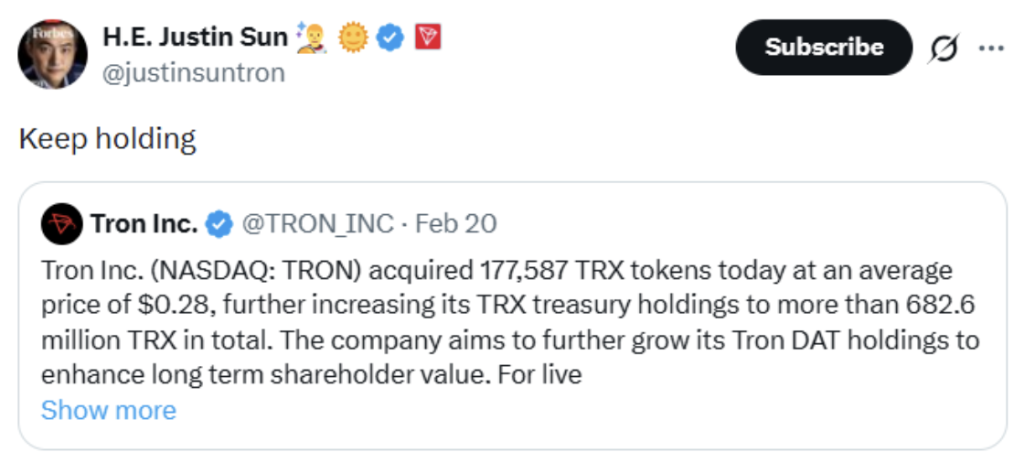
This calm stretch comes right after Tron Inc. acquired another 175,449 TRX at an average price of $0.28. That purchase pushed the company’s total treasury holdings above 682.8 million TRX. It wasn’t a flashy move. It was deliberate.
Justin Sun followed up with a post on X encouraging investors to continue accumulating and holding. His timing was, unsurprisingly, right after the treasury expansion announcement. Sun has a track record of influencing short-term sentiment, and his tone this time signaled confidence. TRON remains in the top eight cryptocurrencies by market cap, sitting around $27.13 billion, and the treasury wallet is publicly visible, which adds a layer of transparency to the strategy.
Charts Show Consolidation, Not Breakout
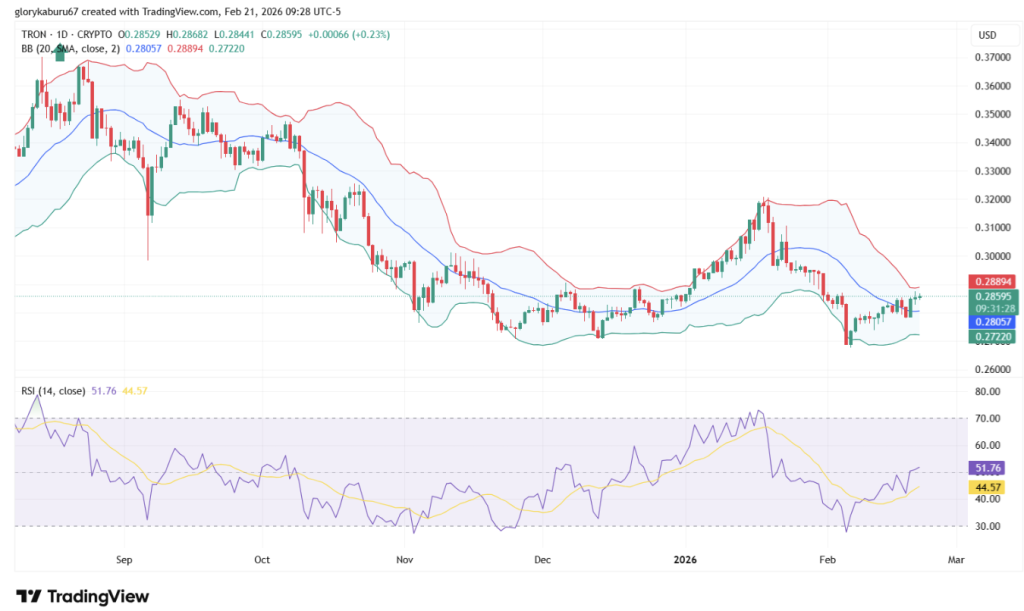
Technically, TRX/USD looks like it’s coiling. The Relative Strength Index sits at 49.82, which is about as neutral as it gets. No overbought extremes. No deep oversold panic. Just balance.
The MACD is flat, offering no strong directional bias. Bollinger Bands show resistance near $0.30 and support around $0.27. Right now, TRX is trading close to the middle band, which usually means the next move could go either way. A decisive break above $0.30 would likely flip short-term sentiment bullish. Until then, it’s range-bound.
There are a few minor caution signals. The Stochastic indicator leans slightly overbought, and the Commodity Channel Index has climbed above 100. That combination sometimes precedes a short pullback. Still, demand appears firm above the $0.27 zone, which is increasingly viewed as both psychological and structural support.
On-chain metrics offer additional context. TRON’s Total Value Locked has surpassed $4 billion, rising about 2% in the past 24 hours. Growing TVL suggests liquidity strength and ongoing user participation. Pair that with steady treasury accumulation, and the $0.27 base looks more intentional than accidental.
Forecasts Split as Range Tightens
Price forecasts for TRX are mixed. Short-term projections suggest a potential retest of $0.27 before any sustained move higher. That wouldn’t break the structure, but it would test patience. On a more bearish note, some quarterly outlooks warn that if macro conditions worsen significantly, TRX could slide toward $0.18.
Longer-term projections are more optimistic. Some annual targets point toward $0.45088, roughly a 58% increase from current levels. For that to materialize, TRX would likely need to break above the 200-day moving average near $0.308 and attract broader capital inflows.
Strategically, Tron’s treasury expansion resembles a classic supply-defense approach. Accumulate during weakness. Encourage holding behavior. Stabilize perception. In risk-off markets, sentiment often drives volatility more than fundamentals. Strength in TRX can signal renewed appetite for smart contract platforms, while weakness tends to align with capital rotating back into Bitcoin or stablecoins.
For now, TRON is boxed between $0.27 and $0.30. Break resistance, and momentum could shift quickly. Lose support, and downside pressure returns. It’s a tight range, and tight ranges rarely last forever.