

- The Ethereum Foundation announced a dedicated post-quantum security team in January 2026
- The initiative builds on years of research into protecting Ethereum from quantum threats
- New funding, devnets, and collaboration aim to ensure a seamless transition without downtime
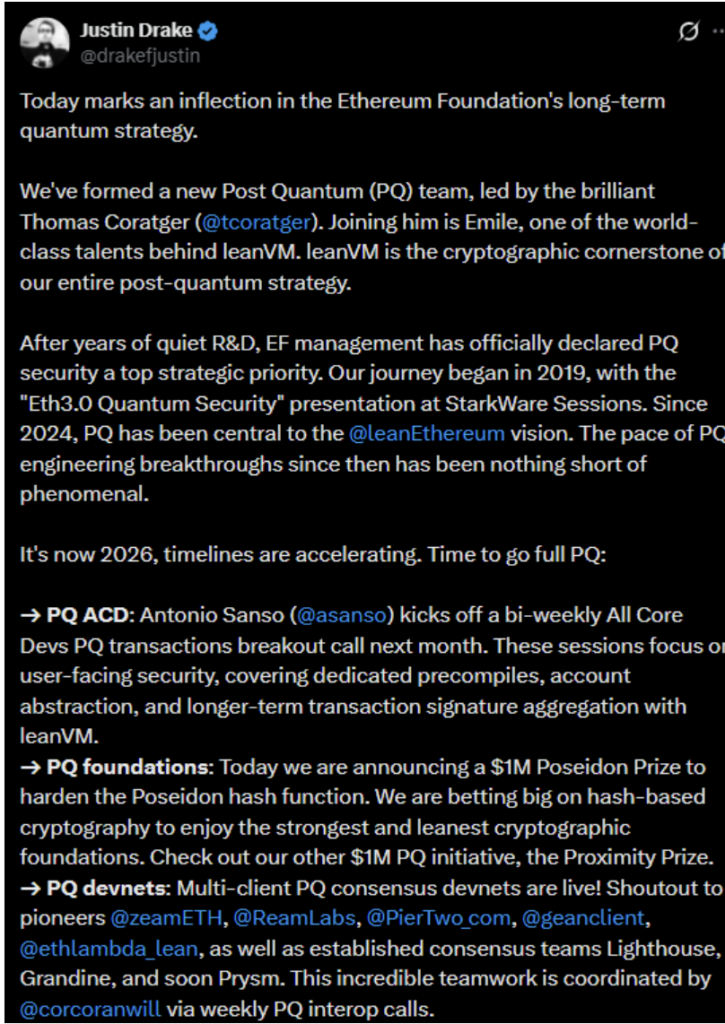
Ethereum grabbed headlines on January 24, 2026, after the Ethereum Foundation officially announced the formation of a dedicated Post-Quantum (PQ) team. The move signals a clear shift in focus toward future-proofing the network against the rising threat of quantum computing. It’s not a reactionary step either, it’s something Ethereum has been quietly preparing for years.
The new team is led by cryptographic engineer Thomas Coratger, with support from Emile of leanVM. Together, they’re building on a long runway of prior research rather than starting from scratch. In a space where security failures can be existential, this announcement reinforces Ethereum’s intention to stay ahead of threats, not chase them.
Ethereum Begins Taking Quantum Risk Seriously
The PQ team sits within Ethereum Crypto’s broader strategy to protect the network from long-term cryptographic risks. Research into post-quantum security began as early as 2019 and gained real momentum under the leanEthereum initiative in 2024.
By 2026, however, timelines around quantum breakthroughs began moving faster than expected. That acceleration pushed the Ethereum Foundation to act more decisively. Justin Drake, an Ethereum Foundation researcher, has explained that sufficiently powerful quantum computers could eventually break widely used cryptographic systems like ECDSA using Shor’s algorithm.
Vitalik Buterin has previously estimated a 20% chance that such a breakthrough could arrive before 2030. That probability may not sound overwhelming, but for a global financial network, it’s more than enough to demand preparation. As a result, quantum resistance is now being treated as a core pillar of Ethereum’s long-term roadmap.
What the New PQ Team Is Working On
Several initiatives are already in motion. Bi-weekly post-quantum breakout calls, led by Antonio Sanso, will focus on protecting user-facing transaction flows. Topics include account abstraction, signature aggregation, and the development of new precompiles through leanVM.
The foundation also announced a new $1 million Poseidon Prize aimed at strengthening the Poseidon hash function. This prize complements the existing $1 million Proximity Prize, both of which are designed to push forward hash-based cryptography. These methods are widely seen as a critical foundation for secure post-quantum systems.
Rather than betting on a single solution, Ethereum is spreading its efforts across research, incentives, and open collaboration. That approach has become a defining feature of how the network evolves.
Development, Testing, and Collaboration Expand
Beyond theory, real development work is already underway. Live multi-client post-quantum consensus devnets have been launched, with teams such as Lighthouse, Grandine, Prysm, zeamETH, and ReamLabs actively contributing.
Several upcoming events will further accelerate progress. A three-day post-quantum workshop is planned for October, along with a dedicated PQ day at EthCC in Cannes on March 29. Ethereum is also leaning into AI-assisted formal verification. In one recent test, a low-cost AI run successfully solved a complex proof related to hash-based SNARKs, a promising signal for future tooling.
The foundation plans to publish a full post-quantum roadmap at pq.ethereum.org, with a clear goal in mind, a seamless transition that involves zero downtime and zero loss of funds.
Education and Industry Coordination Take Center Stage
Ethereum isn’t keeping this work behind closed doors. A six-part educational video series from ZKPodcast is already in production, alongside learning materials tailored for enterprises and even nation-states. The aim is to raise awareness early, before quantum risks move from theoretical to practical.
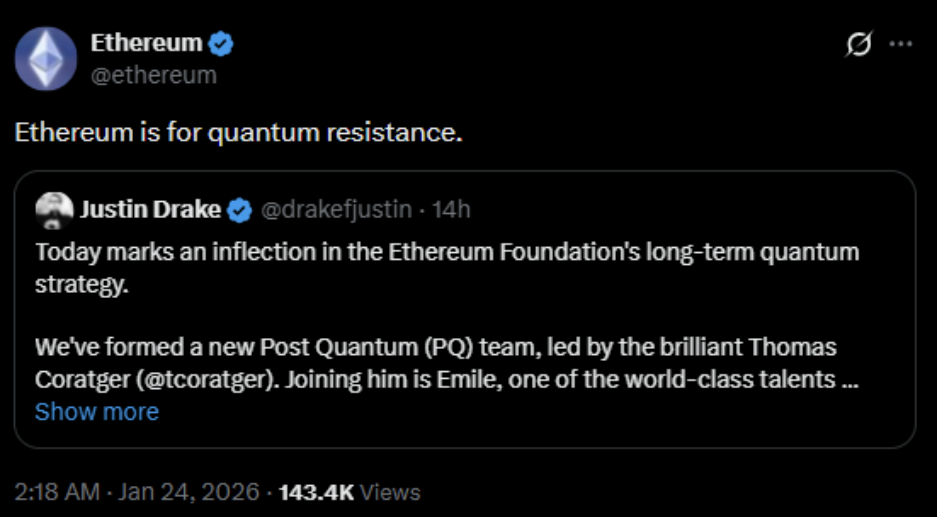
Ethereum will also participate in Coinbase’s new post-quantum advisory board, adding another layer of industry coordination. The official Ethereum account summed up the initiative succinctly with a simple message, “Ethereum is for quantum resistance.” The response from the community has been largely supportive.
Why This Ethereum News Matters
Coverage from outlets like CoinDesk and Cointelegraph has framed the announcement as a defining moment. By preparing for the quantum era ahead of time, Ethereum strengthens its appeal to institutions that care deeply about long-term security and stability.
Quantum computing projects, including Google’s Willow chip, continue to show rapid hardware progress. Against that backdrop, Ethereum’s focus on post-quantum cryptography feels less like speculation and more like risk management.
For many in the community, this marks an important milestone. It shows that blockchain resilience isn’t just about scaling or fees, but about anticipating threats that may still be years away. With dedicated teams, funding incentives, workshops, and education, Ethereum is positioning itself to remain secure even as computing itself changes. This announcement may end up being remembered as the moment Ethereum truly started planning for the quantum future.