
- SOL slipped below $82 as liquidations and negative funding pressure price toward $80 support
- Institutional interest and ETF inflows continue despite short-term weakness
- Major upgrades like Alpenglow and expanded block capacity could reshape Solana’s long-term trajectory
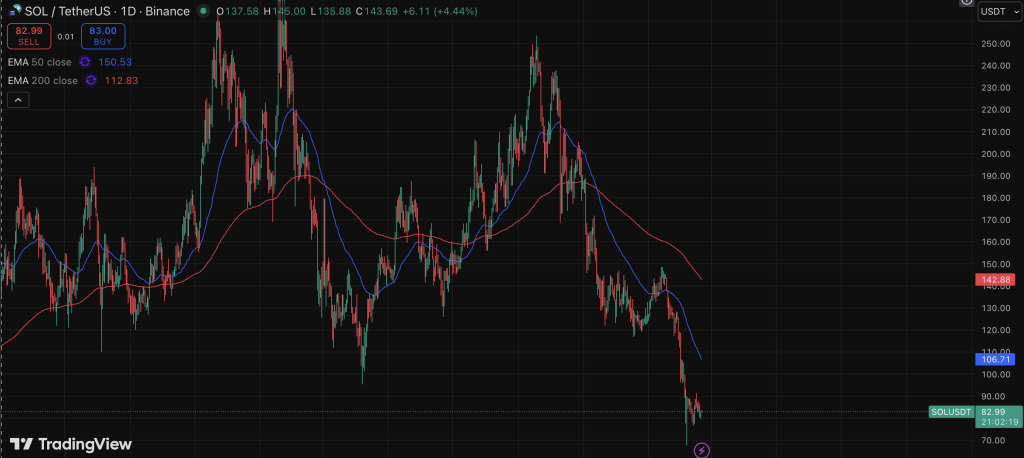
Solana is having a rough week on the surface. Price slipped below $82 on February 19, liquidations spiked, funding flipped negative, and suddenly everyone started watching the $80 support like it’s life or death. At the time of writing, SOL is hovering around $80.75, down about 2.7% on the day and underperforming the broader market.
But that’s just the chart. Behind the scenes, things are a little more layered.
This drop is happening during a broader risk-off move across crypto. Solana, being a higher-beta asset, tends to exaggerate both upside and downside during extreme fear. Add in technical weakness below key moving averages and the 78.6% Fibonacci retracement level, and you’ve got pressure stacking up quickly. Social sentiment hasn’t helped either — it’s been leaning negative.

Institutions Haven’t Walked Away
Despite the price weakness, institutional activity hasn’t vanished. Goldman Sachs recently confirmed that crypto is now essential to its broader strategy and is reportedly holding around $260 million in Solana and XRP-linked funds. That’s not retail hype, that’s capital allocation.
Meanwhile, Coinbase helped form a Quantum Computing Advisory Council. Its CEO downplayed the immediate threat of quantum risks to crypto, but the key takeaway is preparation. Big players are planning ahead, not retreating.
There’s also the ETF angle. The SEC hasn’t approved a spot Solana ETF yet, but discussions are ongoing. And interestingly, Solana-related ETFs have still seen inflows during this downturn. That suggests some institutional buyers are using weakness as an entry point, even if short-term traders are panicking.
Why This Dip Feels Different
Solana has been through brutal drawdowns before. That’s not new. What’s different this time is the disconnect between price and progress.
The network is still shipping upgrades. Development hasn’t slowed. In fact, the Alpenglow upgrade expected in early 2026 could be one of Solana’s most important updates yet. It aims to reduce transaction finality from roughly 12 seconds to around 150 milliseconds. That’s near-instant settlement — the kind of performance needed for institutional trading, payments, and real-time financial applications.
At the same time, Solana is pushing to increase block capacity toward 100 million compute units. That matters because scalability determines whether a chain can stay fast and cheap when usage spikes. If Solana wants to handle global-level traffic, it needs that headroom.
A Bigger Vision Beyond the Chart
Looking further ahead, Solana’s roadmap into 2027 is ambitious. The goal isn’t just to be an altcoin with fast transactions. It’s to become infrastructure for tokenized global markets.
Features like Application-Controlled Execution are designed to improve transaction ordering and reduce MEV-related issues. Projects like DoubleZero aim to improve low-latency connectivity. These are not meme-driven upgrades. They’re infrastructure plays.
That’s why this dip feels structurally different. Price is falling, yes, but the long-term blueprint is becoming clearer. And that contrast is hard to ignore.
What Could Move SOL Next
In the short term, SOL is in a tug-of-war. Funding rates are deeply negative, showing heavy bearish positioning. That creates immediate downside risk, especially if $80 fails. A break below the recent swing low near $68.69 would likely accelerate selling.
But deeply negative funding can also set the stage for a short squeeze. If any strong catalyst appears — ETF progress, a macro shift, or major adoption news — shorts could be forced to cover quickly.
Technically, SOL needs to reclaim the $84 zone to ease pressure. Until then, the structure leans fragile. Hold the $68–$80 region and the market could settle into consolidation. Lose it, and momentum shifts further bearish.
Solana’s Price Looks Weak, But the Context Is Stronger
Right now, Solana looks weak on the chart. There’s no sugarcoating that. But the backdrop behind this drop is more constructive than many past sell-offs.
Institutional involvement remains. Core upgrades are advancing. The network’s long-term plan is more defined than ever. If SOL holds the current range and sentiment gradually improves, this stretch could eventually be viewed as an important accumulation window.
Bear markets never feel bullish in real time. They rarely announce opportunity politely. And sometimes, the strongest setups form when confidence is lowest.