

- Cardano is forming a bullish RSI divergence similar to the setup that preceded a 32% rally in late 2025
- Whales are accumulating aggressively, while long-term holders remain inactive and confident
- A breakout above $0.41 is needed to confirm momentum, while a loss of $0.35 would weaken the setup
Cardano’s price action feels heavy right now, there’s no denying that. ADA remains under pressure, drifting lower and frustrating anyone looking for a clean bounce. Still, under the surface, something familiar is starting to form. A technical structure that sparked a 32% rally late last year is quietly reappearing, and this time it’s being backed by some very specific on-chain behavior.
The real question isn’t whether the signal exists anymore. It’s whether the supporting data is strong enough to push it across the line.
A Familiar Bullish Divergence Returns as Whales Step In Early
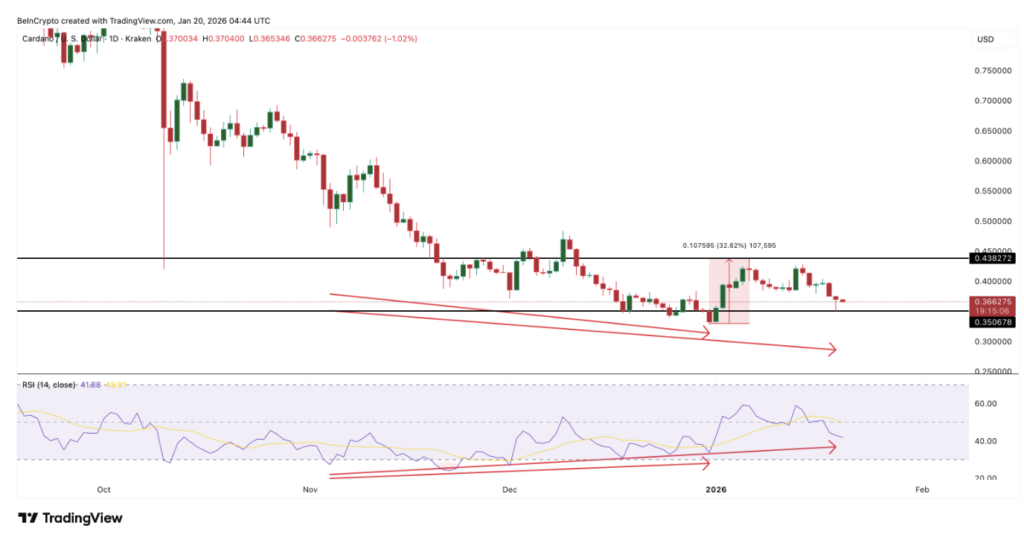
On the daily chart, Cardano is shaping up a classic bullish divergence. Price has pushed to lower lows, but momentum, measured by the Relative Strength Index (RSI), is moving in the opposite direction. That usually tells us selling pressure is losing steam, even if price hasn’t reacted yet.
This setup isn’t new for ADA. Between early November and the end of December 2025, the same divergence appeared. Sellers exhausted themselves, RSI turned higher, and ADA followed with a 32% rally. Now, a similar structure is developing again between November 2025 and mid-January 2026, as long as price continues to defend the $0.35 area.
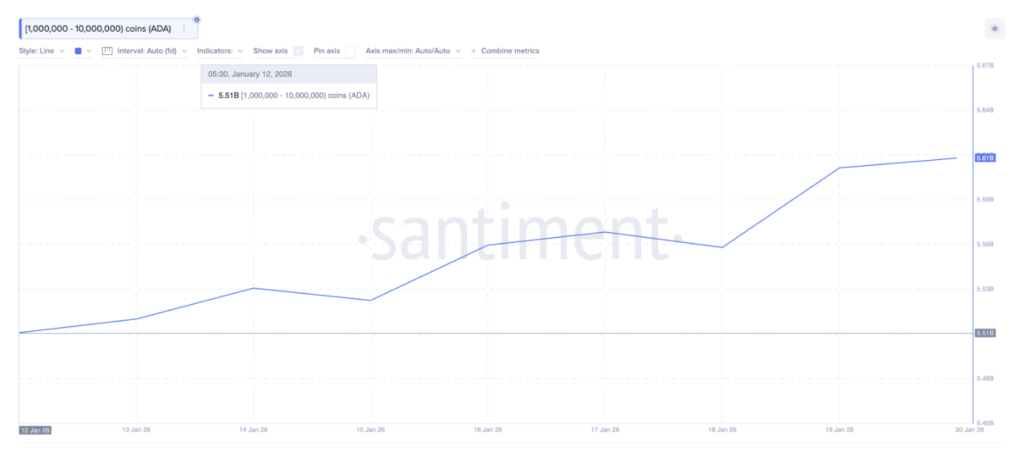
What gives this setup more weight is whale behavior. Wallets holding between 1 million and 10 million ADA have been accumulating since January 12. Their combined balance has increased by roughly 100 million ADA in less than two weeks, representing more than $36 million in added exposure at current prices. This kind of accumulation usually happens before momentum shifts, not after them.
Long-Term Holders Stay Calm While Short-Term Activity Spikes
Digging deeper into on-chain data reveals a split beneath the surface. Long-term holders, defined as wallets holding ADA for 180 to 365 days, are barely moving their coins. Spent coin activity for this group collapsed by more than 99% in recent days, dropping to a monthly low. In simple terms, long-term investors are not selling into weakness.
Short-term holders tell a very different story. Coins held for just 30 to 60 days have suddenly become much more active. Spent coin activity in this cohort jumped over 300% in a short window, signaling increased trading and potential profit-taking if price attempts to bounce.
This imbalance matters. Strong hodler conviction reduces downside panic, but rising short-term activity introduces supply risk on any rally. It’s the same dynamic that capped Cardano’s last RSI-driven bounce before it could evolve into a sustained trend.
Key Price Levels Will Decide Whether History Repeats
Last year’s 32% rally ultimately failed at one level: the 50-day exponential moving average. ADA could not reclaim it, and momentum faded shortly after. That level, now sitting near $0.41, is once again the first major test.
If the current divergence confirms and price pushes higher, a clean daily close above $0.41 would signal that momentum is finally aligning with the setup. Above that, resistance sits near $0.43, followed by $0.48, which closely aligns with the 200-day EMA and would represent a much more meaningful shift in trend.
One difference this time is capital flow. The Chaikin Money Flow (CMF) indicator has been trending higher even as price drifted lower, suggesting steady accumulation rather than weak inflows. Previously, CMF failed to stay positive during rallies. Now, it’s holding above zero, and whale accumulation appears to be a big part of that shift.
On the downside, the setup remains conditional. A sustained break below $0.35 would weaken the divergence and reopen the path toward $0.32, delaying any repeat of last year’s move.