

- XRP dipped below $2 after a leverage flush wiped out over $5 million in long positions amid macro-driven risk-off pressure
- Despite short-term volatility, institutional demand remains strong, with $70 million flowing into XRP-focused funds and new spot ETFs
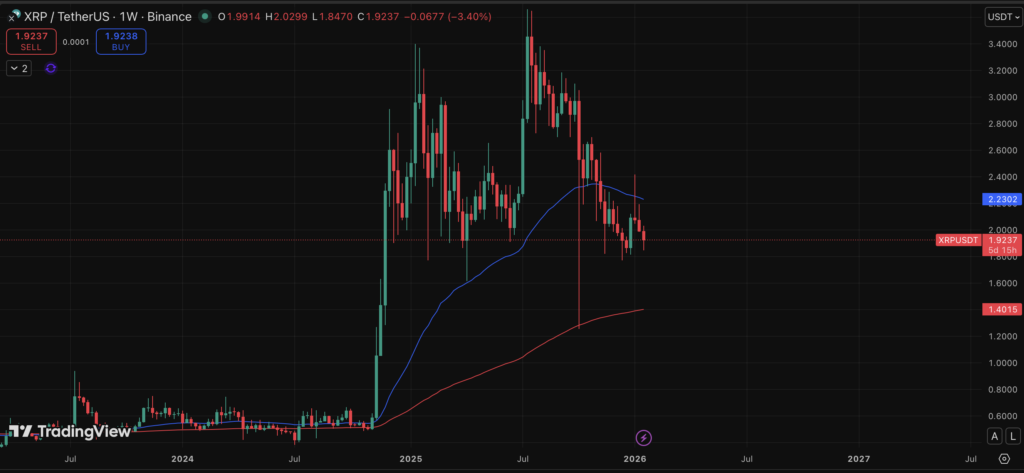
- Key support between $1.85–$1.93 continues to hold, placing XRP in a transition phase rather than a confirmed breakdown
XRP is sitting in an awkward spot this week, and the tape tells two very different stories depending on where you look. On the surface, it’s messy. Leverage got flushed, price dipped under key levels, and volatility spiked. But underneath that noise, institutional demand hasn’t slowed down at all. If anything, it’s quietly picking up.
That contrast is what makes this moment interesting.
Leverage Gets Washed Out Below $2
On January 20, more than $5 million worth of XRP long positions were wiped out in a single wave. Binance alone accounted for over $1 million in forced liquidations. The trigger wasn’t XRP-specific news, but broader macro fear tied to potential EU tariffs on U.S. goods, which pushed the entire crypto market into risk-off mode.
Price slipped briefly below $2, tagging the $1.96 area before finding its footing again. These kinds of moves always feel ugly in real time. Forced selling exaggerates downside, shakes confidence, and keeps traders on edge. From a short-term perspective, it looks bearish, no way around it.
But structurally, leverage flushes often do something useful. They clear crowded positioning. When too many traders lean the same way, the market has a habit of snapping back hard once that excess is gone. This move didn’t break XRP because of weakness in the asset itself. It broke because the broader market sneezed.
Institutions Keep Buying, Quietly
While retail leverage was getting rinsed, a very different flow was happening in the background. XRP-focused investment products pulled in roughly $70 million last week, making XRP the third-largest recipient of crypto fund inflows behind Bitcoin and Ethereum.
That timing matters. These inflows followed the launch of four U.S. spot XRP ETFs, which finally gave institutions a clean, regulated way to get exposure without touching spot markets directly. This kind of capital behaves differently. It’s slower, steadier, and far less reactive to intraday volatility.
Price hasn’t reflected that demand yet, and that’s normal. ETF and fund flows don’t usually show up immediately on the chart. They work in the background, absorbing supply over time. When they matter, they tend to matter all at once.
Support Is Holding, for Now
From a technical angle, XRP hasn’t fallen apart. The $1.85–$1.93 zone, which has acted as support since mid-December, continues to hold. Each dip into that area has found buyers willing to step in, even after the liquidation-driven selloff.
Momentum indicators sit in neutral territory, which fits the current behavior. There’s no panic, but there’s also no real expansion. It’s consolidation after a sharp volatility event. For upside, the market still needs to reclaim the $2.10–$2.20 range. That zone has rejected multiple rebounds and remains the line that separates range-bound chop from something more constructive.
If $1.85 fails on a closing basis, the picture changes quickly and deeper retracement risk opens up. But until that happens, the floor is still doing its job.
A Market in Transition
Right now, XRP is being pulled in two directions at once. Short-term traders are reacting to macro headlines, leverage events, and fast price moves. At the same time, institutions are building exposure quietly through regulated products, largely ignoring the noise.
This doesn’t guarantee an immediate rally. It does, however, make a sustained collapse driven purely by internal weakness harder to argue. If macro pressure eases and broader markets stabilize, XRP already has capital support waiting underneath. If geopolitical risks flare up again, volatility will stay elevated no matter how strong the underlying demand looks.
For now, XRP isn’t breaking down, and it isn’t breaking out either. It’s in a transition phase. Historically, those uncomfortable, confusing periods are often the ones that decide where the next major move really goes.