
- Early SHIB supporter Zach Humphries says Shiba Inu still has a realistic path back to its 2021-style momentum, despite trading over 90% below its all-time high.
- He argues the ecosystem has become scattered with too many side tokens and projects, and calls for a full refocus on SHIB as the core asset, plus a simpler, SHIB-centric roadmap.
- Humphries believes that if the team realigns the ecosystem, captures the next wave of retail FOMO, and gives SHIB clear economic utility, the token can still stage a major recovery
Shiba Inu may look battered on the charts, but early SHIB supporter Zach Humphries thinks the story isn’t over. In fact, he argues SHIB still has a real path back to the explosive energy it had in 2021 — the kind that turned it from a joke meme into a household name overnight.
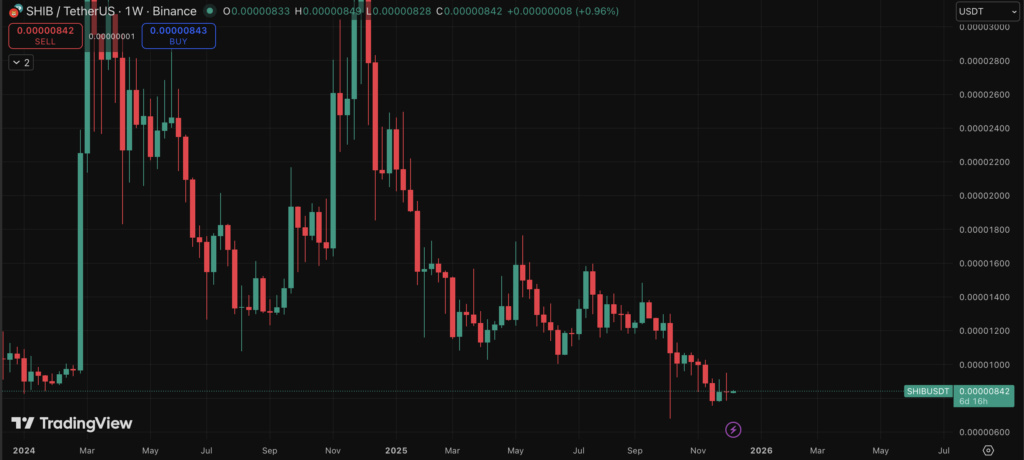
In a recent nine-minute video on X, Humphries, who has been covering SHIB since early 2021, broke down the core changes he believes must happen for SHIB to escape its long slump. That slump is no small thing either: SHIB is still down over 90% from its all-time high of $0.00008845, and the token has bled for months — losing 17% in the last 30 days and more than 60% year-to-date.
Even so, Humphries argues that the collapse hasn’t changed SHIB’s long-term potential. Instead, he says the token’s fundamentals are intact, the brand is still massive, and the community hasn’t gone anywhere… it’s just waiting.
And according to him, SHIB’s comeback depends on fixing three major missteps.
1. SHIB Needs To Become the Center of Its Own Ecosystem Again
Humphries’ biggest criticism is simple: the Shiba Inu ecosystem has sprawled out of control.
After SHIB launched in 2020, developers introduced Shibarium, ShibaSwap, the Metaverse, BONE, LEASH, TREAT, even several NFT collections. In his view, this scattershot expansion took the spotlight away from SHIB — the one token that actually built the community.
He says the ecosystem feels disconnected now. Holders don’t know which token matters, which project actually benefits SHIB, or how any of these new mechanics tie back to the original vision.
Back in 2021, SHIB didn’t need five side projects — it needed a strong identity, a united community, and clear momentum.
Humphries argues that if SHIB is going to rise again, everything the team builds must directly benefit SHIB, not a list of side tokens many investors didn’t ask for.
A full refocus on SHIB-as-the-core, he says, is step one.
2. SHIB Must Capture the Next Wave of Retail Investors
Humphries also pointed out something many forget: meme coins don’t pump because of hedge funds. They pump because the retail crowd shows up hungry for the next big moon play.
Retail traders don’t open a Coinbase account to buy Bitcoin. They show up for cheap tokens with huge upside potential — the exact psychology that pushed SHIB into the spotlight in 2021.
He believes that once retail FOMO returns to crypto, SHIB can still be one of the first tokens they run toward. But only if the project aligns itself for that narrative. That means clearer messaging, fewer distractions, and a return to SHIB’s meme-driven identity instead of trying to be everything at once.
3. Shiba Inu Needs a Roadmap That Is Simple, Transparent, and Actually Executable
Humphries didn’t sugarcoat this part.
He says Shiba Inu’s current roadmap is way too complicated. Between Shibarium, the metaverse, NFTs, a DEX, multiple side tokens, and various experiments — the project looks more like a tangled web than a clean mission.
Crypto holders don’t need ten ambitious ideas. They need one idea that works.
Humphries wants to see a roadmap that:
- clearly links ecosystem growth back to SHIB
- gives SHIB real economic utility
- avoids overwhelming new investors
- focuses on execution, not hype
He suggests SHIB-linked revenue models, token burns tied to ecosystem activity, or other mechanics that create direct value for SHIB holders — not the side tokens.
SHIB Isn’t Dead — But Its Future Depends on Leadership
Humphries wrapped up his message with a blunt but optimistic takeaway: SHIB still has the brand power, community strength, and cultural identity to reclaim its former glory.
But its fate depends on leadership’s ability to refocus, simplify, and reconnect everything back to SHIB itself.
In other words — the path is still open, but not guaranteed.
If SHIB realigns and captures retail momentum, 2021’s energy might not be impossible to revisit. The question now is whether the team chooses clarity over chaos.