
- Only 0.03% of XRP supply is exposed to potential quantum risk
- Bitcoin may have 11–37% of BTC vulnerable due to legacy addresses
- XRPL key rotation offers flexibility Bitcoin currently lacks
The idea of quantum computers breaking crypto isn’t just sci-fi anymore, but it’s also not as simple as “everything is at risk.” The threat is very specific, and it mostly comes down to whether public keys are exposed. Once a transaction is made, that key is out there, and in theory, a powerful enough machine could reverse-engineer the private key from it. That’s where things start to diverge between networks, and not evenly.
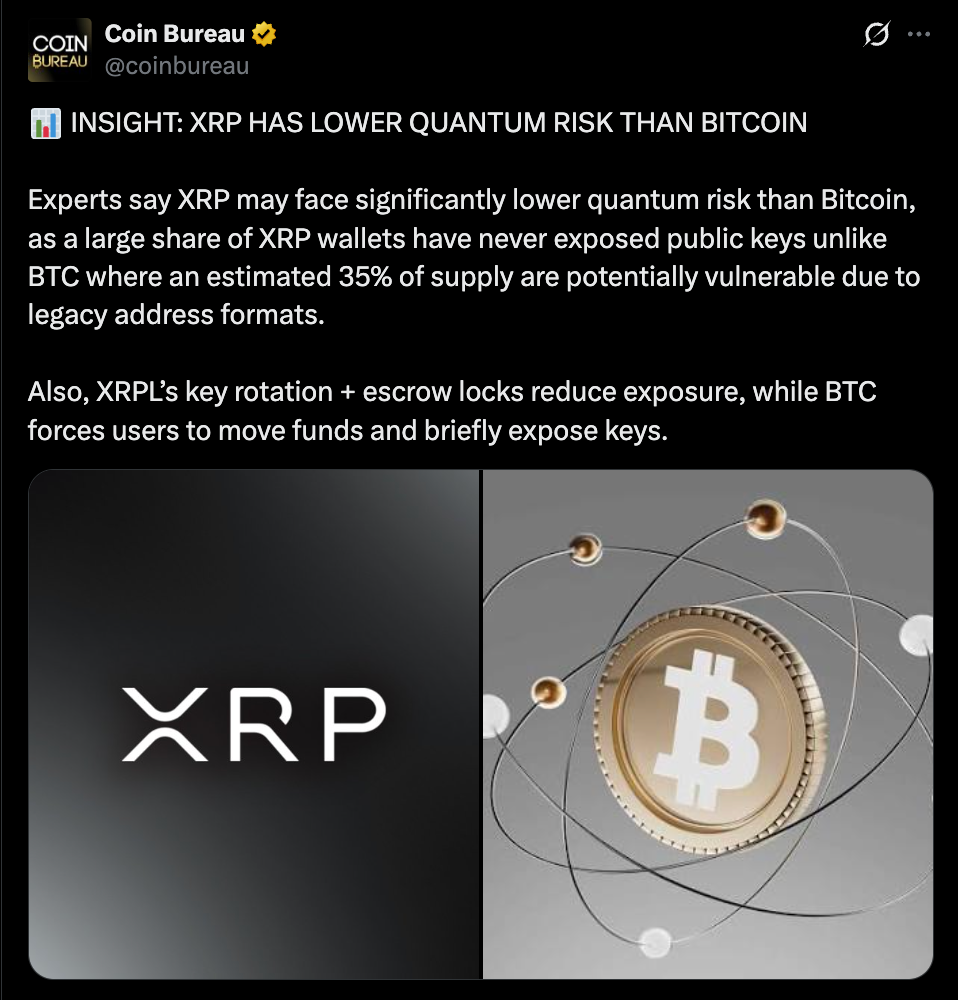
Bitcoin, especially in its early days, used a format called P2PK that exposed public keys directly in transaction outputs. That means some of the oldest BTC, including coins linked to Satoshi, are sitting there with keys already visible. And since those coins haven’t moved, they haven’t been upgraded or rotated, which makes the situation, well, a bit uncomfortable.
XRP’s Exposure Looks Much Smaller
When you look at XRP, the numbers tell a very different story. Roughly 2.4 billion XRP is held in accounts that have never made a transaction, meaning their public keys haven’t been revealed at all. In practical terms, that makes them immune to this specific type of quantum attack, at least under current assumptions.
Only two dormant XRP accounts were found with exposed public keys, holding around 21 million XRP combined. That’s about 0.03% of the circulating supply, which is small enough to be almost negligible, though of course, that depends on how you define “at risk” in the first place.
Bitcoin’s Legacy Design Creates More Surface Area
Bitcoin’s situation is more complicated, mostly because of its history. Early address formats didn’t prioritize hiding public keys the way newer standards do. As a result, a significant portion of BTC, estimates range from 11% to as high as 37%, could be theoretically exposed if quantum capabilities reach a certain level.
That doesn’t mean those coins are about to be stolen tomorrow, not even close. But it does mean Bitcoin has more surface area to think about, especially when compared to networks that were designed later with different assumptions.
Key Rotation Is a Quiet but Important Advantage
One of XRPL’s more interesting features is built-in key rotation. Users can change their signing keys without changing their wallet address, which is a bit like swapping locks without moving houses. It’s simple in concept, but it gives flexibility that Bitcoin doesn’t natively offer.
There are also early steps toward post-quantum cryptography. XRPL’s testnet adopted a NIST-approved signature scheme back in late 2025, although it hasn’t reached mainnet yet. So while the tools are being developed, they’re not fully deployed, at least not yet.
Better Positioned Doesn’t Mean Fully Safe
XRP may be in a stronger position today, but that doesn’t mean it’s immune. The mainnet still relies on elliptic curve cryptography, the same general class of algorithms that quantum computing would target. So the difference is more about preparedness and flexibility, not complete protection.
The real takeaway is that the industry still has time. The threat isn’t immediate, but it’s also not imaginary. What matters now is whether networks and users actually use that time to prepare, because when the shift comes, it probably won’t wait around.