

- XRPL is capturing tokenized Treasury issuance but secondary activity remains limited
- Compliance-focused upgrades improve structure, not necessarily market depth
- Real institutional adoption depends on liquidity, reuse, and trading flow
The XRP Ledger is increasingly being cited as a home for tokenized Treasury products, and that headline sounds like a win. Regulated issuers selecting XRPL signals confidence in its stability, cost efficiency, and governance structure. On paper, it strengthens the institutional narrative that Ripple and XRPL supporters have been building for years.
But issuance alone does not equal adoption. If those Treasuries sit idle without meaningful trading, lending, or collateral reuse, they function more like static inventory than dynamic infrastructure. Markets reward activity, not storage.
Features Improve Control, Not Liquidity
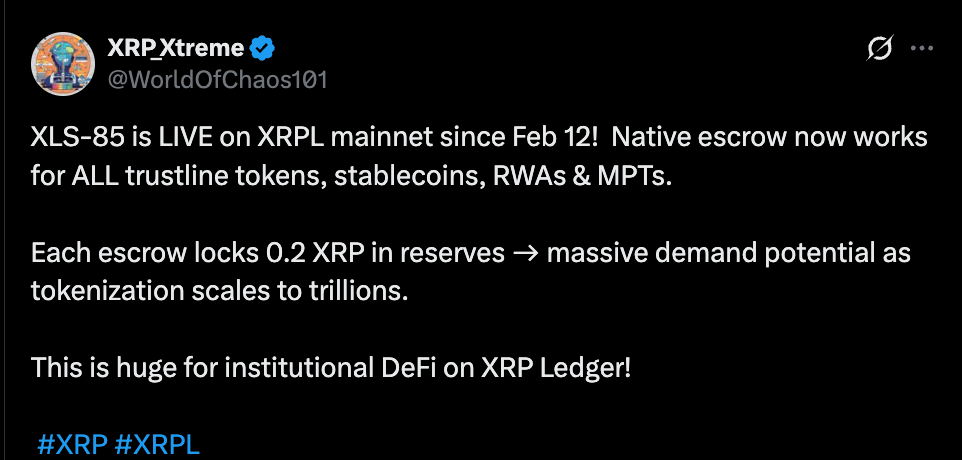
Recent XRPL upgrades — including expanded escrow and compliance-friendly asset controls — are clearly tailored for institutional workflows. Conditional settlement, vesting tools, and tighter issuance mechanics reduce operational friction and align with regulatory expectations.
Still, better tooling does not automatically attract capital flows. Institutions care less about where assets are minted and more about where they can be efficiently traded, financed, and integrated into broader balance-sheet strategies. Liquidity depth, not feature checklists, ultimately determines whether a venue becomes critical infrastructure.
The Coordination Gap
The real bottleneck appears to be coordination, not technology. Issuers, custodians, exchanges, and liquidity providers must align before meaningful volume migrates. That process moves slowly and often depends on internal compliance approvals rather than developer roadmaps.
Until trading venues actively support these tokenized assets and institutions begin reusing them across markets, XRPL risks becoming a parking lot instead of a financial hub. Enterprise readiness is necessary, but it is not sufficient.
Promise Versus Proof
XRPL’s institutional positioning is no longer theoretical. Assets are being issued, and the ledger’s compliance posture is clearer than in prior cycles. That is real progress.
But markets measure success in flow, not potential. Until tokenized Treasuries on XRPL see deeper secondary trading and broader integration into financial workflows, the story remains one of promise rather than proof. The next phase is not about adding features. It is about generating movement.