
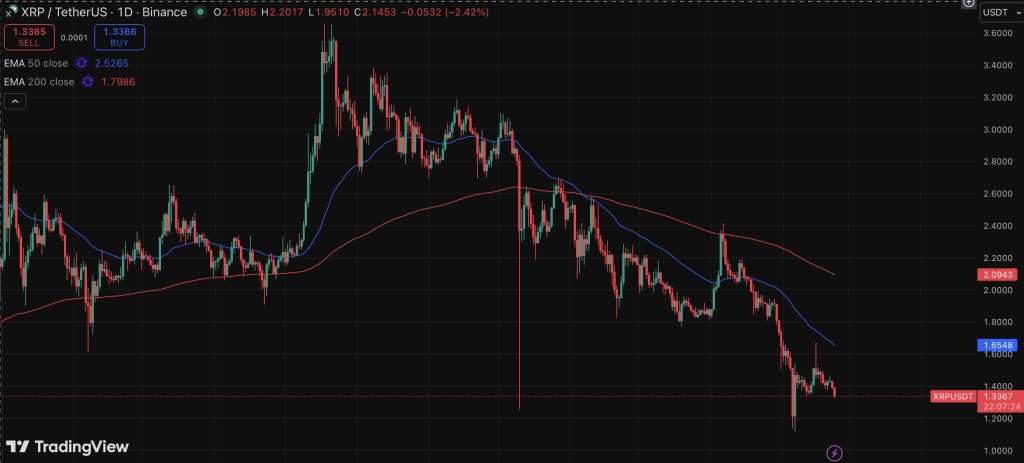
- XRP has fallen over 62% from its July peak of $3.65 and is currently trading below $1.40 in bearish territory.
- AI models suggest a potential bottom could form by spring 2026, with $1.80 and $2.00 as key recovery levels.
- A full bull phase may not begin until Q3 or Q4, with long-term targets ranging between $8 and $13 in aggressive scenarios.
Ripple’s cross-border token hasn’t exactly been calm lately. Back in late 2024, around the time of the U.S. presidential elections, XRP was trading near $0.60. Then came the surge. By January 2025, it had ripped all the way to its 2018 all-time high of $3.40, only to tumble in the months that followed. And just when traders thought it was done, it exploded again, printing a fresh record at $3.65 in July.
Since that summer high, though, the mood has shifted. XRP is now sitting below $1.40, marking a 62% drawdown from its July peak. Earlier this year, it was rejected at $2.40 in January, then dumped to $1.11 in February before finding temporary footing there. A decline of that size, in that timeframe, firmly places the asset in bearish territory. Naturally, that raises the big question: how long before XRP finds its footing and even thinks about new highs?
To explore that, we turned to several AI models, ChatGPT, Gemini, Grok, and Perplexity, to see how they view XRP’s path forward.
Step One: Find the Bottom
Before any talk of new records, there’s one obvious hurdle. XRP needs to bottom out. ChatGPT suggested the token may still be searching for that low, potentially finding it by April. But it also warned that February has historically been a weak month for XRP, and 2026 hasn’t broken that pattern. In past cycles, February often brought sharp declines and heavy drawdowns.
Still, there are signs that the worst of the panic might be fading. Both ChatGPT and Perplexity pointed to the 50% drop between January 6 and February 6, which was met with noticeable buying pressure. Funding rates turned deeply negative, a setup that has historically preceded rallies. And importantly, the intensity of panic selling appears to have cooled.
That doesn’t guarantee a bottom. It never does. But the ingredients for one are at least visible.
Base Building Before Any Real Breakout
Gemini and Grok leaned cautiously optimistic. They suggested XRP could locate a sustainable bottom by spring 2026, which would open the door to a base-building phase. That stage typically involves sideways movement, slow accumulation, and gradual recovery rather than an immediate moonshot.
Gemini added a specific technical marker: XRP would need to reclaim its 50-day EMA, currently near $1.80, to signal a meaningful exit from bearish conditions. Without that reclaim, rallies could remain corrective rather than transformative.
ChatGPT agreed in part, but introduced a reality check. Many of XRP’s previously anticipated catalysts, including the SEC lawsuit resolution and spot ETF approvals, are already priced in. That means new drivers may be required. For summer 2026, it projected a more conservative base case near $2.40. Grok added that a sustained move above $2 would likely mark the technical end of the bear phase.
When Could the Next Bull Phase Begin?
All four AI models aligned on one key point: a full-scale bull run is unlikely before Q3, and more realistically Q4 of this year. Recovery, if it comes, will likely be gradual at first. Markets rarely pivot from deep drawdowns straight into parabolic rallies without consolidation in between.
But once that phase begins, projections turn ambitious again. ChatGPT floated a potential $8 target by the end of 2026 under aggressive institutional adoption scenarios. Perplexity mentioned a broader $8 to $13 range if XRP eventually breaks out from long-term consolidation.
For now, though, XRP remains in the rebuilding stage. The drawdown is real. The support levels are being tested. Before any conversation about $8 or $13 becomes relevant, the token needs to reclaim $2 and stabilize above it. Only then can the next chapter of its cycle truly begin.