
- Satellite internet and stablecoins aim to reach unbanked regions
- The model promises inclusion but raises concerns about power and control
- Execution and governance will determine who truly benefits
World Liberty Financial has announced a partnership with Spacecoin that aims to bring DeFi and payments to regions without reliable banking or broadband. The idea is to layer blockchain finance on top of satellite internet, allowing users to transact with a stablecoin called USD1 as soon as they connect. On paper, it sounds like a clean leapfrog over broken infrastructure. In reality, it raises harder questions about who truly benefits when finance arrives from orbit.
Why Satellite DeFi Sounds Like Financial Inclusion
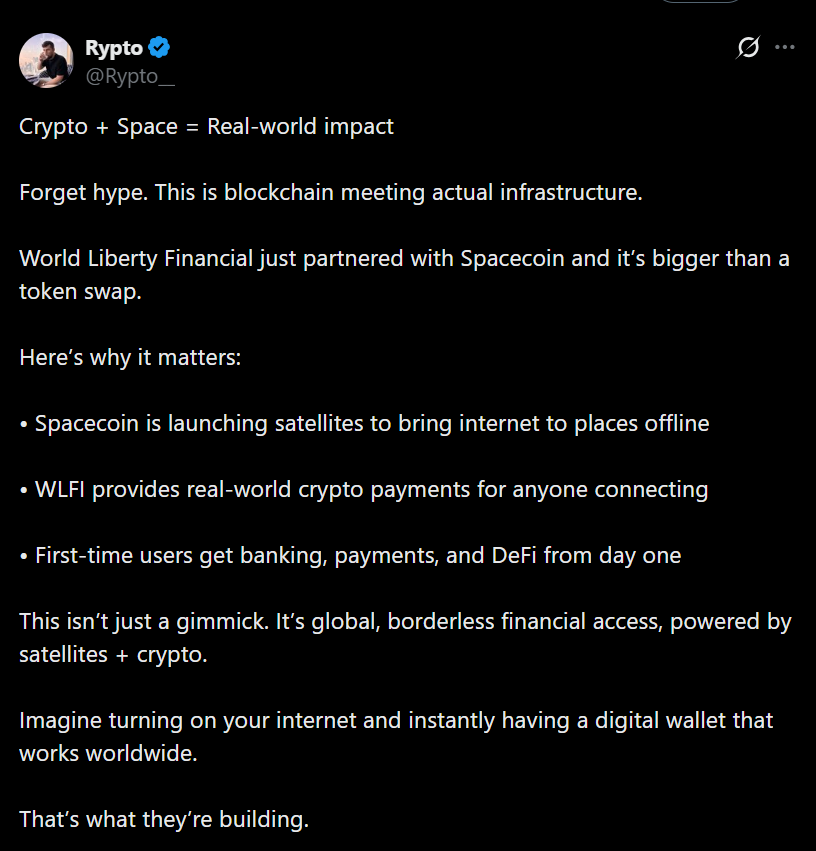
In many parts of the world, the problem isn’t just bad banks, it’s no banks at all. Pairing satellite connectivity with on-chain payments could let people send and receive value without waiting for telecom buildouts or correspondent banking access. Stablecoins can move instantly, avoid volatile local currencies, and cut out expensive remittance rails. For someone living far from financial centers, that combination looks powerful, even liberating.
This approach also fits neatly into the DePIN narrative, where crypto incentives are used to deliver physical infrastructure like internet access. Instead of asking permission from telecom giants, connectivity and money arrive together.
Where the Concerns Start
The catch is trust and power. World Liberty Financial is tied to influential political and financial interests, and stablecoins always concentrate control somewhere. Even if users hold wallets, the issuer still matters. When money flows into underserved regions through a system controlled elsewhere, there’s a real risk that value flows out just as easily.
Financial tools alone don’t create empowerment. Without education, local governance, and genuine ownership, satellite-enabled crypto can become extractive rather than inclusive. People may gain access to payments, but lose leverage over how those systems evolve or how fees, policies, and data are handled.
Access Is Not the Same as Agency
History is full of technologies dropped into developing regions with promises of empowerment that mostly enriched outsiders. Crypto isn’t immune to that pattern. Wallets, stablecoins, and connectivity solve technical problems, but social and economic realities don’t disappear just because a signal comes from space.
If this model works only as a pipeline for capital to move through communities instead of strengthening them, the benefits will be thin and temporary.
Conclusion
World Liberty Financial’s satellite finance push sits on a knife edge. It could genuinely help people bypass broken systems and participate in global markets. Or it could become another layer of extraction wrapped in futuristic language. The difference won’t be the technology. It will be governance, incentives, and whether users gain real control rather than just access.