
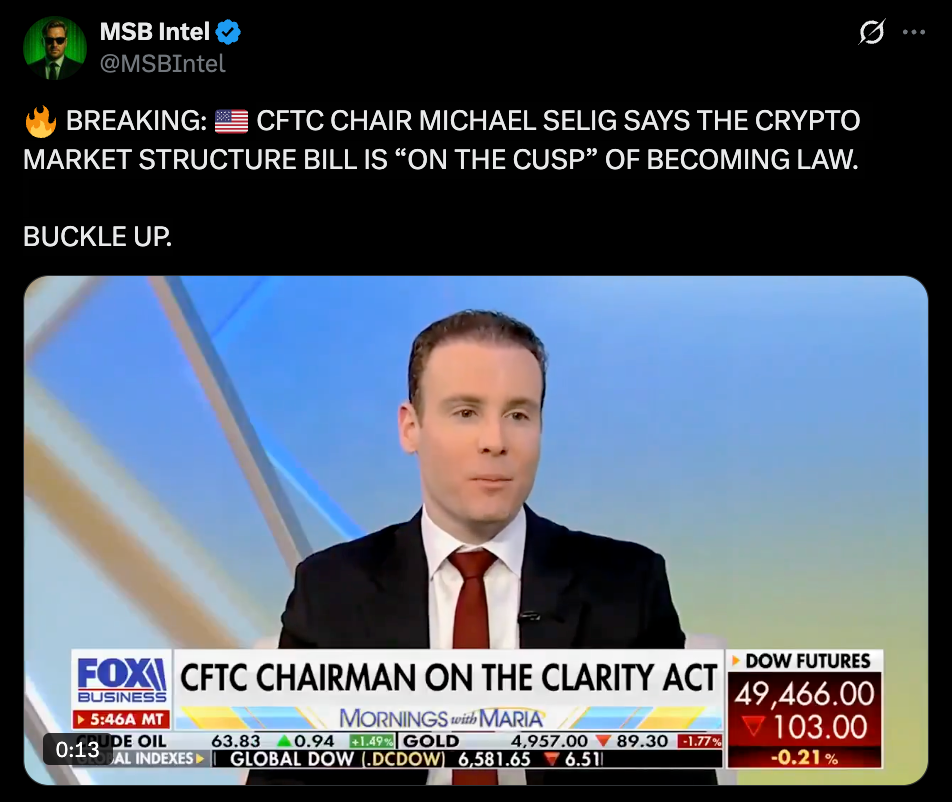
- CFTC Chair Michael Selig says crypto legislation is “on the cusp”
- Congress has advanced bills defining SEC and CFTC oversight roles
- Clear rules could bring capital and firms back to US crypto markets
When a regulator says something is “on the cusp of becoming law,” that’s not filler language. It’s a signal. CFTC Chair Michael Selig, still early in his tenure, is leaning into that phrase while pushing for long-awaited crypto market structure legislation that could finally define the rules of engagement in the United States.
For years, digital asset firms have operated in regulatory gray zones, guessing which agency might claim jurisdiction next. That uncertainty has weighed on valuations, delayed product launches, and quietly pushed innovation offshore. If Selig’s tone reflects real legislative momentum, the ground under US crypto markets could shift fast.
What Congress Has Actually Advanced So Far
This isn’t just talk. The House has already passed the CLARITY Act, which attempts to define the regulatory boundaries between the CFTC and the SEC while outlining a registration framework for digital commodity markets. That matters because definitions turn into compliance obligations, and compliance obligations shape capital flows.
The Senate, however, hasn’t fully unified its approach. Multiple bills are moving, committees are debating language, and jurisdictional tensions haven’t completely disappeared. Political friction is still there, and it could slow final passage, but the fact that substantive drafts exist at all shows this isn’t theoretical anymore.
Why Markets Might Actually React This Time
Crypto markets have heard promises before. But market structure legislation is different from enforcement headlines or isolated guidance. It directly answers the question that has hovered over US crypto for years: who regulates what?
Clear lines between the CFTC and SEC would reduce enforcement-by-surprise and give companies a roadmap for compliance. That clarity could pull capital back onshore, especially from institutions that have been hesitant to commit large allocations without regulatory certainty. Money tends to follow rules, even if those rules are strict, as long as they are predictable.

This Could Be a Turning Point for US Crypto
Selig appears aligned not just with lawmakers but with broader executive branch momentum. If a unified bill makes it through both chambers and lands on the president’s desk, the fog that has surrounded US crypto policy could finally start to lift. That would not solve every issue overnight, but it would mark a structural reset.
For builders, investors, and exchanges operating in the United States, this isn’t background chatter anymore. A finalized market structure law could redefine compliance costs, competitive positioning, and even token classifications. If you’re in crypto, this is one of those moments that may look obvious in hindsight, but right now it feels like standing right before the break.